Why In News?
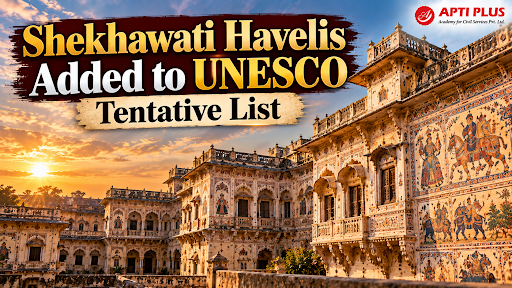
The Government of Rajasthan announced the inclusion of the havelis of the Shekhawati region in UNESCO’s Tentative List of World Heritage Sites.
What is the Shekhawati Region?
Location: Semi-arid desert territory situated in north-western Rajasthan, primarily encompassing the modern districts of Jhunjhunu, Sikar, and Churu (along with parts of Nagaur).
Nomenclature: Named after the 15th-century Rajput chieftain Rao Shekha of the Kachhwaha clan, who established an independent semi-autonomous feudal estates (Thikanas).
Strategic Trade Corridor: Situated along historic inland caravan routes connecting the fertile Gangetic plains of Northern India with the lucrative maritime seaports of Gujarat (Surat, Bharuch, and Mandvi).
What are Shekhawati Havelis?
They are multi-storied residential mansions (havelis) constructed between the 18th and early 20th centuries by affluent Marwari mercantile families (e.g., Birla, Goenka, Poddar, Singhania, Piramal, and Jhunjhunwala).
Double-Courtyard Layout: Built on an introverted architectural plan adapted to the arid desert climate:
-
Mardana Courtyard (Outer): The public, external courtyard serving as the merchant's business office, guest reception, and commercial counting house (Baithak).
-
Zenana Courtyard (Inner): The private, domestic courtyard reserved exclusively for women, offering privacy, shaded micro-climates, and secure domestic quarters.
Architectural Elements: Carved sandstone jharokhas (overhanging enclosed balconies), ornate floral corbels (todas), multi-foliated arches, massive iron-studded teak gateways, and rooftop chattris (pavilions) designed for natural cross-ventilation.

What Makes the Fresco Paintings of Shekhawati Unique?
The "Open-Air Art Gallery of Rajasthan": Every available architectural surface—outer facades, inner courtyards, ceilings, arches, and eaves—is covered with frescoes, earning the region global recognition.
Indigenous Painting Techniques:
-
Buono Fresco (True Fresco / Araish Technique): Pigments applied directly onto wet lime plaster; the surface is repeatedly polished with agate stones, bonding mineral colours into the lime matrix to withstand harsh desert weathering.
-
Fresco-Secco: Detailing applied over dried lime wash using natural plant binders and gum.
-
Natural Pigments: Initial 18th-century frescoes utilized natural mineral and vegetable dyes—indigo (blue), lampblack (black), yellow ochre, and red cinnabar—later transitioning to imported chemical German pigments in the late 19th century.
Eclectic Thematic Narratives:
-
Mythological Traditions: Episodes from the Ramayana, Mahabharata, Rasleela, and Krishna's divine sports.
-
Folk Romances & Chivalry: Legendary regional desert ballads like Dhola-Maru and depictions of Rajput warrior exploits.
-
Colonial Modernity & Technology: Early 20th-century Marwari merchants commissioned murals depicting European novelties they encountered in port cities—steam locomotives, gramophones, biplanes, motorcars, and British colonial officers in bowler hats.
What is the UNESCO World Heritage Tentative List?
It is an inventory of cultural and natural heritage properties that a State Party intends to consider for formal nomination to the UNESCO World Heritage List under the 1972 World Heritage Convention.
Under UNESCO Operational Guidelines, a site must remain on the national Tentative List for a mandatory minimum of one year before a comprehensive nomination dossier can be submitted to the World Heritage Committee.
The nominated Shekhawati cluster (spanning 14 towns) has been submitted under Cultural Criteria (ii), (iii), and (iv), representing an exceptional cultural ensemble shaped by arid ecology, mercantile wealth, and artistic syncretism.
What are the Benefits of UNESCO Recognition?
UNESCO recognition provides global prestige, financial support, and enhanced protection for cultural and natural sites.
Benefits of UNESCO Recognition
-
International Prestige: A UNESCO listing raises global awareness and acts as a mark of high quality. It puts a location on the international map.
-
Tourism and Growth: Recognized sites often see a rise in global visitors. This boosts local economies and creates jobs.
-
Conservation Support: Listed sites gain access to the World Heritage Fund for emergency aid, expert help, and preservation training.
-
Legal Protection: Recognition encourages governments to pass stricter laws and policies to safeguard these important locations.
-
Community Pride: Local residents often feel a stronger sense of identity and pride in their shared heritage and traditions.
Source: THEPRINT
|
PRACTICE QUESTION Q. With reference to the 'Shekhawati Havelis' and their artistic traditions in Rajasthan, consider the following statements: 1. They were primarily built between the 18th and early 20th centuries by wealthy Marwari merchant communities. 2. The traditional 'Araish' technique involves applying pigments onto dry lime plaster finished with synthetic chemical lacquers. 3. Murals on Shekhawati havelis depict traditional Hindu mythological themes alongside modern colonial motifs like steam engines and aeroplanes. Which of the statements given above are correct? (a) 1 and 2 only (b) 2 and 3 only (c) 1 and 3 only (d) 1, 2, and 3 Answer: (c) Explanation: Statement 1 is correct: Shekhawati havelis were constructed primarily from the 18th to the early 20th century by affluent Marwari trading families who accumulated vast fortunes in port cities like Calcutta and Bombay. Statement 2 is incorrect: The traditional Araish method is a true fresco (buono fresco) technique where natural mineral pigments are applied to wet lime plaster and polished repeatedly with agate stones to bond pigments into the plaster, without synthetic lacquers. Statement 3 is correct: Murals in Shekhawati feature an eclectic blend of mythological scenes (Ramayana, Krishna Leela), folk romances (Dhola-Maru), and early 20th-century technologies like motorcars, gramophones, and steam trains. |