Why In News?
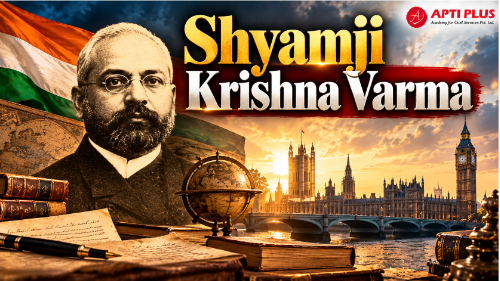
On October 4, 2026, Prime Minister paid homage to revolutionary freedom fighter Shyamji Krishna Varma on his birth anniversary.
Who was Shyamji Krishna Varma?
Born on October 4, 1857, in Mandvi, Kutch, Gujarat, he was a Sanskrit scholar, lawyer, and nationalist organizer.
-
He studied at Balliol College, Oxford, graduated in 1883, served as a lecturer in Sanskrit at Oxford University, and was called to the Bar at the Inner Temple in 1884.
Ideological Foundations: Mentored by Swami Dayananda Saraswati (founder of the Arya Samaj), Varma served as President of the Bombay Arya Samaj in 1875.
-
He was also heavily influenced by the rationalist philosophy of British thinker Herbert Spencer.
Administrator in Princely States: Before moving abroad, Varma served as Diwan (Chief Minister) across multiple princely states, including Ratlam, Udaipur, and Junagadh.
Revolutionary Nationalist & Supporter of Swaraj: Disillusioned by colonial interference in Indian princely states and following the 1897 arrest of Bal Gangadhar Tilak, Varma emigrated to England to devote his life, wealth, and scholarship to securing absolute self-rule (Swaraj) for India.
Indian Home Rule Society
-
Origin: Established in February 1905, in London by Shyamji Krishna Varma alongside prominent nationalists like Madame Bhikaiji Cama, Dadabhai Naoroji, and S.R. Rana.
-
Objectives: Formed with a written constitution to secure Home Rule (Swaraj) for India and carry out anti-colonial propaganda in Britain. It was created to directly challenge the Moderate, loyalist position of the British Committee of the Indian National Congress.
-
Overseas Nationalist Mobilization: Membership was restricted exclusively to Indians, gaining strong support among Indian students in Britain. It collected funds, recruited young activists, and established close contact with revolutionary movements in India.
India House
-
Origin: Inaugurated by Shyamji Krishna Varma in July 1905, at Highgate, London, with an opening address by British socialist leader Henry Mayers Hyndman.
-
Objectives: Functioned as a hostel providing affordable accommodation, community, and intellectual facilities (library, reading room, lecture hall) for Indian scholars in Britain.
-
Nationalist & Revolutionary Hub: Evolved from a residence into a center for political discussions, anti-colonial literature, physical instruction, and covert arms procurement (including Browning semi-automatic pistols shipped to secret societies in India like Abhinav Bharat).
-
Vinayak Damodar Savarkar arrived in 1906 on a Herbert Spencer Fellowship instituted by Varma, organized the Free India Society, and authored his historical work The Indian War of Independence, 1857 while residing at India House.
Indian Sociologist
-
Origin: A monthly journal established in London by Shyamji Krishna Varma in January 1905, subtitled "An Organ of Freedom, and Political, Social, and Religious Reform".
-
Objectives: Guided by Herbert Spencer's doctrine—"Resistance to aggression is not simply justifiable but imperative"—it published critiques of British colonial exploitation and unrighteous rule.
-
Promoted absolute independence, passive resistance, and non-cooperation with foreign governments. Due to its radical stance, it was banned in India in September 1907, forcing Varma to shift its publication to Paris and later Geneva.
What was Shyamji Krishna Varma’s Contribution?
Promotion of Swaraj: Boldly rejected colonial "mendicancy" (petitions and prayers) and advocated Purna Swaraj (complete independence) through passive resistance and boycott of colonial offices.
Support for Indian Students: Instituted travelling fellowships worth 2,000 rupees each—named after Swami Dayananda Saraswati, Herbert Spencer, Chatrapati Shivaji, and Maharana Pratap—enabling bright Indian graduates to study abroad without accepting colonial service.
Overseas Nationalist Networks & Financial Support: Funded political organizations, purchased India House, established the Deshbhakta Samaj (Society of Political Missionaries) with a 10,000 rupee donation, and provided financial backing to revolutionaries.
Internationalisation of India's Freedom Struggle: Built transnational anti-imperialist alliances with Irish Republicans (Gaelic American), Egyptian revolutionaries (Mustafa Kamal Pasha, Ibrahim El Wardani), British socialists, and American public figures.
Significance of Overseas Nationalism
-
International Public Opinion: Challenged British colonial legitimacy at the seat of imperial power in London, awakening European, American, and global audiences to the realities of British exploitation in India.
-
Safe Political Sanctuary & Networking: Provided a secure platform abroad where anti-colonial activists could debate, write, and organize away from immediate arrest by British Indian police.
-
Revolutionary Coordination & Literature: Facilitated the publication and distribution of radical literature (The Indian Sociologist, Savarkar's 1857), while coordinating arms procurement and training for revolutionary groups inside India.
-
Global Solidarity & Anti-Imperialist Alliances: Linked India's national liberation movement with global anti-colonial struggles in Ireland, Egypt, and Pan-Asian networks, laying the groundwork for later international bodies like the Ghadar Party and Berlin Committee.
What is the Legacy of Shyamji Krishna Varma?
Strengthen Diaspora-Led Nationalism: Established the blueprint for organizing Indian freedom struggles from abroad, directly inspiring subsequent movements like the Ghadar Party, the Berlin Committee, and Netaji Subhas Chandra Bose's INA.
Enduring Institutions & Memorials: His London hub lives on through historical memory and its modern 52-acre memorial Kranti Teerth in Mandvi, Kutch (built in 2010), featuring a 1:1 scale replica of India House.
Homecoming of Ashes: In August 2003, fulfilling Varma's legal agreement made in Geneva before his death in 1930, his and his wife Bhanumati's ashes were repatriated to India by then Gujarat Chief Minister Narendra Modi after 73 years in exile.
Conclusion
Shyamji Krishna Varma’s establishment of India House and The Indian Sociologist transformed the overseas Indian diaspora into a formidable intellectual and revolutionary force that internationalized India's fight for absolute Swaraj.
Source: PIB
|
PRACTICE QUESTION Q. With reference to the Indian Home Rule Society (IHRS) established in 1905, consider the following statements:
Which of the statements given above is/are correct? (a) 1 and 2 only (b) 2 and 3 only (c) 1 and 3 only (d) 1, 2, and 3 Answer: (a) 1 and 2 only Explanation: Statement 1 is correct: The Indian Home Rule Society was founded in London on February 18, 1905, by Shyamji Krishna Varma, with support from prominent nationalists like Bhikaji Cama, Dadabhai Naoroji, and S.R. Rana. Statement 2 is correct: It published the monthly journal The Indian Sociologist as its official media organ to advocate self-rule and radical nationalist ideas. Statement 3 is incorrect: It was not created as a branch of the British Committee of the Indian National Congress; rather, it was established as a rival organization to counter the loyalist and moderate opinions held by the Congress's British committee. |