Why In News?
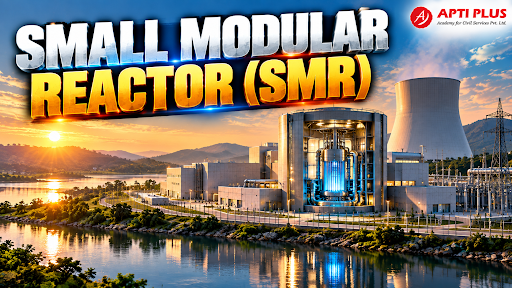
The United States Nuclear Regulatory Commission (NRC) has approved the construction permit for the country's first commercial Small Modular Reactor (SMR)—a 300-megawatt (MW) project.
What is a Small Modular Reactor (SMR)?
Meaning: Advanced nuclear fission reactors that possess significantly smaller physical footprints and power ratings compared to traditional gigawatt-scale nuclear generating units.
Small-Scale Nuclear Reactor: Defined by the International Atomic Energy Agency (IAEA) as reactors with an electrical power generation capacity of up to 300 Megawatts electrical [MW(e)] per module (typically ranging from 10 MW(e) to 300 MW(e)).
Modular Construction: Built from standardized systems and prefabricated sub-assemblies that can be shipped as fully integrated modules via rail, barge, or highway.
Factory-Based Manufacturing: Systems and components are fabricated and pre-tested in controlled factory settings before being transported to the installation site, avoiding complex on-site civil works.
Lower Individual Unit Capacity: Smaller individual megawatt outputs allow incremental, multi-module cluster additions matching localized grid load growth.
Scalable Nuclear Power: Enables flexible scaling from a single unit powering an industrial cluster to multi-module installations (e.g., 4, 6, or 12 modules) supplying major power grids.
How is an SMR Different from a Conventional Reactor?
Smaller Power Output: Conventional gigawatt-scale reactors generate 1,000 MW(e) to 1,600 MW(e) per unit, whereas an SMR module is capped at up to 300 MW(e).
Modular vs Stick-Built Engineering: Conventional stations require extensive "stick-built" on-site civil engineering, deep foundational excavations, and prolonged field-welding; SMRs leverage shop-assembled, standardized reactor pressure vessels.
Construction Footprint: Traditional plants require hundreds of hectares of land and vast exclusion zones; SMRs occupy a compact physical footprint, often needing less than 10% of the land area required for traditional stations.
Construction Timeline: Gigawatt reactors traditionally suffer construction delays lasting 8 to 14 years; SMRs aim for construction windows of 3 to 5 years.
Passive Safety Architecture: Conventional reactors rely heavily on engineered active safety systems (diesel emergency generators, high-pressure coolant injection pumps, and constant human intervention); SMRs use passive safety mechanisms governed by fundamental laws of physics (gravity, natural circulation, and evaporation) that shut down and cool the core for days without off-site electrical power.

How Do SMRs Work?
Nuclear Fission: Heavy fissile nuclei (typically Low-Enriched Uranium, LEU enriched to 3%–5% U-235, or High-Assay Low-Enriched Uranium, HALEU enriched up to 20%) absorb thermal neutrons, splitting to release nuclear fission energy.
Heat Generation: The chain reaction generates intense thermal energy within the fuel assemblies housed in an integral reactor pressure vessel (RPV).
Steam Production: High-temperature primary coolant (light water, gas, liquid metal, or molten salt) transfers heat to a secondary circuit through a steam generator, producing high-pressure dry steam
Turbine Rotation: The generated steam expands through a high-efficiency steam turbine, converting thermal enthalpy into mechanical rotational energy.
Electricity Generation: The rotating turbine drives an electrical generator, feeding synchronized clean baseload power into the transmission grid.
Reactor Cooling: The spent steam is condensed into water via cooling towers or dry-air cooling systems and pumped back into the steam generator, maintaining a closed-loop thermodynamic cycle.
What are the Advantages of SMRs?
Smaller Capital Requirement: Substantially lower initial capital barrier lowers the debt financing burden for utilities and private industrial operators.
Modular Deployment: Allows sequential commissioning where initial operating modules generate revenue to finance subsequent units.
Flexible Siting: Can be installed on brownfield industrial sites, retired coal-fired power station plots, and coastal desalination zones without demanding vast exclusion boundaries.
Lower Construction Risk: Factory assembly and standardized quality assurance reduce on-site delays, regulatory rework, and cost overruns.
Inherent Passive Safety: High thermal margins, integral containment structures, and natural convection eliminate catastrophic Fukushima-style loss-of-coolant meltdown hazards.
Grid Flexibility: Excellent load-following capabilities that ramp power output up and down to balance intermittencies from variable solar and wind generation.
Support for Remote Areas: Capable of supplying clean, reliable energy to off-grid mining sites, remote Arctic settlements, or island territories.
High-Temperature Industrial Applications: Co-generation of high-temperature process heat for petrochemical refining, green steelmaking, and zero-emission chemical synthesis.
What are the Potential Applications?
Baseload Electricity Generation: Providing continuous, 24/7 carbon-free electricity to urban and regional grids.
Industrial Process Heat: Supplying high-grade thermal heat (300°C to 850°C) for cement, glass, chemical, and paper manufacturing, replacing fossil fuel boilers.
Seawater Desalination: Cogeneration plants providing thermal or electrical energy to convert seawater into potable freshwater in arid coastal zones.
Clean Hydrogen Production: Powering high-temperature solid oxide electrolysis cells (SOEC) to manufacture low-cost green hydrogen and green ammonia.
Remote Power & Defense Bases: Supplying uninterrupted micro-grid power for deep-sea ports, military installations, and remote border outposts.
District Heating: Channelling low-temperature waste steam to heat residential and commercial buildings in cold climates.
Why are SMRs Important for India?
Growing Electricity Demand: India’s peak power demand is projected to exceed 400 Gigawatts (GW) by 2030–32, requiring rapid capacity additions across baseload segments.
Clean Energy Transition: Enables the phase-out of aging thermal power stations by directly repurposing land, water pipelines, and switchyard infrastructure of retired coal plants.
Baseload Power Support: Unlike variable solar and wind power, nuclear energy provides continuous capacity factors exceeding 85% to 90%, stabilizing grid frequency.
Complements Variable Renewables: Integrates smoothly with India's aggressive 500 GW non-fossil capacity target by 2030, serving as flexible spinning reserves during non-solar hours.
Industrial Decarbonisation: Decarbonizes hard-to-abate sectors (steel, fertilizers, aluminum) that cannot be electrified using renewable energy alone.
Energy Security: Reduces long-term exposure to volatile imported fossil fuels (crude oil, thermal coal, LNG).
Net-Zero by 2070: Crucial technology lever to achieve India’s Panchamrit climate commitments and net-zero greenhouse gas targets by 2070.
India’s Nuclear Energy Sector
India operates 24 commercial nuclear power reactors with an installed capacity of roughly 8.18 GW, targeting 22.4 GW by 2031–32.
Nuclear Energy Mission & SMR Push: The Union Budget 2024-25 prioritized research and development of Small Modular Reactors, announcing government partnerships with the private sector to develop Bharat Small Reactors (BSR).
Indigenous Reactor Technology: Decades of indigenous mastery over Pressurised Heavy Water Reactor (PHWR) technology, including the standardization of 220 MW(e) and 700 MW(e) domestic designs.
Bharat Small Reactor (BSR): India’s strategy to adapt the proven, indigenous 220 MW(e) PHWR design into a modular, factory-fabricated SMR tailored for captive industrial deployment.
Public-Private Participation (PPP): Legislative and policy initiatives to amend the Atomic Energy Act, 1962 to facilitate private sector capital investment in nuclear power generation.
Nuclear Liability Framework: Navigating legal and corporate ambiguities surrounding Section 17(b) of the Civil Liability for Nuclear Damage (CLND) Act, 2010, which governs supplier liability during nuclear incidents.
Source: TIMESOFINDIA
|
PRACTICE QUESTION Q. Small Modular Reactors can complement renewable energy in India’s clean-energy transition, but their commercial viability and safety remain important challenges. Discuss. 1590 words |