Why In News?
Globally, major donor countries are cutting foreign development assistance for health by up to 60%, forcing developing nations to rely entirely on their own domestic budgets.
Status of Health Sector In India
Improving Health Outcomes: India has reduced Maternal Mortality Ratio (MMR) by 86% since 1990, Under-5 Mortality Rate by 78%, and Neonatal Mortality Rate by 70%, outperforming the global average decline in each case. (Source: Economic Survey 2025–26)
Rising Public Health Expenditure: Government health expenditure has increased, with government spending accounting for 48% of Total Health Expenditure (THE), while Total Health Expenditure is estimated at ₹9.04 lakh crore (3.8% of GDP). (Source: National Health Accounts)
Declining Out-of-Pocket Expenditure (OOPE): Household health spending has fallen to 43.4% of Total Health Expenditure in 2022–23, down from 69.4% in 2004–05, reflecting improved financial protection through public health schemes. (Source: PIB)
Expanding Primary Healthcare: Ayushman Arogya Mandirs (formerly Health & Wellness Centres) are strengthening comprehensive primary healthcare under Ayushman Bharat.
Health Insurance Expansion: Ayushman Bharat–PM Jan Arogya Yojana (AB-PMJAY) provides health insurance coverage of ₹5 lakh per family per year for economically vulnerable households, reducing catastrophic health expenditure.
Disease Control Progress: India's Tuberculosis treatment success rate reached 92%, above the global average of 78%, supporting the goal of TB elimination. (Source: Economic Survey 2025–26)
Digital Health Transformation: The Ayushman Bharat Digital Mission (ABDM) is creating a Digital Public Infrastructure for Health through ABHA IDs, digital health records and interoperable health services.
Human Resource Constraints: India has one modern medicine doctor per 1,263 people and one nurse per 476 people, both below WHO norms (1:1000 doctors and 1:300 nurses), highlighting persistent workforce shortages.
Need for Higher Public Investment: The National Health Policy, 2017 recommends increasing public health expenditure to 2.5% of GDP, while expert assessments continue to emphasise the need for sustained investment in primary healthcare and preventive services.
India’s Major Health Challenges
Rising Burden of Non-Communicable Diseases (NCDs): NCDs such as cardiovascular diseases, diabetes, cancer and chronic respiratory diseases account for around 62% of all deaths in India, increasing demand for long-term and costly healthcare.
-
The National Health Policy (2017) and WHO's Global Action Plan for NCDs emphasise prevention through primary healthcare and lifestyle interventions.
Regional Health Inequalities: Significant inter-state disparities persist in IMR, MMR, life expectancy and healthcare access despite improvements under NHM.
-
The 15th Finance Commission recommended performance-linked health grants, while NITI Aayog's SDG India Index highlights uneven progress across states.
Human Resource Shortages: India continues to face shortages of doctors, nurses and allied health professionals, particularly in rural areas.
-
The High-Level Expert Group (HLEG) on Universal Health Coverage recommended strengthening primary healthcare teams and expanding the health workforce.
Low Public Health Expenditure: Government health expenditure remains around 1.9% of GDP (Union Budget 2026–27), below the National Health Policy target of 2.5% of GDP, limiting infrastructure and service delivery.
Disease Surveillance & Pandemic Preparedness: Gaps in integrated disease surveillance, laboratory capacity and emergency preparedness remain.
-
The National One Health Mission and PM-Ayushman Bharat Health Infrastructure Mission (PM-ABHIM) seek to strengthen surveillance and public health infrastructure.
Persistent Structural Challenges in Health System
Low Public Health Expenditure: Combined Union and State Government Health Expenditure (GHE) was about 1.8%-1.9% of GDP in 2025–26, below the National Health Policy (NHP), 2017 target of 2.5% of GDP by 2025.
Infrastructure Gaps: Shortages in Primary Health Centres (PHCs), Community Health Centres (CHCs), hospital beds and diagnostic facilities, especially in rural and aspirational districts.
Health Workforce Deficit: India faces shortages of doctors, specialists, nurses and allied health professionals in rural areas.
Urban–Rural Disparities: Rural populations continue to face unequal access to quality healthcare, specialists and emergency services.
Rising Disease Burden: India is witnessing a dual burden of communicable diseases and rapidly increasing non-communicable diseases (NCDs).
Fragmented Governance: Overlapping responsibilities among multiple agencies and uneven implementation across States weaken accountability.
Measures to Strengthen the Health System
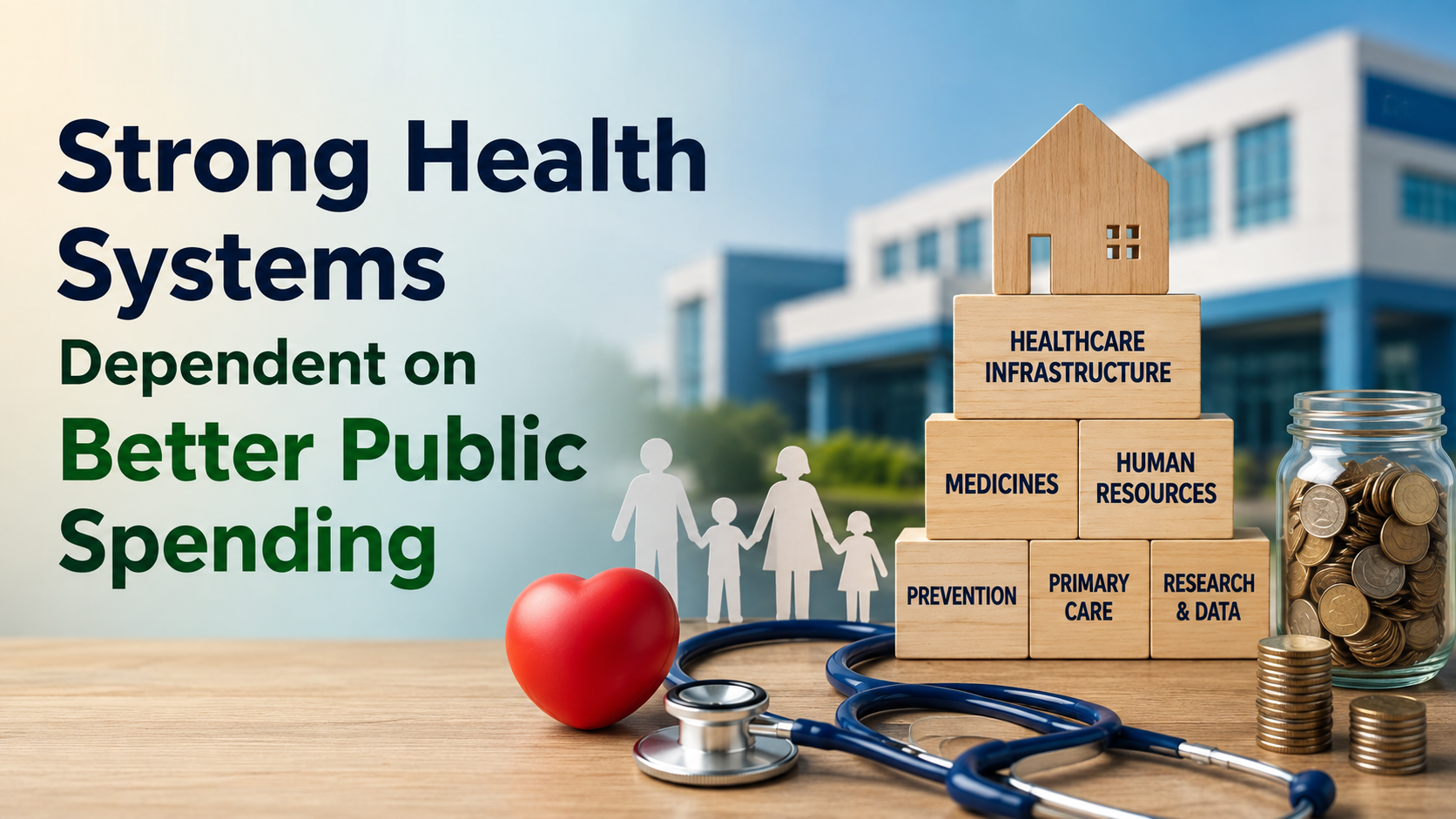
Increase Public Health Spending: Raise public health expenditure to at least 2.5% of GDP in line with National Health Policy 2017, and progressively towards 3% of GDP as recommended by the HLEG on UHC, with greater State participation.
-
The High-Level Expert Group (HLEG) on Universal Health Coverage (Srinath Reddy Committee) recommended raising public health spending to 3% of GDP, with 70% allocated to primary healthcare.
Strengthen Primary Healthcare: Allocate at least 70% of public health expenditure to primary healthcare, expand Ayushman Arogya Mandirs, and strengthen preventive, promotive and community-based care, as recommended by the HLEG on UHC.
Expand Human Resources: Increase medical, nursing and allied health education, strengthen Mid-Level Health Providers, incentivise rural service and adopt competency-based medical education as recommended under NHP 2017 and WHO.
Upgrade Infrastructure: Accelerate investments through PM-Ayushman Bharat Health Infrastructure Mission (PM-ABHIM) to modernise PHCs, CHCs, district hospitals, laboratories, ICUs and disease surveillance systems.
Strengthen Governance: Establish the National Health Regulatory and Development Authority (NHRDA), as recommended by the HLEG on UHC, to improve quality standards, accreditation, patient safety and regulation of healthcare providers.
Reduce Out-of-Pocket Expenditure: Expand Free Drugs and Free Diagnostics Initiatives, strengthen procurement systems and universalise essential medicines, as recommended by the HLEG on UHC and supported by the National Health Mission.
Leverage Digital Health: Scale up the Ayushman Bharat Digital Mission (ABDM), telemedicine, electronic health records and AI-enabled public health surveillance to improve accessibility and continuity of care.
Address Social Determinants of Health: Strengthen convergence with Jal Jeevan Mission, Swachh Bharat Mission, Poshan Abhiyaan and PM Ujjwala Yojana to improve nutrition, sanitation, safe drinking water and clean cooking fuel, in line with the WHO's Social Determinants of Health framework
Promote Preventive Healthcare: Expand population-based screening for NCDs, immunisation, school health programmes and behaviour change campaigns, consistent with the National Health Policy 2017 and WHO recommendations.
Conclusion
To build a resilient and equitable health system, India must increase public financing, prioritize primary care, and properly empower frontline healthcare workforce.
Source: THEHINDU
|
PRACTICE QUESTION Q. Universal Health Coverage cannot be achieved through health insurance alone; it requires sustained investment in public health systems." Discuss. 150 words |