Why In News?
The Central Electricity Authority (CEA) launched a three-year roadmap (FY 2026–27 to FY 2028–29) to replace imported SCADA systems and transition India's power grid to 100% indigenous control systems by 2030.
Highlights of the Central Electricity Authority (CEA) Committee Report
Ban on SCADA Imports Post-2030: The Ministry of Power mandated a complete ban on importing SCADA systems and associated Energy Management Systems (EMS) after 2030 to eliminate foreign cyber-vulnerabilities in critical national infrastructure.
Severe Asymmetry in Current Local Content: The report revealed that despite the 50% minimum local content mandate under Public Procurement orders, existing grid-level SCADA systems in India carry less than 20% domestic content, creating dangerous dependence on foreign Original Equipment Manufacturers (OEMs).
Dedicated Testing & Cybersecurity Validation Platform: Proposed setting up a national testing testbed within two years for zero-day vulnerability scanning before field deployment.
Parallel Pilot Runs at Load Despatch Centres: Indigenous systems will be piloted in parallel with legacy systems across State Load Despatch Centres (SLDCs in Rajasthan, Maharashtra, Tamil Nadu), Regional Load Despatch Centres (RLDCs), and the National Load Despatch Centre (NLDC / GRID-INDIA).
What is SCADA?
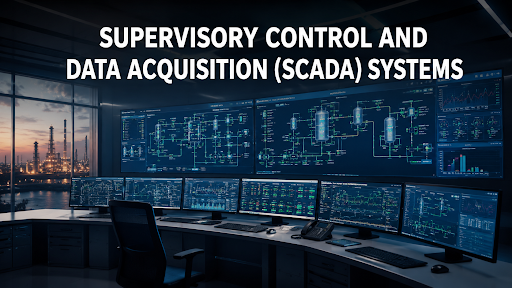
Supervisory Control and Data Acquisition (SCADA) is a centralized industrial control system architecture comprising computers, networked data communications, and graphical user interfaces for high-level real-time process supervision and equipment control.
It serves as the digital brain and nervous system of modern automated industries, converting physical measurements (voltage, current, water flow, gas pressure) into digital data for automated decisions and remote operator commands.
How Does SCADA Work?
Sensors and Actuators: Physical devices installed on grid assets (substations, transformers, transmission lines) that continuously measure parameters like voltage, frequency, oil temperature, and line load.
Remote Terminal Units (RTUs) & Programmable Logic Controllers (PLCs): Microprocessor-based electronic devices that collect analog/digital signals from sensors, convert them into digital telemetry data, and execute local automated commands.
Communication Networks: High-speed, low-latency communication backbones (Optical Ground Wire - OPGW, Satellite, dedicated IP/MPLS networks) transmitting telemetry packets to the control centre.
Central Control Centre (Master Terminal Unit - MTU): Powerful server clusters running real-time software that aggregate network-wide data, run complex algorithms (e.g., Automatic Generation Control, State Estimation), and log event histories.
Human-Machine Interface (HMI): Graphical console interfaces displaying dynamic single-line diagrams (SLDs), alarms, and diagnostic graphs, allowing human load dispatchers to issue remote switching commands.
Where is SCADA Used?
Electricity Grids (Generation, Transmission & Distribution):
-
Generation: Coordinating output at thermal, hydro, and solar-wind plants via Automatic Generation Control (AGC).
-
Transmission: Managing interstate high-voltage sub-stations (765 kV / 400 kV) and High-Voltage Direct Current (HVDC) lines.
-
Distribution: Automated feeder switching, fault isolation, and transformer load monitoring under the Revamped Distribution Sector Scheme (RDSS).
Water Supply & Treatment Networks: Monitoring reservoir levels, canal gates, municipal pumping stations, and sewage treatment plants.
Oil and Gas Infrastructure: Controlling cross-country crude oil and natural gas pipelines, refinery distillation units, and city gas distribution networks.
Transportation Systems: Metro rail traction power, railway signalling systems (Kavach), and airport baggage logistics.
Source: TIMESOFINDIA
|
PRACTICE QUESTION Q. Modern warfare is increasingly shifting toward cyber-physical sabotage of critical national infrastructure. Discuss (10 Marks, 150 Words) |