
Why In News?
The Supreme Court's Central Empowered Committee (CEC) ordered a nationwide survey of elephant corridors and condemned the Assam government for failing to stop illegal Karbi Anglong mining.
Highlights of the Supreme Court Order
The Supreme Court halted illegal stone quarrying and unnotified commercial constructions in the Kaziranga–Karbi Anglong landscape, where unhindered linear infrastructure and open-cast mining sever critical animal corridors used by elephants, tigers, and one-horned rhinos to escape annual Brahmaputra floods.
Inaction on 2019 Mining Ban: Despite the Supreme Court's 2019 order restraining mining along Kaziranga's southern boundary and its catchment streams, mining leases continued under the Karbi Anglong Autonomous Council (KAAC).
Delayed Notification of 9 Animal Corridors: Assam authorities failed to notify nine critical wildlife corridors (including Panbari, Haldibari, Kanchanjuri, and Amguri) despite repeated CEC directives since 2021.
Nationwide Elephant Corridor Audit: The Supreme Court directed the Union Ministry of Environment, Forest and Climate Change (MoEFCC) to conduct fresh ground-truthing of all elephant corridors and prohibit coercive blockades against wild herds.
What are Elephant Corridors?
They are narrow, linear strips of forested land that connect two or more larger, viable elephant habitats, facilitating safe and unhindered movement of wildlife.
Wildlife Movement Routes: Function as ecological lifelines allowing mega-herbivores to traverse fragmented forests in search of seasonal food, water, and mineral licks.
Habitat Connectivity: Bridges isolated protected areas (National Parks, Wildlife Sanctuaries, and Reserved Forests) across human-dominated landscapes.
Seasonal Movement: Facilitates cyclical migrations, such as the monsoon retreat of elephants from submerged river floodplains to elevated hill tracts.
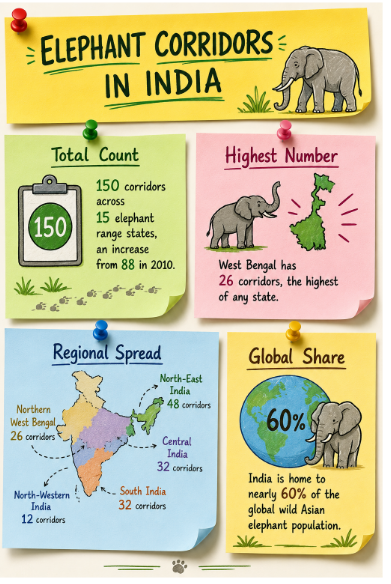
National Distribution: According to the Elephant Corridors of India (2023) report by Project Elephant and the Wildlife Institute of India (WII), India possesses 150 ground-validated elephant corridors across 15 states, with West Bengal hosting the highest (26 corridors).
Why are Elephant Corridors Important?
Preventing Habitat Fragmentation: Counteracts the isolation of elephant populations trapped in fragmented forest patches surrounded by human settlements.
Reducing Human-Elephant Conflict (HEC): Provides safe, designated passage routes, preventing wild herds from straying into agricultural fields, tea estates, and villages.
Maintaining Genetic Diversity: Enables inter-population breeding between disparate herds, preventing genetic inbreeding and sustaining long-term species viability.
Supporting Landscape-Level Wildlife Movement: Acts as multi-species dispersal corridors utilized by tigers, rhinos, swamp deer, leopards, and wild water buffaloes.
Climate Adaptation & Ecological Resilience: Allows wildlife to shift their geographical ranges in response to changing precipitation patterns, extreme heatwaves, and seasonal floods.
Ecosystem Engineering Role: As a keystone species, Asian elephants disperse seeds across vast forest landscapes, maintaining tree diversity and structural forest canopy health.
What are the Major Threats to Elephant Corridors?
Unregulated Stone Quarrying & Mining: Blasting and heavy excavation in Karbi Anglong destroy catchment streams, generate deafening noise pollution, and trigger massive slope erosion.
Linear Transport Infrastructure (Roads & Highways): Arterial highways such as National Highway-715 (NH-37) cut across Kaziranga’s corridors, causing fatal wildlife collisions during flood migrations.
Railway Lines & Electrocution: Unfenced railway tracks bisecting forest corridors cause severe train-hit elephant mortalities across Assam, West Bengal, and Odisha.
Urbanisation & Commercial Real Estate: Construction of highway resorts, dhabas, petrol pumps, and residential townships obstructs historical migratory paths.
Agricultural & Commercial Plantation Expansion: Monoculture tea gardens, rubber estates, and paddy farms replace native tropical moist deciduous forests.
Encroachment of Eco-Sensitive Zones: Encroachment on forest fringes shrinks the legal buffer zones surrounding national parks.
About Kaziranga
Kaziranga National Park: Designated as a UNESCO World Heritage Site (1985) and a Tiger Reserve (2006).
Brahmaputra Floodplain Ecosystem: Dynamic riparian wetland and alluvial grassland habitat sustained by annual monsoon flood pulses.
Karbi Anglong Hills: Elevated southern highlands administered by the Karbi Anglong Autonomous Council (KAAC) under the Sixth Schedule of the Constitution, serving as vital flood refuges.
The 9 Critical Animal Corridors: Includes Panbari, Haldibari, Kanchanjuri, Deosur, Bagori, Harmati, Chirang, Amguri, and Hatidandi, which wildlife cross to reach safety during seasonal inundations .
Key Species Protected: Hosts the world's largest population of the Great Indian One-Horned Rhinoceros (2,613+ rhinos), alongside high densities of Asian elephants, Royal Bengal tigers, Eastern swamp deer, and wild water buffaloes.
Source: THEHINDU
|
PRACTICE QUESTION Q. With reference to the Asian Elephant (Elephas maximus) and wildlife corridors in India, consider the following statements: 1. The Asian Elephant is listed as an Endangered species on the IUCN Red List and in Schedule I of the Wildlife (Protection) Act, 1972. 2. Project Elephant was launched by the Government of India in 1992 as a Centrally Sponsored Scheme. 3. In India, the highest number of ground-validated elephant corridors is found in the state of Assam. Which of the statements given above are correct? (a) 1 and 2 only (b) 2 and 3 only (c) 1 and 3 only (d) 1, 2, and 3 Answer: (a) 1 and 2 only Explanation: Statement 1 is correct: The Asian Elephant (Elephas maximus) is classified as Endangered on the IUCN Red List. It is also granted the highest level of legal protection under Schedule I of the Indian Wildlife (Protection) Act, 1972. Statement 2 is correct: Project Elephant was launched by the Government of India in February 1992 as a Centrally Sponsored Scheme to provide financial and technical support to states for wildlife management and habitat conservation. Statement 3 is incorrect: According to the "Elephant Corridors of India, 2023" report released by the Ministry of Environment, Forest and Climate Change (MoEFCC), West Bengal has the highest number of ground-validated elephant corridors with 26 corridors (accounting for 17% of the total). Assam belongs to the Northeast region, which as a whole is the second-largest region, but individually Assam does not have the highest count. |