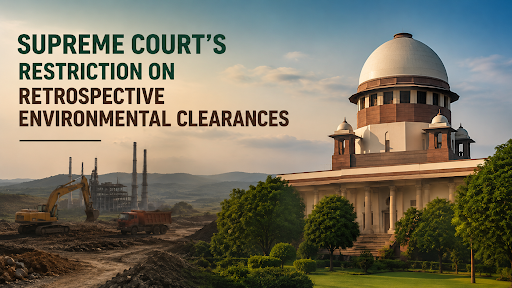
Why In News?
The Supreme Court quashes the Ministry of Environment, Forest and Climate Change (MoEFCC)'s 2021 Office Memorandum (OM) that allowed retrospective Environmental Clearances (EC) for projects operating illegally without prior approval.
What is Environmental Clearance (EC)?
It is a statutory prior approval required for specified industrial, mining, infrastructure and developmental projects before construction or operations commence, ensuring that environmental concerns are integrated into project planning.
Ecological Impact Assessment: The EC process evaluates likely impacts on air, water, land, biodiversity, forests, wildlife, public health and local livelihoods, and prescribes mitigation measures for sustainable development.
Statutory Foundation: The process derives its legal authority from Section 3 of the Environment (Protection) Act, 1986, read with the Environment (Protection) Rules, 1986.
Prior Clearance Mandate: The EIA Notification, 1994, replaced by the EIA Notification, 2006, mandates prior Environmental Clearance for notified projects such as mining, thermal power plants, highways, ports and major industries before project execution.
Decision-Making Process: The EC process includes screening, scoping, Environmental Impact Assessment (EIA), public consultation (where applicable), appraisal by Expert Appraisal Committees (EAC/SEAC), and grant or rejection of clearance.
What is Retrospective (Ex Post Facto) Environmental Clearance?
Post-Facto Regularisation: Ex post facto EC grants approval after a project has already begun construction or operations without obtaining mandatory prior environmental clearance.
Regularisation Mechanism: It allows project proponents to seek legal regularisation after violating environmental laws, usually subject to appraisal and environmental compensation.
Violation of the Precautionary Principle: It undermines the Precautionary Principle, which requires environmental risks to be assessed before irreversible ecological damage occurs.
Contrary to Sustainable Development: Allowing projects first and assessing impacts later weakens the principles of Sustainable Development, Polluter Pays and Environmental Rule of Law.
Constitutional Concerns: It may create unequal treatment by benefiting violators while compliant project proponents bear higher compliance costs, raising concerns under Article 14 and Article 21.
Jurisprudential Position: The Supreme Court held that ex post facto environmental clearance is generally alien to environmental jurisprudence, except where Parliament or the Government provides a lawful statutory framework.
Recent Supreme Court Judgement
2021 Office Memorandum (OM) Quashed: The Court struck down the 2021 OM that created a mechanism for granting ex post facto environmental clearances through administrative instructions.
Administrative Instructions Cannot Override Law: The Court held that an OM has no statutory force and cannot modify or dilute the mandatory requirements of the EIA Notification, 2006.
Prior Environmental Clearance is Mandatory: The Court reaffirmed that prior EC remains the rule, and projects cannot ordinarily commence first and seek approval later.
Rejected Perpetual Regularisation: The Court ruled that the 2021 OM effectively created a continuing mechanism for condoning environmental violations, which is inconsistent with environmental law.
Statutory Route Required: If the Union Government considers an amnesty or regularisation scheme necessary in exceptional public interest, it must do so only through a formal statutory notification issued under Section 3 of the Environment (Protection) Act, 1986, and not through executive instructions.
Environmental Rule of Law Reinforced: The judgment strengthens the principles of precaution, sustainable development, inter-generational equity and environmental rule of law, ensuring that environmental safeguards are not bypassed through administrative shortcuts.
Significance of the Judgment
Precautionary Principle Reinforcement: The judgment ensures authorities prevent environmental degradation before it begins by enforcing mandatory prior assessments.
Judicial Alignment: The ruling explicitly aligns with past landmark judgments like Alembic Pharmaceuticals vs Rohit Prajapati, which concluded that retrospective approvals severely undermine environmental safeguards.
Rule of Law Preservation: The decision establishes that the executive branch cannot bypass strict statutory environmental laws using informal administrative memos, thereby curbing arbitrary state power.
Constitutional Safeguards: The ruling ensures strict adherence to Article 14 (Equality) and Article 21 (Right to Life and a Clean Environment).
Corporate Accountability: The ruling holds powerful corporations directly accountable; prior to the judicial stay, over 100 projects (including major coal and iron mines) received illegal ex-post facto ECs.
Financial Penalties: The Court mandates that violators must pay 100% of the price of illegally mined minerals as compensation under Section 21(5) of the Mines and Minerals (Development and Regulation) Act, 1957.
Ecological Protection: The judgment prevents irreversible destruction in highly protected regions like coastal zones, the Doon Valley, and the Aravali Range.
Public Trust Doctrine: The ruling strongly upholds the Public Trust Doctrine, legally binding the State to act as a trustee of natural resources (such as rivers and forests) for the general public.
Source: THEHINDU
|
PRACTICE QUESTION Q. Consider the following statements regarding the Environment (Protection) Act, 1986: 1. It was enacted under Article 253 of the Constitution to implement the decisions of the UN Conference on the Human Environment. 2. The Act grants the Central Government the power to issue perpetual retrospective environmental clearances through administrative Office Memorandums. Which of the statements given above is/are correct? A) 1 only B) 2 only C) Both 1 and 2 D) Neither 1 nor 2 Answer: A Explanation: Statement 1 is correct. The Environment (Protection) Act, 1986 was enacted by the Indian Parliament under Article 253 of the Constitution. This article empowers Parliament to make laws implementing international treaties, agreements, and conventions. The specific purpose of this Act was to implement the decisions taken at the United Nations Conference on the Human Environment, held in Stockholm in June 1972. Statement 2 is incorrect. The Supreme Court recently struck down the use of administrative Office Memorandums (specifically the 2021 OM) to grant ex post facto (retrospective) environmental clearances. In a judgment delivered in July 2026, the Court ruled that administrative orders cannot supplant delegated legislation (such as the 2006 EIA Notification) or create a "perpetual regime" for regularizing violations. |