Why In News?
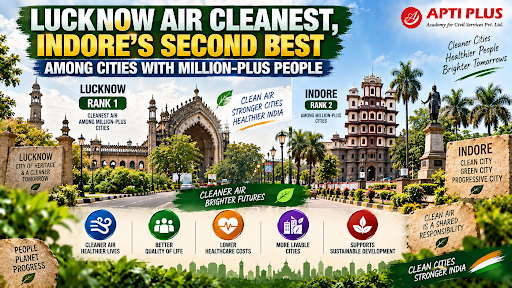
The Ministry of Environment conferred the 5th Swachh Vayu Sarvekshan 2026 Awards, where Lucknow secured 1st place, followed by Indore (2nd) and Jabalpur (3rd) among cities with a population of over 10 lakh under the National Clean Air Programme (NCAP).
What is Swachh Vayu Sarvekshan?
Origin: Launched during 2022–23 by the Ministry of Environment, Forest and Climate Change (MoEFCC) to rank cities based on the execution of targeted clean-air activities rather than solely on ambient monitor readings.
National Coverage: Evaluates 130 non-attainment cities across three distinct population tiers:
-
Category 1: Population greater than 10 Lakh (47 Cities).
-
Category 2: Population between 3 Lakh and 10 Lakh (44 Cities).
-
Category 3: Population less than 3 Lakh (39 Cities).
Objective: Fosters competitive federalism and peer learning among Urban Local Bodies (ULBs) to meet the National Ambient Air Quality Standards (NAAQS).
What Parameters are Assessed under the Survey?
Urban Local Bodies are evaluated on a comprehensive 200-point rubric across eight functional pollution-control domains:
-
Control of Biomass & Municipal Solid Waste Burning: Prevention of open dumping ground fires and 100% door-to-door segregated collection.
-
Road Dust Mitigation: Paving of unpaved road shoulders, mechanized sweeping of arterial roads, and water-sprinkling mist cannons.
-
Dust from Construction & Demolition (C&D) Activities: Mandatory operationalization of C&D recycling plants and geotagged enforcement of dust-control covers.
-
Control of Vehicular Emissions: Public transport fleet electrification, deployment of EV charging stations, and stringent PUC certification audits.
-
Control of Industrial Emissions: Enforcing industrial boiler fuel switches from coal/furnace oil to Piped Natural Gas (PNG) and biomass pellets.
-
Public Awareness & IEC (Information, Education, and Communication) Outreach: Citizen campaigns, school eco-clubs, and real-time grievance redressal via the Sameer application.
How are Cities Evaluated and Ranked?
The assessment follows a structured four-stage audit process:
-
Stage 1 (City Self-Assessment): Cities upload action reports, geotagged photographs, and sensor logs on the PRANA portal.
-
Stage 2 (State-Level Screening): State Pollution Control Boards and State Monitoring Committees scrutinize initial submissions.
-
Stage 3 (CPCB Technical Appraisal): The Central Pollution Control Board (CPCB) evaluates claims using an automated scoring matrix.
-
Stage 4 (Third-Party Field Verification): Independent expert teams conduct random physical inspections across municipal wards, landfills, and transit corridors before finalizing rankings.
National Clean Air Programme (NCAP)
|
What Progress Has NCAP Made?
Official audit data presented on Swachh Vayu Diwas 2026 demonstrates measurable air quality improvements:
-
Widespread Particulate Reduction: 108 out of 130 cities recorded marked improvements in annual average PM10 levels during 2025–26 compared with the 2017–18 baseline.
-
Significant Reductions: 72 cities achieved particulate reductions exceeding 20%.
-
Exceeding Long-Term Targets: 26 cities recorded particulate reductions exceeding 40%, meeting the revised NCAP 2026 target ahead of schedule.
-
National Standards Compliance: 14 non-attainment cities achieved full compliance with the National Ambient Air Quality Standard (NAAQS) for PM10 (60 µg/m³ annual average).
What are the Major Challenges in Urban Air Quality Management?
Winter Meteorological Trapping and Thermal Inversion: In the Indo-Gangetic Plains, seasonal temperature inversions compress the atmospheric boundary layer below 300 meters, trapping particulates regardless of surface municipal sweeping.
Transboundary Pollution and Inter-State Airshed Disconnect: City-centric municipal action plans under NCAP fail to address regional airshed transport of pollution from biomass burning, brick kilns, and thermal power plants across administrative borders.
Gaps in Construction and Demolition (C&D) Waste Processing: Urban Local Bodies face delays in establishing dedicated recycling plants under the Construction and Demolition Waste Management Rules, 2016.
Public Transport Deficits and Rising Vehicular Congestion: Deficits in bus fleet strength force urban commuters to rely on private two-wheelers and older diesel vehicles.
Municipal Fiscal and Technical Capacity Deficits: Urban Local Bodies lack specialized environmental engineering cadres, relying on general administrative staff to execute complex air quality plans.
Sensor Siting Disparities and Exposure Masking: Continuous Ambient Air Quality Monitoring Stations (CAAQMS) placed in university campuses or green parks rather than industrial and transport hubs skew municipal air quality readings.
Way Forward
Airshed-Level Regional Governance: Shift from fragmented city-level action plans to legally empowered regional airshed authorities under the Environment (Protection) Act, 1986, coordinating transboundary agricultural and industrial emissions across states.
Mechanized Sweeping and Shoulder Paving: Allocate tied municipal grants under the 16th Finance Commission to procure heavy-duty mechanical sweepers and mandate end-to-end paving of unpaved road shoulders with interlocking pavers.
Electrification of Urban Public Mobility : Accelerate procurement of electric city buses under the PM-eBus Sewa Scheme to replace aging diesel fleets and build depot-level green charging infrastructure.
Mandating C&D Recycled Materials in Public Infrastructure: Enforce municipal by-laws mandating that public works departments use at least 20% recycled aggregates and pre-cast concrete blocks from C&D recycling plants.
Waste-to-Energy and Geotagged Fire Surveillance: Eliminate open municipal landfill burning by funding bio-methanation and waste-to-energy facilities under SBM-U 2.0, using drone patrols to prevent landfill fires.
Transition of Industrial Clusters to Clean Fuels: Enforce a complete phase-out of high-polluting fuels (pet-coke, furnace oil) in industrial belts under the Petroleum and Natural Gas Regulatory Board (PNGRB) mandate, switching manufacturing boilers to Piped Natural Gas (PNG).
Hyper-Local Citizen Redressal and Real-Time Surveillance: Deploy dense, low-cost sensor networks integrated into the PRANA Portal and CPCB’s Sameer Mobile App to crowdsource and resolve citizen pollution complaints within 4 hours.
Dense Urban Buffer Afforestation: Create urban dense micro-forests under the Nagar Van Yojana along heavy-traffic ring roads, railway tracks, and industrial borders to serve as biological particulate sinks.
Conclusion
Swachh Vayu Sarvekshan 2026 shows performance-linked funding and municipal accountability under NCAP drive air quality gains; expanding airshed governance, public transit electrification, and dust control remains key to hitting national standards.
Source: INDIANEXPRESS
|
PRACTICE QUESTION Q. With reference to the 'Swachh Vayu Sarvekshan 2026' and the National Clean Air Programme (NCAP), consider the following statements: 1. Swachh Vayu Sarvekshan ranks cities based on measures taken to improve air quality rather than purely on ambient air measurements. 2. The 2026 survey ranked Lucknow as the best-performing city among cities with a population of more than 10 lakh. 3. The National Clean Air Programme (NCAP) targets a 40% reduction in particulate matter concentrations by 2026 relative to the 2017–18 baseline. Which of the statements given above are correct? (a) 1 and 2 only (b) 2 and 3 only (c) 1 and 3 only (d) 1, 2, and 3 Answer: (d) Explanation: Statement 1 is correct: The PRANA Swachh Vayu Survekshan Framework evaluates cities based on activities approved under city action plans and tangible control measures (such as road dust suppression, vehicular emission controls, solid waste management, construction & demolition waste, and industrial emissions) rather than exclusively measuring ambient air concentrations. Statement 2 is correct: In the 5th Swachh Vayu Sarvekshan 2026 results announced by the Ministry of Environment, Forest and Climate Change (MoEFCC), Lucknow ranked first among Category-1 cities (population over 10 lakh) with a score of 198 out of 200, followed by Indore and Jabalpur. Statement 3 is correct: Launched in 2019, the National Clean Air Programme (NCAP) originally targeted a 20% to 30% reduction by 2024, which was subsequently revised to achieve up to a 40% reduction in particulate matter (PM 10) and (PM 2.5) concentrations by 2026 compared to the 2017–18 baseline. |