Why In News?
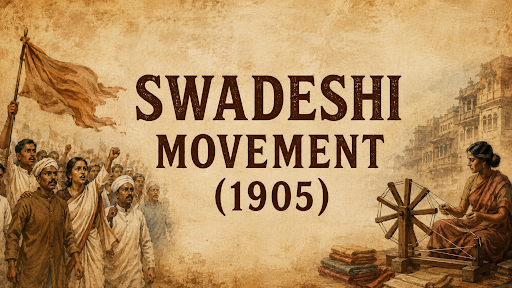
India marks National Handloom Day on 7 August 2026, commemorating the 121st anniversary of the Swadeshi Movement launched on the same date in 1905 at Calcutta Town Hall.
About Swadeshi Movement
The Swadeshi Movement began as a direct reaction to the Partition of Bengal (1905), announced by Viceroy Lord Curzon on 16 October 1905.
Curzon justified the partition as an administrative necessity, but the real aim was to weaken Bengali nationalism by dividing Hindus and Muslims along communal lines.
The formal call for Swadeshi and Boycott was given at a public meeting in the Calcutta Town Hall on 7 August 1905 — this date is now marked as National Handloom Day.
The movement's twin pillars were: Swadeshi (use of indigenous goods) and Boycott (rejection of British goods, especially Manchester cloth and Liverpool salt).
Key Features
-
Economic Nationalism: Indians burnt foreign cloth publicly and promoted Indian mills, handlooms, and khadi.
-
Educational Nationalism: Establishment of National Council of Education (1906) and Bengal National College, with Aurobindo Ghosh as first Principal.
-
Cultural Revival: Rabindranath Tagore composed "Amar Sonar Bangla" (later Bangladesh's national anthem) and organised Rakhi Bandhan Utsav to symbolise Hindu-Muslim unity.
-
Swadeshi Enterprises: Set up of Bengal Chemical and Pharmaceutical Works (P.C. Ray), National Tannery, and Mohini Mills.
Moderates vs Extremists — Divergent Approaches
-
Moderates (Surendranath Banerjee, Gopal Krishna Gokhale) favoured constitutional agitation, petitions, and boycotts limited to Bengal.
-
Extremists (Bal Gangadhar Tilak, Bipin Chandra Pal, Lal Lajpat Rai — the "Lal-Bal-Pal" trio, plus Aurobindo Ghosh) demanded Swaraj and wanted the movement extended nationwide with more assertive methods, including passive resistance.
-
This ideological split led to the historic Surat Split of 1907 at the Indian National Congress session, dividing the party into Moderates and Extremists.
Spread & Role of Samitis
-
Anti-Circular Society, Swadesh Bandhab Samiti (Ashwini Kumar Dutt), and other samitis organised volunteers ("Sevaks") for picketing, arbitration, and relief work.
-
The movement acquired an all-India character, with echoes in Punjab (Lajpat Rai), Maharashtra (Tilak's Ganpati and Shivaji festivals), and Madras (Chidambaram Pillai).
British Response — Repression
-
Government responded with the Prevention of Seditious Meetings Act (1907), the Newspapers (Incitement to Offences) Act (1908), and amendments to the Indian Press Act.
-
Tilak was prosecuted for sedition and deported to Mandalay (1908–1914).
-
Partition was annulled in 1911 during the Delhi Durbar, and the capital shifted from Calcutta to Delhi — a tacit admission of the movement's success.
Significance
-
Marked the transition from moderate petitioning politics to mass-based assertive nationalism.
-
Laid the ideological and organisational foundation for later movements like Non-Cooperation (1920).
-
Its economic self-reliance ethos resonates with modern initiatives like Atmanirbhar Bharat and Vocal for Local .
Source: pib
PRACTICE QUESTIONQ. The Swadeshi Movement was not merely an economic protest but a launching pad for mass nationalism in India." Discuss. (150 words) |