Why In News?
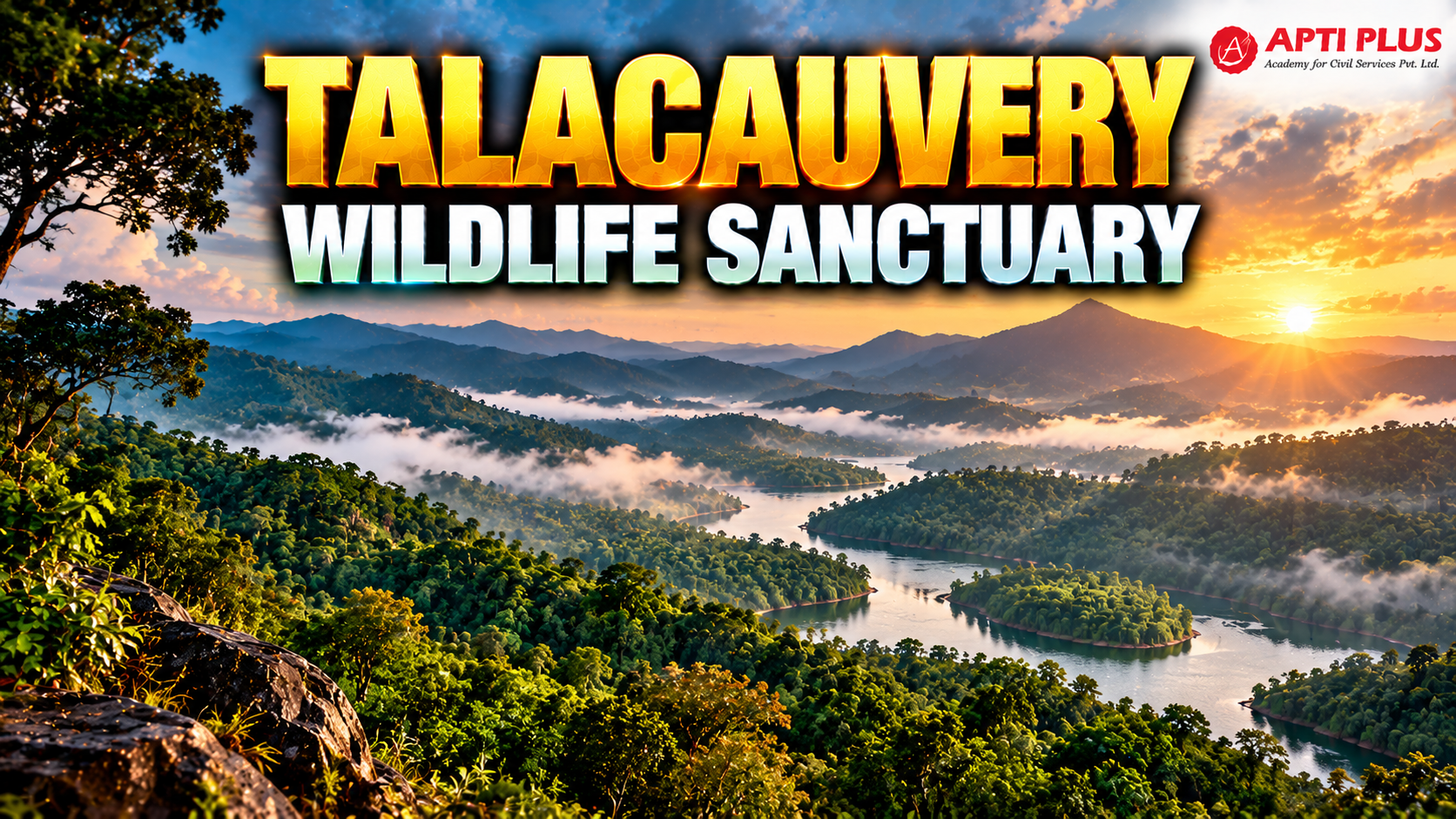
The Talacauvery Wildlife Sanctuary is a protected area in the Western Ghats that has recently been in the news due to anti-poaching operations by the Karnataka Forest Department.
About Talacauvery Wildlife Sanctuary
It is a protected area located in the Kodagu (Coorg) district of Karnataka, situated within the Western Ghats biodiversity hotspot.
● Notified: Established in 1987 under the Wildlife (Protection) Act, 1972.
● Area: Spans roughly 105 sq. km.
● IUCN Category: Category IV (Habitat/Species Management Area).
● Global Status: Part of the UNESCO World Heritage Site (sub-cluster Brahmagiri–Talacauvery) and designated as an Important Bird Area (IBA).
Geographical & Hydrological Profile
● Location & Borders: Located on the steep western slopes of the Central Western Ghats in Karnataka, adjoining the Ranipuram and Kottencheri hills of the Kasaragod district in Kerala.
● River Origin: Encompasses Talakaveri on the Brahmagiri peak/range (approx. 1,355–1,659 m elevation), the sacred birthplace and upper catchment of the Cauvery (Kaveri) River.
● Climate & Rainfall: Receives exceptionally high annual precipitation (>6,000–6,500 mm), ranking among the wettest zones in the Western Ghats.
● Ecological Corridor: Serves as a critical contiguous link connecting Brahmagiri Wildlife Sanctuary with the protected forests of northern Kerala, ensuring gene flow and seasonal movement of large herbivores.
Vegetation & Flora
● Forest Types: Primarily Tropical Wet Evergreen Forests, Tropical Semi-Evergreen Forests, and montane Shola-Grassland ecosystems at higher ridges, alongside interspersed private cardamom and coffee plantations.
● Key Floral Species:
● Mesua ferrea (Ironwood)
● Dysoxylum malabaricum (White Cedar)
● Artocarpus lakoocha (Monkey Jack)
● Calophyllum angustifolium (Poon Spar)
● Michelia champaca (Champak)
● Toona ciliata (Indian Mahogany)
Faunal Diversity
● Mammals: Bengal Tiger, Asian Elephant, Indian Leopard, Dhole (Asiatic Wild Dog), Gaur (Indian Bison), Sloth Bear, Lion-Tailed Macaque, Small-Clawed Otter, Stripe-Necked Mongoose, and Mouse Deer.
● Avifauna: Great Hornbill, Malabar Trogon, Nilgiri Wood Pigeon, and Asian Fairy-Bluebird.
Ecological & Conservation Challenges
● Anthropogenic Pressures: Presence of private enclaves (coffee/cardamom estates), human-wildlife conflict, and recurring issues of wildlife poaching and unauthorized access across inter-state forest borders.
● Soil & Watershed Fragility: High rainfall intensity makes disturbed forest slopes prone to flash floods and landslides, threatening the hydrology of the Cauvery basin.
Source: DECCANHERALD
|
PRACTICE QUESTION Q. With reference to the Eco-Sensitive Zones (ESZ) notified under the Environment (Protection) Act, 1986, consider the following statements:
Which of the statements given above are correct? (a) 1 and 2 only (b) 2 and 3 only (c) 1 and 3 only (d) 1, 2 and 3 Answer: (b) 2 and 3 only Explanation: Statement 1 is incorrect: Eco-Sensitive Zones (ESZs) are not declared under the Wild Life (Protection) Act, 1972. They are notified by the Ministry of Environment, Forest and Climate Change (MoEFCC) under Section 3 of the Environment (Protection) Act, 1986 read with Rule 5 of the Environment (Protection) Rules, 1986. Statement 2 is correct: Under the statutory ESZ guidelines and standard gazette notifications, high-impact activities such as commercial mining, stone quarrying, and crushing units are strictly prohibited inside an ESZ. Statement 3 is correct: As per the standard statutory regulations and the guidelines governing ESZs around Protected Areas, no new commercial hotels and resorts are permitted within one kilometre from the boundary of the protected area (or up to the extent of the ESZ, whichever is nearer), except for small temporary structures meant for eco-tourism. Beyond that 1 km mark, they are categorized as regulated activities conforming to a Zonal Master Plan. |