Why In News?
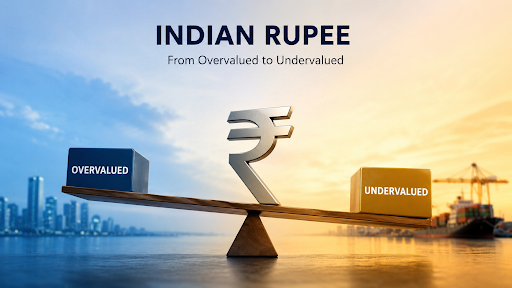
The Reserve Bank of India (RBI) declares the Indian Rupee (INR) undervalued in both nominal and Real Effective Exchange Rate (REER) terms due to global shocks like the West Asia crisis.
What is an Overvalued or Undervalued Currency?
Overvalued Currency
-
Definition: A currency is overvalued when its market exchange rate is much higher than what the country's actual economic fundamentals justify.
-
Measurement: In economics, a Real Effective Exchange Rate (REER) above 100 means the currency is overvalued.
-
Possible consequences:
-
Indian manufactured goods become relatively more expensive and less attractive to foreign buyers.
-
The country suffers a huge loss of trade competitiveness in the global market.
Undervalued Currency
-
Definition: A currency is undervalued when its market exchange rate drops lower than what the economy's true strength dictates.
-
Measurement: A REER below 100 indicates that the currency is undervalued.
-
Possible consequences:
-
Indian exports become cheaper, making domestic businesses highly competitive globally.
-
However, it drastically increases the cost of vital imports like crude oil, machinery, and electronics.
Why Does the RBI Believe the Rupee is Undervalued?
Strong Macroeconomic Fundamentals
-
Robust Growth: India continues to be one of the fastest-growing major economies, posting over 6% growth year after year.
-
Stable Reserves: The country’s foreign exchange reserves (over $676.24 billion), sufficient to cover 11 months of imports, and domestic inflation is under control.
Aggressive RBI Intervention
-
Market Action: RBI sold a cumulative net $15 billion in U.S. dollars during the first quarter (April and May) of FY2026-27 to defend the rupee against extreme volatility.
-
Policy Stance: The RBI intervenes only to prevent panic, showing confidence that the currency's true value is much stronger than current market panic implies.
Market Overshooting
-
External Shocks: The recent depreciation (rupee dropping 5.8% year-to-date) was artificially driven by temporary global events, such as soaring U.S. bond yields and elevated oil prices, rather than domestic weakness.
Why is Exchange Rate Management Important?
Price Stability: Managing the exchange rate prevents a rapidly falling rupee from inflating import costs, which directly triggers severe domestic inflation.
External Sector Stability: Active currency management balances international trade and controls the Current Account Deficit (CAD).
Export Competitiveness: Proper valuation keeps key sectors like IT, textiles, and pharmaceuticals attractive to foreign buyers while protecting import-reliant industries.
Financial Stability: Orderly currency management prevents sudden market panics, anchors investor expectations, and ensures stable market conditions.
What Factors Influence the Value of the Rupee?
Inflation Differential: Faster inflation in India relative to trading partners reduces the real purchasing power of the rupee, pushing the Real Effective Exchange Rate (REER) upward and harming competitiveness.
Current Account Balance: A persistent trade deficit, where imports exceed exports, systematically reduces global demand for the rupee.
FDI and Portfolio Flows: Heavy selling by Foreign Portfolio Investors (FPIs), who recently withdrew $11.9 billion in a single quarter, severely drains the rupee's value.
Crude Oil Prices: High global oil prices force India—which imports over 85% of its crude—to sell more rupees for dollars, depreciating the currency.
Interest Rate Differentials: A narrowing gap between US and Indian interest rates reduces the appeal of Indian bonds, triggering capital flight.
Global Geopolitical Developments: Geopolitical conflicts, such as the Middle East crisis, trigger a "risk-off" sentiment, prompting investors to dump emerging market currencies for safe-haven US dollars.
RBI Market Interventions: The RBI actively buys and sells foreign currency reserves to inject liquidity and smooth out extreme price swings.
What are the Major Challenges?
Rising Global Oil Prices: Costlier crude oil inflates the national import bill, drains foreign exchange reserves, and accelerates domestic inflation.
Volatile Capital Flows: Heavy reliance on foreign capital exposes the Indian economy to sudden, massive withdrawals by foreign investors.
Persistent Current Account Deficit: India's Current Account Deficit stands at 1.2% of GDP, requiring continuous foreign capital inflows to bridge the gap.
Global Financial Uncertainty: Unpredictable shifts in US monetary policy and escalating global trade wars create constant currency shocks.
Policy Dilemma: The RBI faces a tough trade-off between allowing a weak rupee to support exporters and strengthening the currency to shield the economy from expensive imports.
Measures to Strengthen Long-Term Rupee Stability
Maintain Low and Stable Inflation: Keeping inflation low protects the real purchasing power of the rupee and stabilizes the REER.
Promote Export Competitiveness: Expanding domestic manufacturing and diversifying export markets naturally bridges the trade deficit.
Reduce Energy Import Dependence: Transitioning to renewable energy sources drastically cuts India's massive dollar-denominated oil import bills.
Encourage Stable Long-Term Capital Inflows: Attracting permanent Foreign Direct Investment (FDI) provides a safer economic foundation than relying on volatile, short-term portfolio investments.
Strengthen Domestic Manufacturing: Enhancing industrial capacity reduces reliance on expensive imports, protecting the balance of payments.
Limit RBI Intervention to Volatility Control: The RBI must allow market forces to determine the exchange rate, deploying reserves only to prevent destructive panic.
Manage the Impossible Trinity: Policymakers must carefully balance the Impossible Trinity by maintaining independent monetary policy, open capital flows, and a managed exchange rate without depleting reserves.
Conclusion
The Rupee's shift to undervaluation reflects temporary global shocks rather than domestic weakness, offering a strategic advantage to India's export sector if the RBI successfully prevents imported inflation.
Source: THEHINDU
|
PRACTICE QUESTION Q. The concept of the "Impossible Trinity" in economics refers to the inability of a country to simultaneously achieve which of the following? A) Low inflation, high economic growth, and zero unemployment. B) An independent monetary policy, a fixed exchange rate, and free capital flows. C) High export competitiveness, a strong domestic currency, and low import bills. D) A managed float exchange rate, low fiscal deficit, and high foreign direct investment. Answer: B Explanation: The "Impossible Trinity" refers to B) An independent monetary policy, a fixed exchange rate, and free capital flows. Key Elements of the Impossible Trinity
A country can only pick two of these three options at the same time. If you pick a fixed exchange rate and free money movement, you lose control over your own interest rates. |