Why In News?
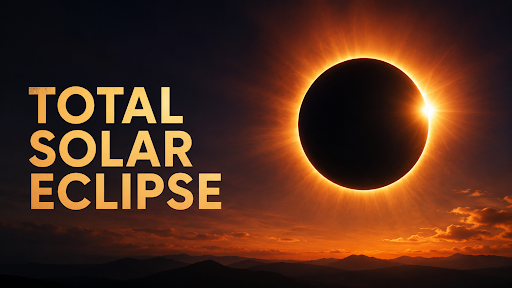
On August 12, 2026, the Moon's umbral shadow will sweep across the Arctic, Greenland, Iceland, and Spain, producing mainland Europe's first total solar eclipse since 1999.
What is a Solar Eclipse?
A solar eclipse is a natural astronomical phenomenon that occurs when the Moon passes directly between the Sun and the Earth, casting its shadow on the Earth's surface and partially or completely blocking sunlight
Core Mechanics of a Solar Eclipse
A solar eclipse can only occur under specific orbital conditions:
-
New Moon Phase: The alignment always happens during a New Moon, when the Moon and the Sun are on the same side of the Earth.
-
The 5° Orbital Tilt: Eclipses do not happen every month because the Moon’s orbital plane is tilted at approximately 5° relative to the Earth’s orbital plane around the Sun (the ecliptic).
-
Lunar Nodes: An eclipse only occurs when the New Moon aligns perfectly at or near the intersection points of the two orbital planes, known as lunar nodes, during biannual periods called eclipse seasons.

Types of Solar Eclipses
Solar eclipses are categorized into four types based on the alignment precision and the Earth-Moon distance:
|
Type of Eclipse |
Description |
Key Features |
|
Total Solar Eclipse |
The Moon completely covers the Sun's disk because it is close to Earth (Perigee). |
Reveals the outer solar atmosphere (Corona). Creates a brief daytime twilight. |
|
Annular Solar Eclipse |
The Moon passes directly in front of the Sun but is near its farthest point from Earth (Apogee), making it appear smaller. |
The Sun’s outer edge remains visible, forming a brilliant "Ring of Fire" (Annulus). |
|
Partial Solar Eclipse |
The Sun, Moon, and Earth are not perfectly aligned. Only a fraction of the Sun is obscured. |
The Sun takes on a unique crescent shape. It is visible over a much wider geographic region. |
|
Hybrid Solar Eclipse |
A highly rare phenomenon where the eclipse transitions between annular and total along its global path. |
Occurs due to the curvature of the Earth modulating the Moon's distance. |
Key Shadow Regions
The type of eclipse observed depends strictly on which part of the Moon's shadow you stand in:
-
Umbra: The dark, inner central region of the shadow. Observers in this path witness a total solar eclipse.
-
Penumbra: The lighter, outer portion of the shadow. Observers here experience a partial solar eclipse.
-
Antumbra: The area beyond the umbra where the Moon appears entirely within the Sun's boundaries, creating an annular solar eclipse.

Significance of Eclipse
Study of Solar Corona: Eclipses offer rare natural opportunities to observe the corona without expensive coronagraph instruments blocking the Sun's disc.
Solar Wind Research: Ground and airborne observations during totality help scientists trace the origin points of solar wind streams.
Space Weather Studies: Data gathered supports better forecasting of solar storms that threaten satellites and power infrastructure.
Sun-Earth Interaction: The eclipse allows testing of models describing how solar radiation and particles affect Earth's upper atmosphere.
Atmospheric Studies: Sudden loss of sunlight during totality lets researchers study rapid atmospheric cooling and ionospheric changes.
Historically, total eclipses have driven major discoveries — the element helium was first identified in the Sun's spectrum during the 1868 eclipse, and the 1919 eclipse provided observational confirmation of Einstein's General Theory of Relativity by measuring starlight bending near the Sun.
Why the Recent Eclipse Will Not Be Visible from India?
-
Geographic Location: India lies far outside both the umbral and penumbral shadow tracks of this eclipse.
-
Eclipse Path: The shadow path stays confined to the Arctic, North Atlantic, and parts of Europe.
-
Local Time: By the time the eclipse occurs, it is night-time in India, ruling out any visibility.
-
Night-time Conditions in India: Since the Sun is below the horizon for Indian observers during the event, no partial or total phase can be seen from anywhere in the country.
Source: ECONOMICTIMES
|
PRACTICE QUESTION Q. Consider the following statements regarding a total solar eclipse:
Which of the statements given above are correct? A) 1 and 2 only B) 2 and 3 only C) 1 and 3 only D) 1, 2, and 3 Answer: CExplanation: Statement 1 is correct: A solar eclipse can only happen during the new moon phase. This occurs when the Moon aligns directly between the Earth and the Sun, meaning its illuminated side faces away from Earth. Statement 2 is incorrect: A total solar eclipse is not visible from the entire sunlit side of the Earth at the same time. It is only visible along a very narrow strip on Earth's surface known as the path of totality (usually around 100 miles wide) as the Moon's shadow sweeps across the planet. Regions outside this path but within the partial shadow see only a partial eclipse. Statement 3 is correct: The Moon casts two main types of shadows during an eclipse. The umbra is the dark, inner central shadow where the sunlight is completely blocked. Anyone standing inside the umbra experiences a total solar eclipse. The lighter, outer shadow is called the penumbra. |