Why In News?
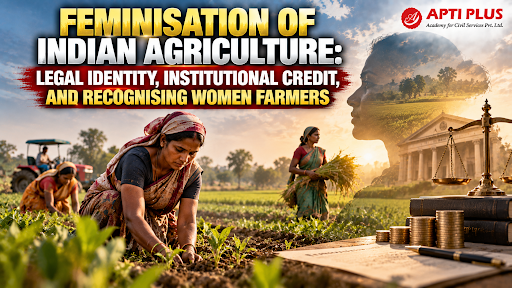
Maharashtra has become the first state to pass the Women Farmers’ Empowerment Bill, 2026, legally establishing an activity-based, land-delinked definition of a farmer and issuing an enforceable Woman Farmer Certificate.
Why Does Delinking Farmer Status from Land Ownership Matter for Women?
Feminisation of Agriculture Deepens While Titles Stagnate
According to the Periodic Labour Force Survey (PLFS 2023–24), over 76.9% of rural female workers in India depend on agriculture for their primary livelihood, compared to approximately 49% of rural men.
Ownership Asymmetry Persists in Land Revenue Records
The 10th Agricultural Census (2015–16) notes that women operate only 13.96% of total operational agricultural landholdings, accounting for merely 11.57% of operated land area, leaving over 85% of active female agricultural workers landless.
Land Title Dependency Blocks Institutional Entitlements
Central and state agricultural welfare schemes—including direct income support under PM-KISAN, subsidized credit through Kisan Credit Cards (KCC), input subsidies for fertilizers, and disaster compensation under PMFBY—rely on land revenue records, excluding women cultivators.
Highlights of Maharashtra Women Farmers' Empowerment Bill 2026
Delinking Identity from Land Titles: The Woman Farmer Certificate (WFC) allows landless women, tenants, and agricultural laborers to be officially recognized as farmers without needing land ownership.
Broad Definition of Farmer: Adopting the National Policy for Farmers, 2007, the law covers crop cultivation, animal husbandry, poultry, fishery, agro-forestry, vermiculture, mushroom cultivation, and primary processing.
Application and Issuance: Eligible women aged 18 and above can apply via the local Gram Sabha or Nagar Panchayat, with certificates issued within 15 days of approval.
Financial and Welfare Access: The WFC unlocks institutional credit/concessional loans, crop insurance, direct subsidies, modern farming technology, and market procurement support.
Institutional Support Systems:
-
Women Farmers Empowerment Council: Chaired by the Chief Minister for high-level policy direction.
-
State Monitoring Committee: Headed by the Chief Secretary to oversee execution and grievances.
-
State Women Farmers Empowerment Cell & Assistance Officers: Nodal bodies and designated district/sub-district officers to aid registration and outreach.
Digital Registry & Dedicated Fund: Establishes a centralized database of certified women farmers alongside the Maharashtra State Fund for Women Farmers to finance development initiatives.
Which Structural Gaps Block Women’s Access to Credit, Subsidies, and Markets?

Exclusion from Formal Agricultural Refinancing
According to the Reserve Bank of India (RBI) Internal Working Group on Agricultural Credit, women receive less than 10% of total commercial bank agricultural credit disbursements, forcing smallholder female cultivators to rely on non-institutional moneylenders charging interest rates exceeding 24%–36%.
Incomplete Enforcement of Succession Reforms
Despite the Hindu Succession (Amendment) Act, 2005 granting daughters equal coparcenary rights—upheld unconditionally by the Supreme Court in Vineeta Sharma vs Rakesh Sharma (2020)—customary patriarchal norms prevent women from registering inherited land titles.
Gender-Blind Agricultural Extension Architecture
Agricultural universities, Krishi Vigyan Kendras (KVKs), and state extension agents traditionally design field training and drone demonstrations for male heads of households, overlooking female cultivators who manage daily agronomic decisions.
Ergonomic Mismatches in Mechanization
Mainstream farm equipment (tillers, tractors, sprayers) is engineered for male physical parameters, increasing musculoskeletal strain on female laborers in the absence of gender-adapted light implements.
Way Forward to Institutionalize Rights for Women Farmers
Enact a Model Central Law for Women Farmers
The Ministry of Agriculture and Farmers Welfare should draft a National Model Bill on Women Farmers’ Rights, urging all states to adopt activity-based certification systems modeled after Maharashtra's legislation.
Redesign PM-KISAN and PMFBY Guidelines
Amend central operating guidelines to allow registered Woman Farmer Certificate holders to receive direct benefit transfers and crop insurance claim settlements without requiring submission of land title deeds.
Mandate Digital Joint Titling on State Land Portals
State Revenue Departments must integrate digital land-record portals (such as Bhulekh and Mahabhumi) with automated joint-titling triggers whenever agricultural land transfers to married male successors.
Design Collateral-Free Credit Quotas for Women Cultivators
The RBI and NABARD should establish dedicated 20% priority sub-targets for women farmers under the Kisan Credit Card scheme, utilizing Self-Help Group (SHG) and Joint Liability Group (JLG) peer-guarantees in lieu of land mortgages.
Mainstream Gender-Adapted Agricultural Machinery
Direct funding from the Sub-Mission on Agricultural Mechanization (SMAM) toward developing lightweight weeders, battery-operated harvesters, and ergonomic sprayers designed specifically for female agricultural workers.
Conclusion
Maharashtra’s decoupling of agricultural identity from land ownership resolves a longstanding policy gap, proving rural empowerment demands granting legal status, credit access, and dignity to women farm laborers.
Source: THEHINDU
|
PRACTICE QUESTION Q. Examine how transitioning from title-based to activity-based definitions of a farmer addresses structural inequalities arising from the feminisation of agriculture in India. 150 words |