Why In News?
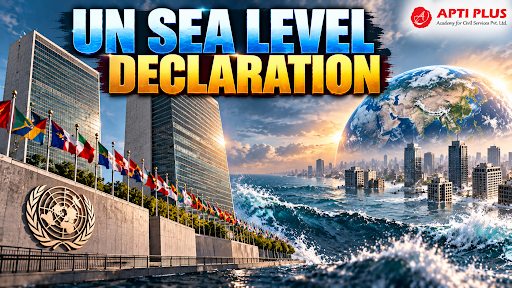
The UN Declaration on Sea Level Rise was adopted by consensus by the United Nations General Assembly, during a high-level meeting in New York.
Key Highlights of the UN Declaration on Sea
-
Adoption at UNGA: India welcomed the landmark declaration at the 81st UN General Assembly, emphasizing climate equity and support for vulnerable nations.
-
Legal Continuity for States: Ensures Small Island Developing States (SIDS) retain sovereignty, UN membership, and maritime zones under UNCLOS even if they lose physical territory.
-
Protection of Maritime Zones: Safeguards territorial waters and Exclusive Economic Zones (EEZs) against sea-level rise impacts.
-
Human Rights & Displacement: Recognizes sea-level rise as a threat to housing, freshwater, food security, and cultural identity. Calls for stronger adaptation, resilient infrastructure, early-warning systems, and increased finance for developing countries.

What Is Sea-Level Rise?
Sea-level rise is the long-term increase in the average height of the Earth's ocean surface. Global sea levels have risen by about 8 to 9 inches (21 to 24 cm) since 1880, and the rate of rise is speeding up.
Primary Drivers:
-
Thermal Expansion: Ocean water expands as it absorbs more than 90% of excess planetary heat, accounting for nearly 40–50% of observed global sea-level rise.
-
Melting Mountain Glaciers: Accelerated retreat of non-polar mountain ice caps in the Himalayas, Andes, and Alps discharging freshwater into river basins and oceans.
-
Greenland Ice Sheet Loss: Rapid surface ablation and calving of Arctic ice sheets, currently shedding hundreds of billions of tonnes of mass annually.
-
Antarctic Ice Sheet Dynamics: Destabilization of marine-grounded glaciers in West Antarctica (e.g., Thwaites and Pine Island Glaciers) threatening catastrophic non-linear tipping points.
Coastal Vulnerability: Compounded by local factors including land subsidence, tectonic plate movement, sediment compaction, and storm surge amplification.

Why Is Sea-Level Rise A Major Global Concern?
Coastal Flooding & Inundation: Low-lying deltas and littoral zones face chronic inundation during high tides (sunny-day flooding) and intensified storm surges.
Accelerated Coastal Erosion: Encroaching waves degrade natural sediment budgets, destroy littoral barrier bars, and undermine coastal protective dunes.
Saltwater Intrusion: Marine incursions contaminate inland freshwater aquifers, coastal wetlands, and shallow water tables, precipitating acute drinking water crises.
Loss of Habitable Land: Submergence of low-lying islands directly destroys physical living spaces, forcing internal displacement and cross-border migration.
Destruction of Critical Infrastructure: Ports, airports, coastal highway corridors, and desalinisation plants suffer chronic structural corrosion and operational failure.
Threat to Food and Water Security: Salinization renders fertile coastal agricultural soils barren and degrades mangrove nurseries essential for artisanal fisheries.
Why Are Small Island Developing States (SIDS) Particularly Vulnerable?
Low-Lying Topography: Nations such as Tuvalu, Kiribati, and the Maldives maintain an average elevation of less than two meters above sea level, making total submergence an imminent physical reality.
Constrained Land Mass: Narrow geographic widths leave zero room for inland retreat, meaning coastal inundation impacts the entire sovereign land footprint.
Limited Fiscal and Adaptation Capacity: SIDS endure high per-capita infrastructure adaptation costs and disproportionate debt burdens, limiting construction of massive coastal dykes.
Coastal Population Concentration: Over 80% of human settlements, administrative seats, and healthcare networks in atoll nations are situated within one kilometer of the coastline.
Over-Dependence on Marine Resources: Heavy reliance on exclusive economic zone (EEZ) fisheries, coral reef ecotourism, and ocean resources makes marine ecosystem collapse economically devastating.
Imminent Risk of Permanent Displacement: Physical unviability will trigger forced mass migration, threatening cultural extinction and the loss of ancestral heritage.
What Is The Statehood Issue In International Law?
The Montevideo Convention Criteria (1933): Under Article 1 of the Montevideo Convention on the Rights and Duties of States, legal statehood requires four traditional pillars:
-
A defined territory;
-
A permanent population;
-
An effective government; and
-
The capacity to enter into relations with other states (international legal personality).
The Extinction Dilemma: If an atoll nation's territory is entirely submerged or becomes completely uninhabitable, traditional legal doctrine could treat the state as extinguished, rendering its population stateless and voiding its sovereign voice.
The Principle of Statehood Continuity: SIDS assert that because land loss results from anthropogenic global warming rather than voluntary cession or lawful conquest, the international community must recognize perpetual statehood, preserving their sovereignty, UN membership, and sovereign equality regardless of physical inundation.
Protection of Maritime Entitlements: Under the UN Convention on the Law of the Sea (UNCLOS), maritime zones (Territorial Sea, Contiguous Zone, and 200-nautical-mile EEZ) are measured from low-water coastal baselines.
-
As coastlines retreat, retreating baselines could cause island nations to forfeit resource-rich oceanic jurisdictions.
What Are The Direct Implications For India?
Vulnerable Continental Coastline: India possesses a 7,516.6 km coastline across 9 coastal states and 4 Union Territories, where over 250 million citizens live within 50 km of the sea.
Extreme Exposure of Island Territories:
-
Lakshadweep Archipelago: Composed of low-lying coral atolls with elevations ranging between 1 to 2 meters, Lakshadweep faces high risks of freshwater salinization, coastal erosion, and coral reef bleaching.
-
Andaman and Nicobar Islands: High tectonic and storm vulnerability, where sea-level rise threatens coastal mangroves, tribal settlements, and critical naval defence infrastructure.
Megacity Vulnerability: Commercial hubs including Mumbai, Kolkata, and Chennai face severe risks of compounding tidal surges, inundation of coastal transit corridors, and drainage congestion.
Way Forward
Operationalize Resilient Climate Finance: Expedite the full capitalization of the Fund for Responding to Loss and Damage (FRLD) and secure ambitious adaptation allocations under the New Collective Quantified Goal (NCQG) at COP29/COP30.
-
Example: Antigua and Barbuda Agenda for SIDS (ABAS), establishing a global dedicated SIDS debt-relief and climate support framework.
Institutionalize Nature-Based Coastal Protection: Restore natural bio-shields, marine mangrove forests, and biogenic coral reefs that dissipate wave energy far more cost-effectively than concrete breakwaters.
-
Example: India’s MISHTI (Mangrove Initiative for Shoreline Habitats & Tangible Incomes) scheme, revitalizing coastal mangrove cover across 11 littoral states.
Deploy Universal Early-Warning Infrastructure: Scale up high-resolution ocean monitoring, Doppler radars, and storm-surge prediction arrays to ensure zero human casualties during extreme surge events.
-
Example: UN Early Warnings for All (EW4All) Initiative, delivering multi-hazard early warning systems to vulnerable maritime and island zones.
Build Climate-Proof Coastal Assets: Ensure public infrastructure conforms to forward-looking, climate-resilient engineering standards.
-
Example: Coalition for Disaster Resilient Infrastructure (CDRI) – Infrastructure for Resilient Island States (IRIS), designing cyclone- and surge-proof lifelines in SIDS.
Codify Binding International Treaties: Formalize the UN Declaration into a binding international legal instrument through the ongoing deliberations of the International Law Commission (ILC) and upcoming Advisory Opinions from the International Court of Justice (ICJ).
Conclusion
The UN Sea-Level Rise Declaration marks a historic milestone in international law, affirming that rising tides cannot wash away the sovereign rights, dignity, and statehood of small island nations.
Source: DOWNTOEARTH
|
PRACTICE QUESTION Q. With reference to sea-level rise and international ocean law, consider the following statements: 1. Thermal expansion of ocean water accounts for almost half of observed global mean sea-level rise. 2. Under the United Nations Convention on the Law of the Sea (UNCLOS), the Exclusive Economic Zone (EEZ) extends up to 200 nautical miles from baseline. 3. The Coalition for Disaster Resilient Infrastructure (CDRI) launched the 'IRIS' initiative specifically targeted at Small Island Developing States. Which of the statements given above are correct? (a) 1 and 2 only (b) 2 and 3 only (c) 1 and 3 only (d) 1, 2 and 3 Answer: (d) Explanation: Statement 1 is correct: According to NASA, thermal expansion of seawater (the process by which water expands as it warms up) is one of the primary drivers of global mean sea-level rise. Over the 20th century and in recent decades, it has historically accounted for about half of the observed global sea-level rise, with the remaining share largely driven by melting land-based ice sheets and glaciers. Statement 2 is correct: Under Article 57 of the United Nations Convention on the Law of the Sea (UNCLOS), the Exclusive Economic Zone (EEZ) of a coastal state is an area beyond and adjacent to the territorial sea that extends up to 200 nautical miles measured from the baselines from which the breadth of the territorial sea is measured. Statement 3 is correct: The Coalition for Disaster Resilient Infrastructure (CDRI) officially launched the 'IRIS' (Infrastructure for Resilient Island States) initiative at the COP26 World Leaders Summit. This flagship program is designed with and specifically targeted at Small Island Developing States (SIDS) to equip them with technical support, tools, and partnerships to build climate- and disaster-resilient infrastructure systems. |