Why In News?
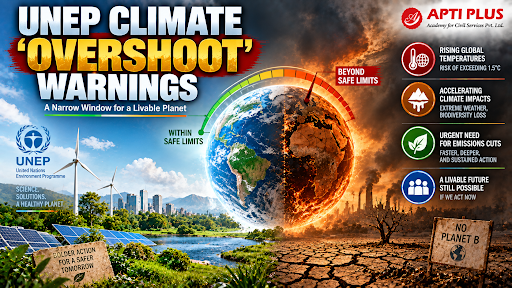
The United Nations Environment Programme (UNEP) published a report titled 'Limiting Overshoot: Navigating Exceedance of 1.5°C and Pathways Towards Return', urging nations to minimize the duration and peak of global temperature overshoot.
What is Climate Overshoot?
-
Definition: A climatic scenario where global average surface temperatures temporarily exceed the Paris Agreement’s 1.5°C ceiling before declining back.
-
Temporary Exceedance Window: Driven by inadequate near-term emission cuts, causing global atmospheric greenhouse gas concentrations to surpass safe carbon budget limits.
-
Peak Warming Followed by Cooling: Characterized by an initial temperature rise to a maximum peak, followed by gradual cooling driven by massive global carbon removal.
-
Overshoot, Peak and Decline Framework: A structured global strategy that limits the maximum temperature peak and accelerates the timeframe to return to 1.5°C.
Highlights of the UNEP Report
Best-Case 1.8°C Peak Warming Pathway: Even under the most ambitious net-zero scenarios with rapid decarbonization, peak global warming will likely reach around 1.8°C.
Severe Danger of 2.6°C Warming by 2100: Current unconditional Nationally Determined Contributions (NDCs) set humanity on a dangerous trajectory toward 2.6°C to 2.8°C of warming.
Multiplication of Extreme Disasters: More than 3 billion people will face chronic lethal heat exposure if global temperatures linger above 1.5°C for several decades.
Extensive Marine and Terrestrial Loss: Irreversible bleaching and mortality of 99% of global warm-water tropical coral reefs occurs once warming crosses 1.5°C.
Compounding Food and Water Crises: Global crop yield declines in tropical agricultural breadbaskets threaten food security for vulnerable communities across South Asia.
|
Why is 1.5°C Important?
|
What are the Major Climate Risks of Overshoot?
Unprecedented Wet-Bulb Heatwaves: Causes recurring deadly wet-bulb temperature heat domes exceeding 35°C in the Indo-Gangetic plains, shutting down outdoor labor.
Irreversible Mountain Glacier Melt: Accelerated melting of the Hindu Kush Himalaya cryosphere disrupts freshwater flows for 1.3 billion downstream people across South Asia.
Centuries of Committed Sea-Level Rise: Destabilization of the Thwaites Glacier in Antarctica locks in irreversible multi-meter coastal inundation for megacities like Mumbai.
Destabilization of the AMOC Ocean Current: Freshwater deluge from Arctic melt risks shutting down the Atlantic Meridional Overturning Circulation, altering global monsoons.
Amazon Rainforest Savannization: Extended tropical drought pushes the Amazon basin past its ecological tipping point into a net carbon-emitting dry savanna.
Way Forward
Minimize Overshoot Magnitude and Duration: Front-load deep fossil fuel emission cuts before 2030 to prevent peak warming from ever exceeding 1.7°C.
Institutionalize Stringent CDR Governance: Formulate clear multilateral carbon accounting standards under Article 6.4 of the Paris Agreement to verify real carbon storage.
Operationalize the Loss and Damage Fund: Disburse non-debt grants through the Santiago Network to climate-vulnerable island and coastal nations suffering from heat extremes.
Scale Nature-Based Sponge Infrastructure: Re-engineer urban floodplains under the National Mission on Sustainable Habitat to absorb cloudburst floods without civic breakdown.
Enforce Global Methane Abatement Mandates: Mandate zero routine flaring and leak detection across oil and gas facilities under the UNEP International Methane Emissions Observatory.
Conclusion
Treating climate overshoot not as an excuse for delay but as a call for aggressive near-term mitigation paired with adaptation is humanity's sole pathway to planetary survival.
Source: THEHINDU
|
PRACTICE QUESTION Q. Critically evaluate the role and governance challenges of large-scale Carbon Dioxide Removal (CDR) technologies in achieving long-term net-negative emissions. (10 Marks, 150 Words) |