Why In News?
The Ministry of Housing and Urban Affairs (MoHUA) informs Parliament about efforts to combat the Urban Heat Island (UHI) effect driven by human-induced global warming.
What is the Urban Heat Island (UHI) Effect?
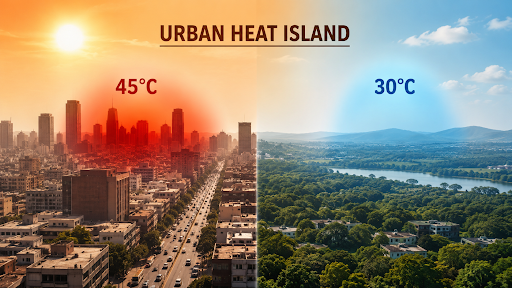
The Urban Heat Island (UHI) effect occurs when urban areas experience higher temperatures than surrounding rural areas due to the replacement of natural land cover with dense, heat-absorbing materials like concrete, asphalt, and metal.
Causes
Low Albedo Materials: Dark surfaces like asphalt absorb and store massive amounts of solar energy instead of reflecting it.
Increased Energy Usage: Air conditioning units cool indoor spaces but exhaust waste heat directly into the outdoor urban atmosphere.
Lack of Vegetation: Deforestation eliminates natural cooling benefits from shade and evapotranspiration.
Urban Canopy: Tall skyscrapers trap heat between buildings, creating multiple layers of thermal reflection.
Wind Blocking: Densely packed buildings block wind flows, reducing natural convective cooling.
Air Pollutants: Vehicular and industrial emissions trap solar radiation in the local atmosphere, acting as a localized greenhouse.

Why is the Urban Heat Island Effect a Major Concern?
Increased Heat Stress: Extreme heat endangers public health, threatening to increase heat-related deaths by one-third by 2050 in cities like Lucknow, Chennai, and Surat.
Higher Energy Demand: Rising urban temperatures increase electricity consumption for cooling, with building cooling demand projected to rise 11 times between 2017-18 and 2037-38.
Poor Air Quality: Elevated cooling demands drive fossil fuel combustion, increasing fine particulate matter and ground-level smog.
Water Stress: Impervious concrete surfaces block rainwater infiltration, depleting groundwater reserves and amplifying local heat.
Climate Change Amplification: The UHI effect intensifies global warming impacts locally, as India's average annual mean temperature rises by 0.64°C per 100 years during 1901-2022.
Labor Productivity Loss: Heat stress reduces physical work capacity, threatening to slash 2% to 4% of urban economic output by 2050.

What are the Major Challenges?
Rapid Urbanisation: Rapid urban growth converts green open spaces into paved, heat-trapping infrastructure, expanding the UHI footprint.
Loss of Urban Green Cover: Deforestation disrupts microclimates, destroying natural shade and reducing the air-filtration benefits of urban forests.
High Impervious Surface Area: Extensive asphalt and concrete cover restricts water drainage and eliminates soil moisture, causing solar energy to heat the ground directly.
Weak Enforcement of Urban Planning Norms: Many cities suffer from unplanned expansion and poor adherence to URDPFI guidelines and building codes.
Climate Change Increasing Heat Extremes: Summer maximum temperatures in cities like Delhi face projected increases of up to 2.1°C by mid-century under high emission scenarios.
Limited Public Awareness: The general public and local builders lack awareness regarding sustainable cooling practices and ICAP guidelines.
Financial Barriers: Climate-responsive materials increase construction costs by 20-35%, creating financial hurdles for affordable housing projects.
Way Forward
Increase Urban Tree Cover and Green Roofs: Plant Miyawaki forests to grow dense, native vegetation 10 times faster than conventional plantations.
Promote Cool Roofs and Reflective Building Materials: Applying white, reflective coatings lowers indoor temperatures by 2.1°C to 4.3°C; Telangana's Cool Roof Policy targets 300 sq. km of cool roofs by 2028 to save 600 million units of electricity annually.
Expand Urban Wetlands and Water Bodies: Cities adopt "Sponge City" concepts to restore wetlands and lakes, retaining water and cooling the microclimate.
Improve Public Transport and Reduce Vehicular Emissions: Investing in green mobility reduces exhaust heat, supported by AMRUT completing 473 km of pedestrian and cycling tracks.
Integrate Heat Action Plans into Urban Governance: Cities scale up heat-health early warning systems, yielding a benefit-cost ratio exceeding 50:1.
Strengthen Climate-Responsive Urban Planning: Urban Local Bodies enforce URDPFI guidelines to build compact cities, optimize street orientation, and mandate green building codes.
Promote Energy-Efficient Appliances: Mandate the replacement of inefficient air conditioners through Bureau of Energy Efficiency (BEE) programs to reduce waste heat.
Conclusion
By adopting innovative solutions like cool roofs, Miyawaki forests, and strict climate-responsive urban planning, Indian cities can lower temperatures and build resilient habitats for millions.
Source: PIB
|
PRACTICE QUESTION Q. Traditional urban planning models in India are inadequate to handle rising climate extremes." Discuss. 150 words |