Why In News?
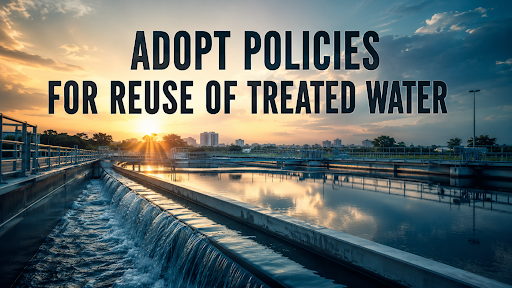
Indian States and Urban Local Bodies (ULBs) must adopt mandatory policies for safely reusing treated wastewater, leveraging sewage as an economic resource to avert severe urban water stress.
What is Treated Wastewater?
Treated wastewater is municipal sewage, domestic greywater/blackwater, or industrial effluent that has undergone systematic physical, biological, and chemical purification processes in a Sewage Treatment Plant (STP) or Effluent Treatment Plant (ETP) to remove hazardous contaminants.
Stages of Sewage Treatment:
-
Primary Treatment: Physical screening and sedimentation to remove floating solids, grit, and heavy sludge.
-
Secondary Treatment: Biological digestion (using activated sludge, sequential batch reactors, or moving bed biofilm reactors) to break down dissolved organic matter and lower Biochemical Oxygen Demand (BOD).
-
Tertiary & Advanced Treatment: Chemical coagulation, sand filtration, membrane filtration (Ultrafiltration / Reverse Osmosis), and disinfection (chlorination, ozonation, or UV radiation) to eliminate pathogens and dissolved solids.
Treatment Standards: Regulated by Central Pollution Control Board (CPCB) guidelines specifying maximum permissible limits for BOD (≤10 mg/l), Total Suspended Solids (TSS ≤20 mg/l), Chemical Oxygen Demand (COD ≤50 mg/l), and Fecal Coliforms (<100 MPN/100 ml).
Non-Potable Reuse: Reclaimed water treated to designated fitness standards for industrial cooling, agriculture, horticulture, and urban washing rather than direct human drinking.
What are the Major Uses of Treated Wastewater?
Industrial Processes & Cooling: Supplying boiler feed and cooling water to thermal power plants, petrochemical refineries, steel mills, and textile dyeing clusters.
Agricultural Irrigation & Agro-Forestry: Irrigating non-food commercial crops, timber plantations, cotton fields, and fodder grasses.
Urban Landscaping & Horticulture: Watering public parks, green medians, golf courses, and civic botanical gardens.
Construction & Infrastructure: Mixing concrete, dust suppression on highway construction corridors, and soil compaction.
Railway Operations & Transport Washing: Washing passenger train rakes, railway platform aprons, and state transport bus depots.
Thermal Power Plants (Mandatory 50-km Rule): Sourcing treated municipal wastewater for power plant cooling towers within a 50 km radius under the Ministry of Power's Tariff Policy.
Dual-Piping for Toilet Flushing: Dedicated non-potable plumbing lines in large commercial complexes and residential townships.
Artificial Groundwater Recharge: Controlled infiltration basins to replenish depleted non-potable deep aquifers following tertiary treatment.
Why is Wastewater Reuse Important for India?
Freshwater Conservation: India houses 18% of the global human population but possesses only 4% of the world's renewable freshwater resources. Reusing wastewater reduces freshwater withdrawals from over-stressed river basins.
Groundwater Depletion Mitigation: Reclaimed water relieves extraction pressure on over-exploited aquifers across the Indo-Gangetic and Deccan plateau regions.
Curbing Riverine Pollution & Eutrophication: Preventing the direct discharge of 44,000+ MLD of untreated urban sewage into national river systems like Ganga, Yamuna, Godavari, and Cauvery.
Climate Resilience & Drought Proofing: Unlike rainfed surface reservoirs, municipal sewage is a climate-independent, perennial water source that flows continuously regardless of monsoon deficits.
Advancing the Circular Economy: Reclaims valuable nutrients (nitrogen, phosphorus) and generates biogas (methane) for captive green power generation at STPs.
What is the National Framework for Safe Reuse of Treated Water (SRTW)?
Nodal Authority & Inception: Formulated by the National Mission for Clean Ganga (NMCG), Ministry of Jal Shakti, to establish a nationwide policy architecture for treated used water.
State Reuse Policy Mandate: Directs all States and Union Territories to notify dedicated Safe Reuse of Treated Water policies with statutory time-bound reuse targets (e.g., 20% reuse by 2030, 50% by 2035).
Economic Models & Market Creation: Fosters Public-Private Partnerships (PPP) using Hybrid Annuity Models (HAM) to monetize treated water off-take agreements with industrial buyers.
Sectoral Allocation Priorities: Formulates structured priority matrices allocating reclaimed water first to heavy industry, followed by urban utilities, agriculture, and environmental flow maintenance.
Institutional Convergence: Establishes coordination mechanisms between State Pollution Control Boards (SPCBs), Urban Local Bodies (ULBs), and industrial development corporations.
|
Benefits of Treated Wastewater Reuse
|
Major Government Initiatives for Wastewater Management
National Framework for Safe Reuse of Treated Water: Apex national guidelines setting standards, pricing models, and governance frameworks for reclaimed water.
City-Level Reuse Action Plans under AMRUT 2.0: The Atal Mission for Rejuvenation and Urban Transformation (AMRUT 2.0) mandates cities to prepare City Water Balance Plans, funding dual-piping and recycle projects to cover at least 20% of city water demand through recycled water.
Namami Gange & Arth Ganga Model: Integrates sewage infrastructure with revenue generation by selling treated sludge as organic bio-fertilizer and marketing treated effluent to Indian Oil refineries (e.g., Mathura Refinery project).
Swachh Bharat Mission (Urban) 2.0 - Water+ Certification: Recognizes cities that treat 100% of their wastewater and reuse at least 25% of treated water for commercial and horticultural purposes.
State-Level Reuse Policies: Progressive policies notified by Gujarat (2018), Maharashtra, Karnataka, Uttar Pradesh (SRTW Policy 2026), and Odisha (Policy on Reuse of Treated Used Water 2026).
Major Structural Challenges in India’s Wastewater Ecosystem
Inadequate Treatment Infrastructure & Capacity Gaps: Urban India treats less than 38% of its generated sewage due to missing trunk sewer networks, non-functional STPs, and frequent power outages.
Severe Quality Monitoring & Regulatory Gaps: Inconsistent biological treatment causes treated water to exceed fecal coliform and heavy metal safety thresholds.
High Capital & Operational Costs of Tertiary Treatment: Advanced membrane and UV systems require significant capital investment and skilled technical operation that small municipalities cannot afford.
Absence of Dedicated Distribution Networks: Most Indian cities lack secondary distribution pipelines to transport treated water from suburban STPs to distant industrial zones.
Social Taboos & the "Yuck Factor": Deep psychological aversion and religious taboos among farmers and citizens against handling recycled water derived from toilet waste.
Policy and Institutional Bottlenecks
-
Constitutional Division of Powers: Under the Seventh Schedule of the Indian Constitution, Water is a State subject (Entry 17, State List), resulting in fragmented regulations and lack of uniform national enforcement.
-
Subsidised / Underpriced Freshwater Tariffs: Artificially cheap raw freshwater supplied to industries disincentivizes private companies from purchasing higher-cost tertiary-treated water.
-
Weak Financial and Technical Capacity of Urban Local Bodies (ULBs): Indian municipal corporations lack creditworthiness, technical engineering cadres, and project structuring capacity to execute large PPP reuse contracts.
-
Data Deficits & Fragmented Monitoring: Lack of digital, centralized database tracking sewage generation, treatment quality, and end-use allocation across urban centers.
What India Can Learn from Domestic & International Models
Case Study 1: Surat Municipal Corporation (SMC) Industrial Sale Model (Domestic Benchmark): Surat established a 115 MLD tertiary treatment plant supplying recycled water to the Pandesara textile industrial cluster, earning over ₹140 crore annually and recovering 100% of its capital and operational costs.
Case Study 2: Nagpur Municipal Corporation & Thermal Power Plant Integration: Nagpur supplies 190 MLD of secondary-treated sewage to Mahagenco's Koradi and Khaparkheda thermal power stations, freeing up 190 MLD of freshwater from the Pench reservoir for drinking water supplies.
Case Study 3: Israel’s National Agricultural Wastewater Recycling Model (Global Gold Standard): Israel recycles over 90% of its municipal wastewater, utilizing advanced filtration and purple-pipe distribution networks to meet more than 50% of the nation's total agricultural irrigation demand.
Case Study 4: Singapore’s NEWater Closed-Loop Circular System: Singapore’s Public Utilities Board (PUB) utilizes microfiltration, reverse osmosis, and ultraviolet disinfection to produce NEWater, meeting up to 40% of the island’s industrial and non-potable water needs.
Way Forward: Building a Resilient Circular Water Economy
Formulate Harmonised National Quality Standards for Reclaimed Water: Establish clear, binding Bureau of Indian Standards (BIS) parameters defining microbiological and chemical safety levels for diverse non-potable sectors.
Enforce Rationalised Freshwater Pricing and Industrial Quotas: Increase freshwater tariffs for industrial consumers and mandate volumetric reuse quotas to make treated wastewater commercially competitive. (Source: NITI Aayog)
Mandate Dual-Piping Infrastructure in Building By-Laws: Amend state municipal building codes to make dual-plumbing systems mandatory in all new residential complexes (over 20,000 sq. meters) and commercial establishments for toilet flushing.
Scale Up Hybrid Annuity Model (HAM) Public-Private Partnerships: Attract private capital by linking private operator annuity payouts to verified water quality and off-take delivery milestones under the Namami Gange framework.
Incorporate Wastewater Reuse into City Master Plans: Mandate Urban Local Bodies to develop 10-year City Wastewater Reuse Master Plans identifying industrial demand clusters, pipeline right-of-ways, and decentralized STP locations.
Launch Public Information Campaigns to Eliminate Social Stigma: Conduct scientific literacy campaigns demonstrating the safety and chemical purity of reclaimed water to overcome psychological resistance in agriculture and landscaping.
Conclusion
Adopting mandatory policies for the safe reuse of treated wastewater transforms urban sewage from an environmental pollutant into a strategic economic asset, securing India's circular water future.
Source: THEHINDU
|
PRACTICE QUESTION Q. How can the integration of industrial clusters with municipal sewage treatment plants create a self-sustaining financial model for Urban Local Bodies (ULBs)? (10 Marks, 150 Words) |