Why In News?
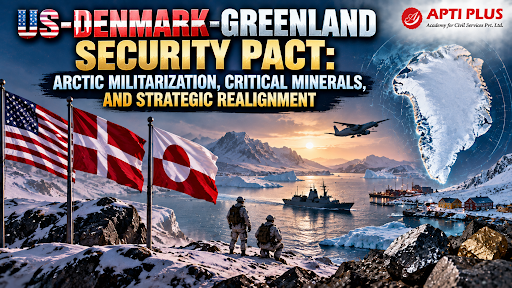
The United States, Denmark, and Greenland signed a trilateral security agreement in New York, modernizing defense arrangements under the 1951 Defense of Greenland Agreement.
Why Did the US, Denmark, and Greenland Sign the 2026 Arctic Security Agreement?
The Pact Updates the Legacy 1951 Defense Framework
Signed by US President Donald Trump, Danish Prime Minister Mette Frederiksen, and Greenland Premier Múte B. Egede, the agreement formally amends the 1951 bilateral defense treaty and the 2004 Igaliku Agreement to address twenty-first-century Arctic security challenges.
Sovereignty Safeguards Eliminate Territorial Controversy
The 2026 accord reaffirms that Greenland remains an autonomous constituent country within the Kingdom of Denmark, possessing full constitutional self-determination under the 2009 Act on Greenland Self-Government.
Military Access Expands Across the High North
The treaty grants US forces modernized access rights for maritime patrols, surveillance radar upgrades, joint air operations, and airfield logistics, reinforcing NATO's defense posture across the North Atlantic.

What Strategic Geopolitical Imperatives Drive the Militarization of the Arctic Region?
Russia Fortifies the Northern Flank
Russia has modernized its Northern Fleet, reopened Soviet-era military outposts across the Arctic littoral, and deployed Bastion-P coastal missile systems alongside nuclear-powered icebreakers.
China Declares a "Polar Silk Road" Presence
Despite lacking Arctic coastlines, China designated itself a "Near-Arctic State" in its 2018 Arctic White Paper, investing in dual-use polar scientific stations, ice-capable merchant fleets, and port infrastructure to secure commercial transit through the Northern Sea Route (NSR).
Pituffik Space Base Anchors Global Ballistic Defense
Located 750 miles north of the Arctic Circle, the Pituffik Space Base (formerly Thule Air Base) hosts the US Space Force, operating solid-state phased-array radars that track intercontinental ballistic missiles (ICBMs) and monitor military satellites traversing polar orbits.
Securing the Strategic GIUK-N Gap
Expanding operational capabilities in Greenland protects the Greenland-Iceland-United Kingdom-Norway (GIUK-N) Gap, an indispensable naval maritime chokepoint through which Russian submarines must transit to access the wider Atlantic Ocean.
How Do Critical Rare Earth Minerals and New Shipping Lanes Reshape Arctic Geopolitics?
Greenland Holds Mineral Reserves
The island possesses deposits of rare earth elements (REEs)—including neodymium, praseodymium, terbium, and dysprosium essential for electric vehicle motors, wind turbines, and guided missiles—at sites like Kvanefjeld (Kuannersuit) and Kringlerne.
Western Powers Seek Alternative Supply Chains
China controls over 70% of global rare earth extraction and 90% of magnet processing; the trilateral pact facilitates bilateral US-Greenland joint ventures to develop processing facilities, blocking state-backed Chinese mining consortiums.
Accelerating Ice Loss Opens Global Maritime Passages
Scientific assessments by the Intergovernmental Panel on Climate Change (IPCC) indicate that the Arctic Ocean is warming at nearly four times the global average, accelerating the seasonal melting of sea ice and opening the Northern Sea Route, which cuts transit distances between Europe and East Asia by 30% to 40% compared to the Suez Canal.
What Strategic and Ecological Stakes Does India Hold in Arctic Governance?
Institutional Presence via Arctic Council Observer Status
India gained permanent Observer status in the Arctic Council in 2013 (reaffirmed in 2019 and 2023), participating in working groups addressing scientific monitoring and environmental protection.
India’s Arctic Policy 2022 Sets the Strategic Blueprint
Titled "India and the Arctic: Building a Partnership for Sustainable Development", the policy rests on six foundational pillars: science and research, climate protection, economic and human development, transportation connectivity, polar governance, and national capacity building.
Scientific Research Polar Footprint
India operates the Himadri Research Station at Ny-Ålesund in Svalbard (established in 2008), deployed the IndARC multi-sensor moored underwater observatory in Kongsfjorden (2014), and manages atmospheric laboratories through the National Centre for Polar and Ocean Research (NCPOR) in Goa.
Monsoon Teleconnections Link Arctic Melt to Food Security:
Atmospheric research by Indian scientists confirms strong climatological teleconnections between Arctic sea-ice loss and the Indian Summer Monsoon (ISMR), where accelerated high-latitude warming alters the mid-latitude jet stream, triggering severe unseasonal droughts and intense western disturbances across peninsular India.
Source: REUTERS
|
PRACTICE QUESTION Q1. With reference to the Arctic region and international legal frameworks, consider the following statements:
Which of the statements given above are correct? (a) 1 and 2 only (b) 2 and 3 only (c) 1 and 3 only (d) 1, 2, and 3 Answer: (a) Explanation: Statement 1 is correct: The Svalbard Treaty of 1920 (Spitsbergen Treaty) recognizes the full sovereignty of Norway over the Svalbard archipelago while stipulating equal rights of commercial access for signatory states and Article 9, which prohibits the establishment of naval bases, fortifications, and the use of the territory for warlike purposes (demilitarized status). Statement 2 is correct: The Pituffik Space Base (formerly Thule Air Base) in northwestern Greenland hosts the 12th Space Warning Squadron of the United States Space Force, operating the Solid State Phased Array Radar System (SSPARS) designed for intercontinental ballistic missile (ICBM) early-warning detection. Statement 3 is incorrect: India is not a voting member of the Arctic Council. Only the eight Arctic littoral states (Canada, Denmark, Finland, Iceland, Norway, Russia, Sweden, and the United States) hold full member status with voting rights. India has held Observer status since 2013, which does not confer decision-making or voting privileges, even after releasing its comprehensive Arctic Policy in 2022. |