Why In News?
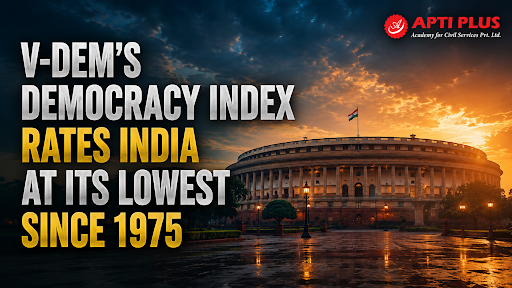
The V-Dem Institute's Democracy Report 2026 ranked India 106th on the Electoral Democracy Index (EDI), marking its lowest score since 1975.
What is V-Dem (Varieties of Democracy)?
The Varieties of Democracy (V-Dem) Institute is an independent research organisation based at the Department of Political Science, University of Gothenburg, Sweden.
-
World’s Largest Democracy Dataset: Gathers and analyzes over 450 distinct democratic indicators across 202 countries, spanning historical data from 1789 to the present.
-
Expert-Coded Methodology: Relies on subjective evaluations provided by thousands of country experts, processed through Bayesian statistical measurement models to estimate latent democratic traits.
-
Multi-Dimensional Conceptual Framework: Rejects the idea of democracy as a simple binary (democracy vs. dictatorship), measuring governance across five comprehensive principles.
Dimensions of Democracy Measured by V-Dem
-
Electoral Democracy Index (EDI): Foundational core of democracy; evaluates whether rulers are chosen through competitive, clean, free, and fair multi-party elections with universal adult franchise, free speech, and freedom of association.
-
Liberal Democracy Index (LDI): Combines the Electoral index with institutional checks and balances, independent judicial review, equality before the law, and strong protection of individual civil liberties against executive overreach.
-
Participatory Democracy Index (PDI): Measures the active participation of citizens beyond voting, including vibrant civil society organisations (CSOs), direct democratic voting, and decentralized local self-governance.
-
Deliberative Democracy Index (DDI): Evaluates whether political decisions are guided by respectful public debate, evidence-based reasoning, and consultative legislative scrutiny rather than authoritarian decrees.
-
Egalitarian Democracy Index (EDI-Eq): Assesses whether political power, constitutional rights, and public welfare resources are distributed equally across diverse social, economic, and religious groups.
Highlights of the V-Dem Democracy Report 2026
The V-Dem Democracy Report 2026, titled "Democracy Report 2026: Unraveling The Democratic Era?", was published by the Varieties of Democracy (V-Dem) Institute at the University of Gothenburg, Sweden.
It highlights that global democracy has regressed to 1978 levels, effectively erasing nearly 50 years of democratic gains.
Key Highlights
-
Autocratisation Wave: A record 41% of the global population (residing in 44 countries) is currently undergoing "autocratisation".
-
Democracies Outnumbered: The report tallies 92 autocracies and 87 democracies globally.
-
Population Breakdown: A staggering 74% of the world's population lives in autocracies, while only 7% live in liberal democracies.
-
Major Regressions:
-
For the first time in 50 years, the United States of America is no longer classified as a liberal democracy.
-
New autocratisers identified include the UK, US, Italy, Croatia, and Slovakia.
-
New democratizers include Botswana, Guatemala, and Mauritius.
-
Primary Targets: Freedom of expression is the hardest hit area (worsening in 44 countries), followed closely by media censorship and repression of civil society.
India-Specific Findings
-
Status Classification: India continues to be classified as an "electoral autocracy", a category V-Dem has assigned to the country since 2017.
-
Index Rankings:
-
Electoral Democracy Index (EDI): India ranks 106th out of 179 countries, scoring 0.38 (its lowest level since the 1975 Emergency).
-
Liberal Democracy Index (LDI): India ranks 105th (down from 100th in the previous assessment).
-
Drivers of Decline: The report cites a systematic dismantling of democratic institutions, steep declines in judicial accountability, weakening autonomy of the Election Management Body (EMB), and targeted restrictions on academic, cultural, and media freedoms.
Indian Counter-Perspective
A research study by the Economic Advisory Council to the Prime Minister (EAC-PM), authored by Sanjeev Sanyal, exposed severe systemic biases in Western perception indices like V-Dem and Freedom House.
-
Opaque Expert Selection: Indices rely on tiny, unaccountable panels of 5 to 10 subjective respondents per country, whose identities remain anonymous.
-
Disregard for Massive Empirical Realities: Ignore the scale of Indian General Elections—conducting peaceful, transparent elections for 968+ million registered voters with a 66%+ voter turnout across 10+ lakh polling booths with 100% VVPAT-backed Electronic Voting Machines.
-
Frequent Peaceful Power Alternation: Ruling parties routinely lose state and parliamentary elections across India, demonstrating robust, functioning multi-party competition.
Source: ANINEWS
|
PRACTICE QUESTION Q. Which of the following is NOT one of the five core high-level principles of democracy evaluated by the V-Dem Institute? (a) Liberal Democracy (b) Participatory Democracy (c) Sovereign Autarkic Democracy (d) Deliberative Democracy Answer: (c) Sovereign Autarkic Democracy Explanation: The five core dimensions measured by V-Dem are Electoral Democracy, Liberal Democracy, Participatory Democracy, Deliberative Democracy, and Egalitarian Democracy. |