Why In News?
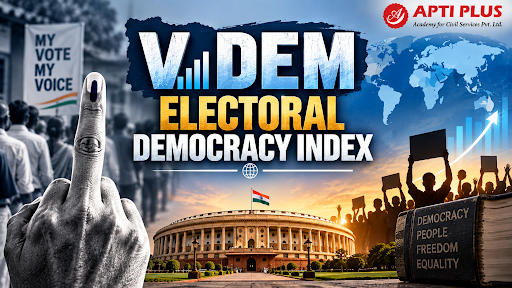
The V-Dem Democracy Report 2026 ranked India 106th out of 179 countries on the Electoral Democracy Index
What is the V-Dem Electoral Democracy Index?
It is published by the Varieties of Democracy (V-Dem) Institute that measures how closely countries achieve free, fair, and meaningful elections along with basic political freedoms.
-
Framework: Measures electoral democracy through suffrage breadth, clean elections, freedom of expression, and associational freedom.
-
Five Core Democracy Principles: Forms the foundation for high-level indices: Electoral, Liberal, Participatory, Deliberative, and Egalitarian.
-
Four-Tier Regime Classification: Categorizes nations into Liberal Democracy, Electoral Democracy, Electoral Autocracy, and Closed Autocracy.
Key Findings of the Democracy Report 2026
-
India's Relative Stagnation: Ranks 106th among 179 surveyed nations on the Electoral Democracy Index, registering a composite score of 0.38.
-
Electoral Autocracy Designation: Alleges multiparty elections exist alongside severe curbs on independent media, political dissent, and civil liberties.
-
Global Autocratization Wave: Reports that 72% of the world's population currently resides under electoral or closed autocratic regimes.
-
Top Global Performers: Nordic nations Denmark, Sweden, and Norway continue to occupy top ranks across all electoral and liberal governance tiers.
India’s Response
Economic Advisory Council to the Prime Minister (EAC-PM) criticized Methodological Flaws in Perception-Based Indices
-
Subjective Expert Bias: Relies on subjective qualitative scoring from 3 to 5 anonymous academic respondents per country rather than verifiable facts.
-
Disregard of Objective Metrics: Ignores objective electoral indicators like voter turnout rates, voter roll inclusivity, and non-violent regime transitions.
-
Western Liberal Cultural Bias: Imposes uniform Anglo-Saxon institutional models, penalizing large developing democracies managing complex social diversities.
-
Circular Citation Echo Chamber: Credit rating agencies and the World Bank borrow perception scores from V-Dem and Freedom House, distorting sovereign borrowing costs.
-
Skewed Question Formulation: Frames survey questionnaires in vague, opinionated terminology that forces subjective ideological judgments over empirical facts.
Source: thehindu
|
PRACTICE QUESTION Q. With reference to the 'Varieties of Democracy' (V-Dem) Institute and its democracy indices, consider the following statements: 1. The V-Dem Institute is an intergovernmental agency functioning under the direct administrative control of the United Nations General Assembly. 2. The Electoral Democracy Index (EDI) is rooted conceptually in Robert Dahl's institutional requirements for a polyarchy. 3. V-Dem classifies world regimes into four categories: Liberal Democracy, Electoral Democracy, Electoral Autocracy, and Closed Autocracy. Which of the statements given above are correct? (a) 1 and 2 only (b) 2 and 3 only (c) 1 and 3 only (d) 1, 2, and 3 Answer: (b) 2 and 3 only Explanation: Statement 1 is incorrect: The V-Dem Institute (Varieties of Democracy) is an independent research institute based at the Department of Political Science at the University of Gothenburg in Sweden. It is not an intergovernmental agency, nor does it function under the administrative control of the United Nations General Assembly. Statement 2 is correct: The Electoral Democracy Index (EDI), often referred to as the Polyarchy Index, is directly grounded in political theorist Robert Dahl's conceptual framework of "polyarchy". It measures the core institutional requirements needed for electoral democracy, such as freedom of expression, freedom of association, universal suffrage, and clean, competitive elections. Statement 3 is correct: Through its Regimes of the World (RoW) typology, V-Dem classifies political systems into four distinct categories:
|