Why In News?
The Archaeological Survey of India (ASI) plans to redevelop Ujjain's Vaishya Tekri as a Buddhist heritage site on the lines of Sanchi.
What Is Vaishya Tekri?
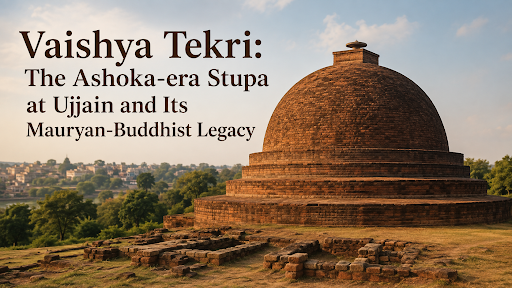
Vaishya Tekri is an ancient archaeological mound located near Kanipura village on the Maksi-Ujjain road, about 5–7 km from Ujjain city centre.
It is a large circular mound surrounded by a rectangular depression, believed to conceal the remains of a major Buddhist stupa.
The site sits within a Mauryan-era cultural landscape, linked historically to Ujjain's role as a Mauryan provincial capital.
It is a confirmed Buddhist archaeological site: the 1938–39 excavation exposed portions of the main stupa and two smaller stupas.
Much of the mound remains unexplored, as the earlier dig was halted after a gas leak left several labourers unconscious.
What Is a Stupa?
A stupa is a Buddhist religious monument, built as a relic repository to house sacred remains of the Buddha or Buddhist saints.
It functions as a symbol of the Buddha's teachings (Dhamma) and a site of devotion and circumambulation.
A classical stupa is a hemispherical structure (the dome, or "anda"), topped by a harmika (a small railed platform).
Above the harmika rises the chatra, an umbrella-like finial symbolising spiritual sovereignty.
Devotees circle the stupa along the pradakshina patha, the circumambulatory path around its base.

Historical Significance of the Ujjain Stupa
The stupa is tentatively dated to the 3rd century BCE, the Mauryan period.
It is traditionally associated with Emperor Ashoka, said to have been built or expanded during his time as governor of Ujjain, before he became emperor.
Buddhist chronicles, the Mahavamsa and Dipavamsa, record that Ashoka married Devi at Ujjain, and tradition links the stupa to her Buddhist devotion.
Bricks recovered from the site show both pre-Mauryan and Mauryan construction phases, indicating renovation and expansion under Ashoka, followed by further additions in the Shunga and Satavahana periods.
The site demonstrates the early expansion of Buddhism into Central India, beyond the Gangetic heartland.
It reinforces Ujjain's place within the wider Mauryan administrative and Buddhist cultural network.
Why Was Ujjain Important in Ancient India?
Ujjain (ancient Ujjayini) was the capital of the Avanti Mahajanapada, one of the 16 great kingdoms of ancient India.
It functioned as a major urban and commercial centre, sitting on key trade routes linking north and south India.
Its strategic location made it a Mauryan administrative and provincial headquarters, governed at one point by prince Ashoka himself.
As a nodal point on trade routes, Ujjain became naturally linked to expanding Buddhist religious and monastic networks.
Ashoka's Role in the Spread of Buddhism
Ashoka gave direct royal patronage to Buddhism after the Kalinga War, reshaping his rule around the principle of Dhamma (moral governance).
He is credited with constructing numerous stupas across the empire, including at Sanchi, Sarnath, and reportedly Ujjain.
His Rock and Pillar Edicts, inscribed across the subcontinent, publicised his Dhamma policy to ordinary subjects.
Ashoka's Dhamma policy emphasised non-violence, tolerance, and welfare, projected through public monuments and inscriptions.
He sent Buddhist missions beyond India, notably to Sri Lanka, extending Buddhism's reach outside the subcontinent.
Source: INDIANEXPRESS
|
PRACTICE QUESTION Q. With reference to a Buddhist stupa, the "Harmika" refers to: (a) The umbrella-like finial atop the dome (b) The railed platform above the dome, symbolising the sacred enclosure (c) The circumambulatory path around the base (d) The relic chamber inside the dome Answer: (b) The "Harmika" in a Buddhist stupa refers to option (b): the railed platform above the dome, symbolizing the sacred enclosure. |