Why In News?
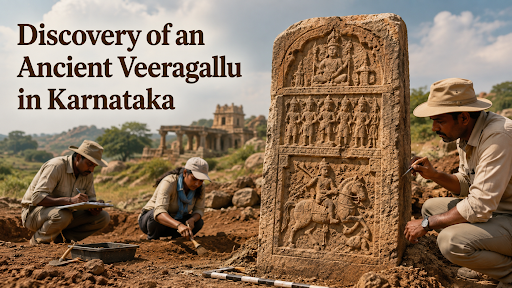
Residents of Neeragunda village, Karnataka, unearthed a 12th-century Veeragallu during temple restoration.
What is Veeragallu (Hero Stone)?
A Hero Stone — called Veeragallu in Kannada, Nandikal across Tamil Nadu, and "Hero Stone" in South Indian historiography — is a carved memorial stone slab erected to honour warriors, chieftains, or common heroes who died in battle, protecting cattle, defending women, or defending their kingdom
Origins: Trace to the Iron Age and Sangam period (c. 3rd century BCE), beginning as simple megalithic menhirs before evolving into finely sculpted panels across Karnataka, Tamil Nadu, Andhra Pradesh, and Maharashtra.
Reached artistic and epigraphical maturity under major dynasties — Chalukyas, Rashtrakutas, Gangas, Kadambas, and Hoysalas — between the 5th and 14th CE.
Historian Upinder Singh, in A History of Ancient and Early Medieval India, records that at least 2,650 Veeragallus dating from the 5th to 13th century have been found in Karnataka alone— largely due to easy availability of rock in these regions.
Key Features — Three-Tiered Narrative
-
Bottom Panel: Depicts the earth-bound event — battle scene, cattle raid, or the incident causing the hero's death.
-
Middle Panel: Shows apsaras (celestial nymphs) carrying the slain hero's soul upward to heaven, reflecting belief in salvation through valorous death.
-
Top Panel: Depicts the hero seated in reverence before a deity — commonly a Shiva Linga or Vishnu — completing the narrative arc from death to divine union.
Symbolic Elements
Inscriptions: Carry detailed Old Kannada or Vatteluttu script along the base, recording the hero's lineage, the conflict, the ruling monarch, and the precise calendar date — making these stones datable primary sources, unlike most sculptures.
Achandrarkam Symbolism: Sun and Moon motifs at the apex signify that the hero's glory shall last as long as the sun and moon exist — a recurring medieval South Indian epigraphic formula.
Cause-of-Death Categories:
-
Gograhana — died defending cattle from raiders.
-
Turugol — died rescuing stolen livestock.
-
Penbuyyal — died protecting village women.
Architectural Placement: Erected at village borders, sacred groves, tank bunds, or temple precincts, chosen deliberately so the community could offer annual homage — showing hero stones functioned as living sites of local memory, not just static monuments.
Significance of the Neeragunda Find
Resolves Hoysala Chronology: The inscription fixes King Vishnuvardhana's death to 11 December 1141, settling a long-standing scholarly debate on Hoysala dynastic dating.
Reveals the Garuda Tradition: The find highlights how royal bodyguards (Garudas) ritually sacrificed themselves after the king's death, evidencing an extreme form of feudal loyalty unique to Hoysala court culture.
Significance
-
Warfare Study: Panels detail sword fighting, spear-hurling, and elephant deployment in actual medieval combat.
-
Social Customs: Sati-depicting stones give dated physical evidence of practices otherwise known mainly from texts.
-
Religious Beliefs: The apsara-heaven motif shows how martyrdom was sacralised in medieval Deccan society.
-
Political & Administrative History: Precise inscriptions fix ruler chronology and record local tax and village data.
-
Linguistic Evidence: Old Kannada/Vatteluttu inscriptions trace the evolution of South Indian scripts.
Source: THEHINDU
|
PRACTICE QUESTION Q. With reference to Hero Stones (Veeragallu), consider the following statements:
Which of the statements given above is/are correct? (a) 1 and 2 only (b) 2 and 3 only (c) 1 and 3 only (d) 1, 2 and 3 Answer: (b) Explanation: Statement 1 is incorrect: Hero stones are not found only in Karnataka. Although Karnataka has the largest concentration of them, they are also widely found in Tamil Nadu (where they are called Naṭukal), Andhra Pradesh, Maharashtra, Goa, and other parts of India. Statement 2 is correct: The tradition and custom of erecting memorial hero stones date back to the Iron Age and are extensively documented in ancient Sangam literature. Statement 3 is correct: Sculptural panels on hero stones are typically divided into tiers; the middle tier frequently depicts the fallen hero being carried to heaven or the abode of the gods by celestial nymphs or maidens (apsaras). |