Why In News?
The Ministry of Road Transport and Highways (MoRTH) issued a draft notification to make Vehicle-to-Vehicle (V2V) safety communication systems mandatory for all new vehicles manufactured from October 1, 2028.
What is Vehicle-to-Vehicle (V2V) Technology?
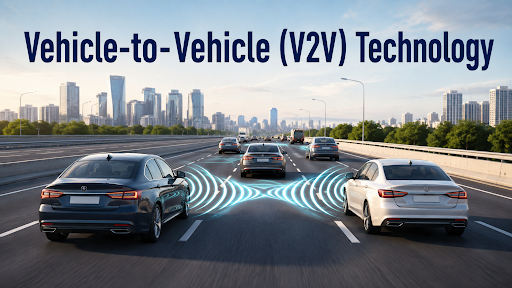
It is an advanced wireless communication framework that enables nearby motor vehicles to continuously broadcast and receive real-time data regarding their speed, location, direction, acceleration, and braking status.
As a core component of the Intelligent Transportation Systems (ITS) framework, it uses a peer-to-peer mesh network to create an expansive, connected vehicle ecosystem aimed at preventing road accidents.
Working Mechanism: Compliant vehicles utilize factory-fitted On-Board Units (OBUs), which contain direct communication radios (C-V2X), Global Navigation Satellite System (GNSS) receivers, and on-board processors.
Real-Time Data Exchange: Vehicles periodically broadcast small packets of low-latency data (at a rate up to 10–25 Hz). These packets carry parameters including:
-
Vehicle speed, acceleration, and deceleration status
-
Real-time GPS coordinates and direction of travel
-
Braking status and lane-change maneuvers
Operating Range: It functions via direct short-range communication up to approximately 300 metres with millisecond-level latency, working independently of cellular mobile networks.
Significance
Mitigating High Road Fatalities: India accounts for about 11% of global road deaths despite having only 1% of the world’s vehicles. V2V directly addresses the 78% of accidents caused by human error by giving drivers proactive warnings.
Overcoming Line-of-Sight Limitations: Unlike cameras or Radar/LiDAR sensors in current Advanced Driver Assistance Systems (ADAS) that require a direct line of sight, V2V can detect threats around blind corners, over crests, or through heavy fog and monsoon downpours.
Traffic Optimization & Platooning: Real-time speed coordination allows for "platooning" (vehicles driving close together safely at constant speeds), which reduces aerodynamic drag, optimizes fuel consumption, and cuts urban traffic congestion.
Source: business-standard
PRACTICE QUESTIONQ. With reference to Vehicle-to-Vehicle (V2V) communication technology, consider the following statements:
Which of the statements given above are correct? (a) 1 and 2 only (b) 2 and 3 only (c) 1 and 3 only (d) 1, 2 and 3 Answer: c Explanation: Statement 1 is correct: V2V (Vehicle-to-Vehicle) is a direct sub-category of the broader Vehicle-to-Everything (V2X) architecture, which also includes V2I (Vehicle-to-Infrastructure) and V2P (Vehicle-to-Pedestrian). Statement 2 is incorrect: V2V functions via direct peer-to-peer transmissions (using dedicated spectrum bands like 5.9 GHz) without needing a cellular network subscription or routing data through telecom towers. Statement 3 is correct: Radio frequency signals broadcasted by nearby vehicles pass through or bend around obstacles, enabling non-line-of-sight (NLOS) warnings for hidden hazards and blind curves. |