Why In News?
A study in the Journal of Threatened Taxa revealed that relocating a livestock carcass dump 2.4 km away from high-tension power lines in Dehradun eliminated vulture electrocutions.
What are Vultures?
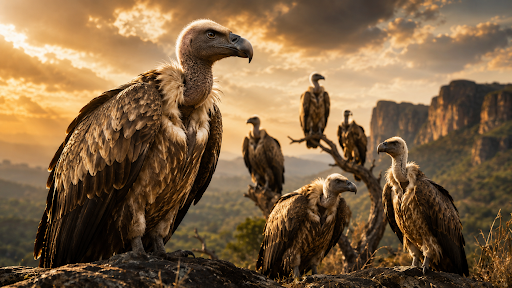
Vultures are obligate scavengers (nature's primary waste managers and sanitation workers). They play a vital role in balancing ecosystems:
-
Diet: Scavenges on carrion (dead flesh) rather than hunting live prey.
-
Appearance: Known for a bare, featherless head and neck, which helps keep them clean while feeding.
-
Types: Divided into Old World vultures (found in Europe, Africa, and Asia) and New World vultures (found in the Americas).
Vulture Diversity in India
Out of 23 global species, 9 vulture species are found in India.
|
Vulture Species |
IUCN Status |
Key Characteristics & Notes |
|
White-rumped Vulture (Gyps bengalensis) |
Critically Endangered |
Dark body with a prominent white rump patch. Suffered the steepest historic decline. |
|
Indian Vulture / Long-billed (Gyps indicus) |
Critically Endangered |
Native to India, Pakistan, and Nepal. Nests securely on cliffs. |
|
Slender-billed Vulture (Gyps tenuirostris) |
Critically Endangered |
Narrow neck and long bill. Prefers forested river valleys; breeds mostly in Upper Assam. |
|
Red-headed / King Vulture (Sarcogyps calvus) |
Critically Endangered |
Distinctive bald red head. Solitary feeder inhabiting open forests and scrublands. |
|
Egyptian Vulture (Neophron percnopterus) |
Endangered |
Smallest vulture in India. Yellow face and white plumage; uniquely uses tools (rocks) to crack eggs. |
|
Himalayan Griffon (Gyps himalayensis) |
Near Threatened |
Large, high-altitude resident of the Himalayas. First successful captive breeding occurred at Guwahati Zoo. |
|
Cinereous Vulture (Aegypius monachus) |
Near Threatened |
One of the heaviest Old World vultures. Winter migrant to India, commonly spotted at Jorbeer, Rajasthan. |
|
Bearded Vulture / Lammergeier |
Near Threatened |
Specialised bone-eating bird that drops bones from heights to crack them open. |
|
Eurasian Griffon (Gyps fulvus) |
Least Concern |
Migratory winter visitor to northern and north-western India. |
Legal Protection: All 9 species are protected under Schedule I of the Wildlife (Protection) Act, 1972, granting them the highest level of legal security in India.
Why are Vultures Ecologically Important?
-
Rapid Carcass Disposal: A flock of Gyps vultures cleans an entire adult cattle carcass in under 40 minutes, minimizing biological hazard exposure.
-
Zoonotic Disease Regulation: Suppresses feral dog populations, checking fatal rabies transmission and anthrax spore contamination across rural villages.
-
Nutrient Cycling Acceleration: Metabolizes bone minerals and animal proteins, returning vital nitrogen, phosphorus, and calcium into terrestrial food chains.
-
Zero-Carbon Municipal Sanitation: Delivers free biological waste processing, eliminating crores of rupees in fuel and incinerator infrastructure costs.
Why Vultures Populations are Declining
-
Veterinary Diclofenac Toxicity: Widespread agricultural use of diclofenac, a non-steroidal anti-inflammatory drug (NSAID) in cattle, caused catastrophic vulture deaths.
-
Catastrophic Population Collapse: India suffered over a 99% collapse in resident Gyps vulture populations between 1992 and 2007.
-
Fatal Visceral Gout Pathology: Ingesting treated cattle carcasses triggers acute renal failure and massive uric acid crystallization across internal visceral organs.
-
Lethal Carcass Contamination Data: Government-supported veterinary surveys detected diclofenac residues in 10% of surveyed livestock carcasses, with 4% carrying fatal doses.
Source: THEHINDU
|
PRACTICE QUESTION Q. With reference to vulture conservation in India, consider the following statements: 1. Diclofenac causes acute renal failure and visceral gout in Gyps vultures due to their inability to metabolize the drug. 2. Meloxicam and Tolfenamic acid are scientifically approved as safe veterinary alternatives to toxic NSAIDs. 3. India's resident Gyps vultures are categorized as Least Concern under the IUCN Red List. Which of the statements given above are correct? (a) 1 and 2 only (b) 2 and 3 only (c) 1 and 3 only (d) 1, 2, and 3 Answer: (a) 1 and 2 only Explanation: Statement 1 is correct: Vultures lack the specific functional enzyme needed to break down and metabolize the veterinary Non-Steroidal Anti-Inflammatory Drug (NSAID) Diclofenac. When they scavenge carcasses treated with the drug, it causes acute renal (kidney) failure and visceral gout (accumulation of uric acid crystals on internal organs), leading to death. Statement 2 is correct: Systematic scientific testing and clinical evaluations conducted by bodies like the Indian Veterinary Research Institute (IVRI) and the Bombay Natural History Society (BNHS) have officially approved Meloxicam and Tolfenamic acid as safe veterinary alternatives. Unlike toxic drugs, these do not cause fatal uric acid spikes or kidney issues in wild or captive vultures. Statement 3 is incorrect: India's resident Gyps vulture species—the Oriental White-backed Vulture (Gyps bengalensis), the Long-billed/Indian Vulture (Gyps indicus), and the Slender-billed Vulture (Gyps tenuirostris)—are categorized as Critically Endangered, not Least Concern, on the IUCN Red List due to catastrophic population crashes. |