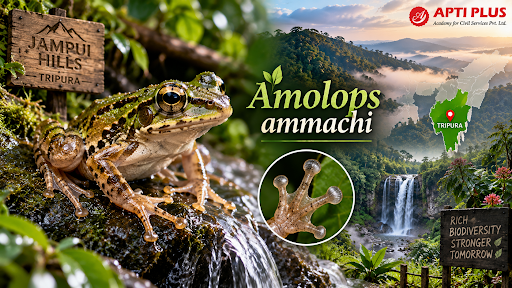
Why In News?
Scientists discovered Amolops ammachi, a new cascade frog species in Tripura's Jampui Hills.
What is Amolops ammachi?
-
It is a newly discovered species of torrent frog that lives exclusively in fast-flowing mountain streams and cascades.
-
Belongs scientifically to the genus Amolops within the ranid family, specialized for steep freshwater torrent habitats.
-
Found inhabiting the moist tropical evergreen forest streams of the Jampui Hills along the Tripura-Mizoram border.
-
The scientific name honors the late Kerala social worker Padmini Varkey, affectionately called 'Ammachi'.
Characteristics of Amolops ammachi
-
Tadpole Suction Discs: Larvae possess abdominal suctorial discs to anchor onto rocks in fast-flowing currents.
-
Adult Toe Pads: Expanded adhesive pads on digits enable adult frogs to grip wet, slippery boulders.
-
Webbed Hind Feet: Fully webbed feet facilitate strong propulsion through violent torrents.
-
Cryptic Camouflage: Mottled olive-green and brown skin blends seamlessly into moss-covered rocks.
-
Hydrodynamic Body: Streamlined, flattened body shape minimizes water resistance against heavy flows.
-
Rheophilic Stream Dependency: Strictly reliant on oxygen-rich, fast-moving mountain cascades in shaded forests.

Who are Amphibians?
-
Dual-Life Vertebrates: Cold-blooded animals (like frogs) with aquatic larval stages and terrestrial adult lives.
-
Permeable Skin: Breathe and drink through thin, moist skin instead of relying solely on lungs.
-
Three Orders: Classified into Anura (frogs/toads), Caudata (salamanders/newts), and Gymnophiona (caecilians).
-
Metamorphosis: Develop from aquatic, jelly-like eggs/tadpoles into air-breathing adults.
-
Evolutionary Pioneers: Early vertebrates that transitioned from oceans to land 370 million years ago.
Why are Amphibians Important?
-
Living Ecological Health Barometers: Highly porous skin absorbs toxins, serving as early warning signs of chemical pollution.
-
Natural Biological Pest Controllers: Control agricultural and household pests by consuming large quantities of insects.
-
Vital Food Chain Connectors: Serve as essential energy bridges between aquatic and terrestrial food webs.
-
Aquatic Stream Algae Cleaners: Tadpoles maintain water clarity and oxygen levels by consuming algae and detritus.
-
Biomedical Drug Discoveries: Skin secretions provide compounds for new antibiotic and pain-relief research.
-
Nutrient Cycling in Forests: Facilitate essential mineral transfer between aquatic and forest environments.
Source: DOWNTOEARTH
|
PRACTICE QUESTION Q. Which of the following physical adaptations is characteristic of cascade frogs belonging to the genus 'Amolops'? (a) Large vocal sacs for desert communication (b) Specialized abdominal sucker discs on tadpoles to anchor onto rocks in fast currents (c) Salt-excreting glands on skin for marine survival (d) Spatulate digging claws on front limbs for subterranean burrowing Answer: (b) Explanation: Cascade frogs of the genus Amolops have evolved specialized abdominal sucker discs on their tadpoles, enabling them to anchor onto slippery rocks and thrive in the fast-flowing mountain streams where they reside. |