Why In News?
Ophiopogon japonicus has been documented in the wild in India for the first time in West Kameng, Arunachal Pradesh.
What is Ophiopogon japonicus?
Ophiopogon japonicus is a monocotyledonous herb placed within the family Asparagaceae (subfamily Nolinoideae), having historically been classified under the lily family (Liliaceae).
Popularly known as dwarf lilyturf, mondo grass, or fountain plant, it is an evergreen perennial that forms low, dense mats spreading via subterranean stolons and slender rhizomes.
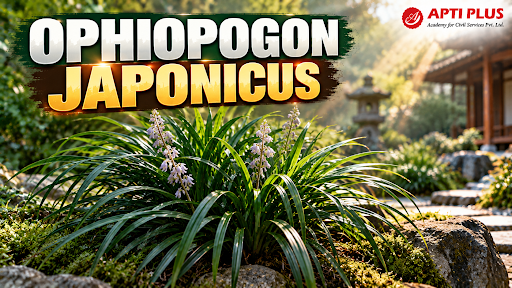
Morphological Characteristics: Features arching, narrow, linear grass-like leaves (15–30 cm long) with distinctive retro-serrulate (backwardly serrated) margins and a lustrous dark green texture.
Floral Architecture and Cobalt-Blue Seeds: Produces short, nodding racemes with small white-to-pale-purple flowers that develop into pea-sized, metallic bright blue, berry-like fleshy seeds.
Tuberous Medicinal Root System: Subterranean roots develop swollen tuberous sections rich in water and secondary metabolites, renowned in East Asian pharmacopeias as "Ophiopogonis Radix" or "Maidong".
Habitat
-
Native East Asian Biome: Indigenous to temperate and subtropical montane regions across China, Japan, and the Korean Peninsula, extending into northern Vietnam and Nepal.
-
Broad Altitudinal Tolerance: Demonstrates wide ecological plasticity, growing from low montane valleys at 200 metres up to sub-alpine altitudes of 2,800 metres.
-
Humid Microclimate: Requires cool, moist, well-shaded habitats, growing in humus-rich, acidic-to-neutral forest soils along riverbanks, ravines, and moist slopes.
Medicinal Properties
-
Traditional Chinese Medicine (TCM): Known as Maidong, its dried tuberous roots have been prescribed for centuries to nourish Yin, moisten the lungs, and clear heart heat.
-
High Concentration of Steroidal Saponins: Contains specialized secondary metabolites, including ophiopogonins (A, B, C, D) and ruscogenin, responsible for its pharmacological activities.
-
Cardioprotective and Anti-Ischemic Properties: Modern clinical studies indicate that ophiopogonin extracts help reduce myocardial infarction damage, regulate cardiac arrhythmias, and enhance coronary circulation.
-
Anti-Inflammatory and Antioxidant Mechanisms: Bioactive polysaccharides and flavonoids from the rhizomes scavenge free radicals and downregulate pro-inflammatory cytokines.
-
Respiratory and Immunomodulatory Therapeutics: Used clinically to soothe chronic dry coughs, protect mucosal barriers, and stimulate macrophage immune defense.
Ecological Role
-
Slope Stabilization and Soil Conservation: The fibrous, stoloniferous root matrix binds loose topsoil on steep Himalayan slopes, mitigating soil erosion from monsoon runoff.
-
Micro-Habitat Moisture Retention: Forms dense vegetative cover that buffers ground temperatures, maintains soil humidity, and provides shelter for soil invertebrates.
Source: TIMESOFINDIA
|
PRACTICE QUESTION Q. With reference to the botanical species Ophiopogon japonicus, recently recorded in India, consider the following statements: 1. It is an evergreen perennial herb belonging to the family Asparagaceae. 2. In India, it was documented for the first time in the wild in the state of Arunachal Pradesh. 3. Its tuberous roots are widely known in Traditional Chinese Medicine as "Maidong" for their therapeutic and cardioprotective properties. 4. It produces bright yellow, winged capsules adapted exclusively for wind dispersal. Which of the statements given above are correct? A) 1, 2, and 3 only B) 2 and 4 only C) 1 and 3 only D) 1, 2, 3, and 4 Answer: A Explanation: Statements 1, 2, and 3 are correct: Ophiopogon japonicus (dwarf lilyturf) is an evergreen perennial of the Asparagaceae family (Statement 1). It was documented in the wild in India for the first time in West Kameng district, Arunachal Pradesh, by researchers from WII and Uluberia Herbarium (Statement 2). Its dried tuberous roots, known as Maidong or Ophiopogonis Radix, have documented use in East Asian traditional medicine for respiratory and cardiac conditions (Statement 3). Statement 4 is incorrect: It produces small, bell-shaped white-to-lilac flowers that develop into pea-sized, metallic bright blue, berry-like fleshy seeds—not yellow winged capsules. |