Why In News?
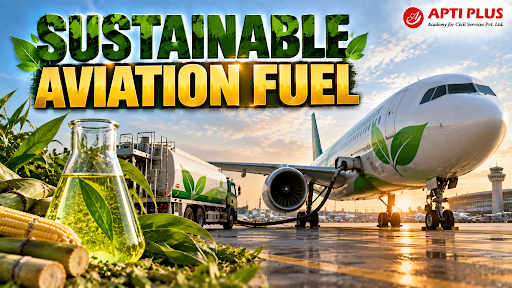
Akasa Air and Bharat Petroleum Corporation Limited (BPCL) have operated a commercial flight powered by a 1% Sustainable Aviation Fuel blend.
What is Sustainable Aviation Fuel?
Non-Fossil Alternative Jet Fuel: Sustainable Aviation Fuel (SAF) is a liquid hydrocarbon fuel produced from renewable, bio-based, or synthetic waste feedstocks rather than conventional unrefined petroleum crude.
Carbon Footprint Reduction: Depending on the feedstock and refining pathway, SAF can reduce net greenhouse gas (GHG) emissions by up to 80% compared to conventional fossil-derived Aviation Turbine Fuel (ATF) on a full life-cycle basis.
Utilization of Waste and Circular Feedstocks: Refined from non-food biological resources—such as used cooking oil (UCO), agricultural stubble, forestry trimmings, municipal waste, and captured carbon dioxide.
Certified Drop-In Fuel Compatibility: Chemically engineered to match the energy density, flash point, and freeze point of Jet A/A-1 fuel, requiring zero modifications to existing aircraft jet engines, fueling systems, or airport pipelines.

What are the Major Sources of SAF?
Used Cooking Oil (UCO) and Animal Fats: Processed via Hydroprocessed Esters and Fatty Acids (HEFA), this constitutes over 90% of commercially available global SAF today due to mature refining kinetics.
Agricultural Crop Residues and Bagasse: Surplus paddy stubble, wheat straw, and sugarcane bagasse converted into synthetic gas or alcohols (Alcohol-to-Jet pathway), preventing open farm stubble burning.
Municipal Solid Waste (MSW) and Industrial Off-Gases: Sorting organic household waste and recycling industrial carbon emissions into synthesis gas via the Fischer-Tropsch (FT) processing route.
Forestry Residues and Dedicated Energy Crops: Wood residues, saw-mill shavings, and hardy non-food plants grown on degraded wastelands (such as Jatropha or Camelina) that do not compete with food crops.
Synthetic E-Kerosene (Power-to-Liquid / PtL): Synthesized by combining green hydrogen (produced via water electrolysis using renewable electricity) with captured carbon dioxide from industrial chimneys or direct air capture (DAC).
What are the Advantages of SAF?
Life-Cycle Emission Reductions: Because biomass absorbs atmospheric carbon dioxide during its growth phase, burning SAF recycled from biomass releases predominantly biogenic carbon back into the atmosphere.
No Fleet or Infrastructure Replacements: Operates seamlessly within existing airport hydrants, distribution tankers, fuel farms, and turbofan engines without costly airline capital expenditure.
Economic Valorisation of Agricultural Wastes: Creates a new revenue stream for farmers by incentivizing the collection and sale of crop stubble, helping curb seasonal air pollution.
Exploitation of India’s Abundant Domestic Biomass: Capitalizes on India’s agrarian base, which produces over 500 million tonnes of agricultural residue annually, to build an indigenous refining industry.
Cleaner Combustion with Lower Particulates: SAF contains virtually no sulphur compounds and lower aromatic content than fossil ATF, reducing ground-level sulfur dioxide pollution and high-altitude contrail formation.
What are the Challenges?
Prohibitive Cost and the 'Green Premium': SAF currently costs two to four times more to produce than conventional fossil ATF, imposing a heavy economic burden on airlines operating in price-sensitive markets.
Severe Global and Domestic Supply Deficits: Global SAF production accounts for less than 0.5% of total aviation fuel demand, leaving airlines unable to secure long-term off-take volumes.
Fragmented Biomass Supply Chains: Aggregating bulky agricultural residue across millions of smallholder farms involves complex logistics, transportation costs, and seasonal storage constraints.
Complex Technical Certification Hurdles: Gaining ASTM approval and international sustainability certification (such as ISCC or RSB) requires extensive lab testing and regulatory verification.
Inter-Sectoral Competition for Biomass: Other decarbonisation programs—such as Compressed Bio-Gas (CBG) under SATAT and 2G Ethanol blending—compete for the same agricultural feedstocks.
What is India’s SAF Potential?
Immense Surplus Agricultural Biomass: India generates an estimated 150–200 million tonnes of surplus biomass each year, enough to support domestic SAF blending targets if aggregated efficiently.
Rapidly Expanding Civil Aviation Fleet: Indian carriers have placed aircraft orders exceeding 1,200 jets, positioning India as a strategic growth market for green aviation fuel.
World-Class Refining and Petrochemical Infrastructure: State-owned and private refiners (such as BPCL, IOCL, and MRPL) possess the hydroprocessing and chemical engineering capacity to repurpose refineries for SAF production.
Synergies with the National Biofuel Ecosystem: Leverage institutional expertise gained from the Ethanol Blended Petrol (EBP) program to build collection networks for Used Cooking Oil and biomass.
Expansion of Low-Cost Renewable Power: India's aggressive buildout of solar and wind capacity provides a base for future production of green hydrogen and synthetic Power-to-Liquid (PtL) fuels.
Way Forward
Setting Phased Domestic SAF Blending Mandates: Implement the Ministry of Petroleum and Natural Gas roadmap mandating indicative blending targets (e.g., 1% in 2027, scaling to 2% in 2028 for international flights).
-
Example: National Biofuel Coordination Committee (NBCC) SAF Roadmap, establishing phased blending targets for domestic and international civil aviation.
Developing Structured Supply Chains for Used Cooking Oil (UCO): Enforce traceable collection of discarded cooking oil from restaurants and food processors to prevent illegal reuse and guarantee SAF feedstocks.
-
Example: FSSAI's RUCO (Repurpose Used Cooking Oil) Initiative, regulating the collection and diversion of used cooking oil into certified biodiesel and biokerosene refiners.
Offering Financial Viability Gap Funding (VGF) for 2G SAF Refineries: Provide fiscal incentives, capital subsidies, and production-linked incentives (PLI) to bridge the cost difference between fossil ATF and green fuels.
-
Example: Pradhan Mantri JI-VAN (Jaiv Indhan-Vatavaran Anukool fasal awashesh Nivaran) Yojana, extending viability gap support to second-generation bio-refinery plants.
Forming Public-Private Airline and Refiner Off-Take Pacts: Establish multi-year off-take agreements between commercial airlines and state-owned oil marketing companies to de-risk refinery investments.
-
Example: Akasa Air and BPCL Commercial SAF Collaboration, operationalizing commercial flights using certified domestic SAF blends.
Harmonizing National Testing with International CORSIA Frameworks: Align Bureau of Indian Standards (BIS) fuel specifications with ICAO and ASTM international certifications to allow Indian airlines to claim CORSIA credits.
-
Example: Directorate General of Civil Aviation (DGCA) Environmental Guidelines, aligning national airlines with global carbon reporting and CORSIA compliance structures.
Conclusion
By utilizing its surplus agricultural biomass to produce Sustainable Aviation Fuel, India can establish a competitive, infrastructure-ready ecosystem that decarbonizes civil aviation, boosts rural economies, and meets global climate targets.
Source: ECONOMICTIMES
|
PRACTICE QUESTION Q. The 'CORSIA' mechanism, often seen in news related to international environmental governance, is administered by which of the following organizations? A) United Nations Environment Programme (UNEP) B) International Civil Aviation Organization (ICAO) C) International Maritime Organization (IMO) D) United Nations Framework Convention on Climate Change (UNFCCC) Answer: B Explanation: - CORSIA (Carbon Offsetting and Reduction Scheme for International Aviation) is a global market-based measure adopted by the International Civil Aviation Organization (ICAO) to address carbon dioxide emissions from international civil flights. |