Why In News?
At the BRICS Summit, Prime Minister Narendra Modi warned against the weaponisation of technology and critical mineral supply chains.
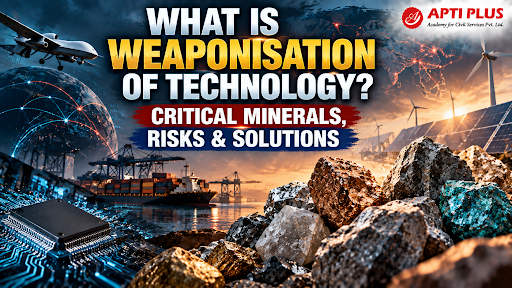
What is Weaponisation of Technology?
Weaponisation of technology refers to the strategic manipulation of technological dependence by dominant states to achieve geopolitical, economic, or military leverage. It transforms innovation into an instrument of coercion and control in the global order.
Leveraging Technological Dependence
-
Powerful nations exploit monopolies in critical technologies (AI, semiconductors, 5G, quantum computing) and intellectual property regimes to influence dependent economies.
-
Example: Restrictions on advanced chip exports to curb rival technological rise.
Denial Regimes & Export Licensing Curbs
-
Use of unilateral export controls, entity blacklists, and sanctions to deny access to cutting‑edge tech.
-
Seen in U.S. export bans on high‑end processors and lithography equipment.
Exploitation of Global Network Chokepoints
-
Based on the theory of “weaponised interdependence” — control over centralized global hubs (e.g., SWIFT, semiconductor design software, operating systems) enables surveillance and denial.
Constraining Sovereign Industrial Capabilities
-
Restricting dual‑use technologies hampers economic modernization, telecom upgrades, and industrial competitiveness of target nations.
Compromising Defence Autonomy
-
Dependence on imported defence microchips, sensors, and encryption processors creates vulnerabilities in wartime operations.
What are Critical Minerals?
Critical minerals are metallic and non‑metallic elements essential for advanced manufacturing, clean energy transition, and national security, yet lack easy substitutes and are vulnerable to supply disruptions. They form the strategic backbone of the Fourth Industrial Revolution.
Essential Building Blocks
-
Enable technologies like EV batteries, semiconductors, solar panels, and defence systems.
-
Represent the intersection of economic resilience and technological sovereignty.
Key Mineral Spectrum
-
Includes lithium, cobalt, nickel, graphite, silicon, titanium, and 17 Rare Earth Elements (REEs) such as neodymium, dysprosium, terbium.
-
Each plays a unique role in energy storage, electronics, and precision engineering.
Clean Energy & Net‑Zero Mobility
-
Core inputs for lithium‑ion batteries, EV traction motors, wind turbines, and photovoltaic cells.
-
Directly linked to global decarbonisation goals and energy security.
Microelectronics & Defence Hardware
-
High‑purity forms are indispensable for semiconductor fabrication, fighter jet airframes, radar systems, and night‑vision optics.
Geographical & Processing Asymmetry
-
Mining may be globally dispersed, but processing and refining are concentrated in a few nations (notably China).
-
Creates geopolitical chokepoints and strategic vulnerabilities akin to energy dependence in the oil era.
How Can Technology Become a Strategic Weapon?
Technology has evolved from being a tool of progress to a strategic instrument of power projection. States now weaponise technological dominance to influence global supply chains, surveillance networks, and military capabilities — redefining geopolitics in the digital age.
Semiconductor Fabrication Chokepoints
-
Control over extreme ultraviolet (EUV) photolithography scanners, electronic design automation (EDA) software, and foundry capacity cripples an adversary’s computing ecosystem.
-
Example: Export restrictions on advanced chips and lithography machines to limit rival AI and defence capabilities.
Operating Systems & Cloud Dominance
-
Monopoly over enterprise cloud platforms and operating systems enables data surveillance and remote operational disruption.
-
Strategic leverage arises from dependence on proprietary digital infrastructure.
Offensive Cyber Warfare
-
Deployment of zero‑day exploits, malware, and firmware tampering can paralyse critical infrastructure — power grids, nuclear plants, and air traffic systems.
-
Cyber operations blur the line between peace and conflict.
Control of AI Models & Computing Power
-
Restricting access to high‑performance GPUs and AI model weights prevents non‑aligned nations from developing sovereign AI ecosystems.
-
Creates a hierarchy of “AI‑rich” and “AI‑poor” states.
Digital Standards & Intellectual Property Monopolies
-
Imposing restrictive IP licensing and technical standards locks developing economies into proprietary ecosystems, curbing indigenous innovation.

How Can Critical Minerals Become Strategic Weapons?
Exploitation of Processing Monopolies: While mining is global, China controls nearly 60–70% of global rare earth extraction and over 85–90% of global refining and permanent magnet manufacturing, giving it dominant leverage. (Source: United States Geological Survey)
Unilateral Export Bans and Export Licensing Restrictions: Restricting shipments of critical raw materials (such as gallium, germanium, antimony, and graphite) disrupts foreign automotive, aerospace, and semiconductor industries.
Strategic Market Flooding and Price Predation: Dominant market players can artificially depress mineral spot prices to render competing high-cost Western and Indian mining ventures economically unviable.
Vulnerability of Decarbonisation Timelines: Nations striving to meet Paris Climate targets can see their energy transition stalled if critical battery-grade lithium and battery cathodes are withheld during diplomatic disputes.
Coercive Securing of Overseas Mining Concessions: Using economic leverage and infrastructure loans to capture mining concessions across mineral-rich African and Latin American countries, monopolizing unextracted resources.
Why is This Important for India?
Clean Energy and EV Trajectory: India’s commitment to achieving 500 GW of non-fossil energy capacity by 2030 and rapid electric vehicle adoption requires a secure supply of battery-grade lithium, cobalt, and nickel.
Foundational to India Semiconductor Mission (ISM): Setting up commercial semiconductor fabrication units and advanced packaging units requires guaranteed imports of high-purity polysilicon, rare gases, and sputtering targets.
Modernising Indigenised Defence Manufacturing: Domestic military programs—including the Tejas fighter jet, nuclear submarines, and air-defence missiles—depend on advanced titanium alloys, stealth coatings, and permanent neodymium magnets.
Overcoming 100% Import Reliance for Key Minerals: India is almost 100% import-dependent for critical minerals like lithium, cobalt, nickel, and heavy rare earths, making its economy vulnerable to external supply shocks.
Safeguarding Strategic Autonomy: Escaping external supply coercions is necessary for India to maintain an independent foreign policy without compromising its technological and industrial growth.
Steps taken by India
-
National Critical Minerals Mission (NCMM): Instituted under the Ministry of Mines to create a comprehensive regulatory, financial, and exploration roadmap across 30 identified critical minerals.
-
Legislative Overhaul via MMDR Amendment Act, 2023: De-listed six atomic minerals (including lithium, titanium, and beryl) from the restricted list, allowing private sector commercial auction and extraction.
-
Securing Overseas Assets via KABIL: Khanij Bidesh India Limited (KABIL)—a joint venture of NALCO, HCL, and MECL—is acquiring equity stakes in lithium and cobalt mining blocks in Argentina, Australia, and Chile.
-
Strategic Multilateral Partnerships: Joined the US-led Minerals Security Partnership (MSP) and collaborative Quad initiatives to develop resilient, diversified critical mineral supply chains outside monopolistic channels.
-
Incentivising Circular Economy and Urban Mining: Notified battery waste management rules and extended producer responsibility (EPR) frameworks to incentivize domestic lithium and rare earth recycling from retired electric vehicle battery packs.
What are the Major Challenges?
Extreme Concentration of Refining Infrastructure: Even if mining is diversified, establishing chemical beneficiation and smelting plants involves complex environmental regulations, heavy capital costs, and toxic tailings management.
Escalating Geotechnological Protectionism: Major industrial powers are erecting trade barriers, subsidy wars (like the US Inflation Reduction Act), and stringent domestic value-addition requirements.
Long Gestation Periods for Greenfield Mining: Developing a discovered mineral deposit into an active, operational commercial mine takes an average of 10 to 15 years due to environmental and land acquisition hurdles.
Heightened Resource Nationalism: Mineral-rich developing nations (such as Indonesia and Zimbabwe) are implementing raw mineral export bans to force domestic smelting, complicating raw material procurement.
High Costs of Technological Transition: Substituting rare minerals with synthetic alternatives or lower-yield compositions often compromises hardware efficiency and demands massive corporate R&D expenditures.
Way Forward
Accelerating Domestic Chemical Refining Infrastructure: Provide capital expenditure subsidies and Production Linked Incentives (PLI) to establish midstream mineral processing parks in India.
-
Example: Production Linked Incentive (PLI) Scheme for Advanced Chemistry Cell (ACC) Battery Storage, designed to incentivize integrated domestic battery cell manufacturing.
Expanding Bilateral Off-Take Agreements via KABIL: Secure sovereign government-to-government long-term mineral off-take pacts in Africa, Latin America, and Australia backed by diplomatic credit lines.
-
Example: KABIL’s Exploration and Development Agreement with Argentina’s CAMYEN, securing exploration rights over five lithium brine blocks in Catamarca province.
Institutionalising a National Strategic Critical Mineral Reserve: Build physical stockpiles of essential critical minerals (dysprosium, cobalt, battery-grade lithium) to absorb short-term global supply shocks and price spikes.
-
Example: Strategic Petroleum Reserves (SPR) Framework by ISPRL, serving as a successful model for replicating national mineral storage repositories.
Mandating Closed-Loop Battery and E-Waste Recycling Quotas: Enforce strict recycled content thresholds in new electronic goods and batteries to develop a robust urban mining industry.
-
Example: Battery Waste Management Rules, 2022, mandating phased minimum percentages of recovered materials used in 100% of newly manufactured batteries.
Advancing Open and Multilateral Technology Governance: Strengthen partnerships across the Global South, BRICS, and Quad to formulate open standards for emerging technologies, preventing exclusive digital tech cartels.
-
Example: Global Digital Compact under the United Nations, promoting open-source digital public infrastructure and equitable AI distribution globally
Conclusion
Decoupling economic statecraft from resource monopolies through open, resilient partnerships is imperative to prevent critical minerals and frontier technologies from becoming instruments of geopolitical coercion.
Source: LIVEMINT
|
PRACTICE QUESTION Q. Examine how the weaponisation of critical mineral supply chains and advanced technologies impacts the global transition toward clean energy and economic sovereignty. (10 Marks, 150 Words) |