Why In News?
The Forest Advisory Committee (FAC) under the Union Environment Ministry gave "in-principle" forest clearance to the 1200-MW Kalai-II hydroelectric power project on the Lohit River, risking the survival of the White-bellied Heron.
About White-bellied Heron
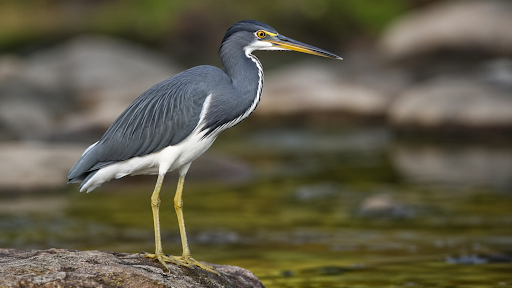
The White-bellied Heron is the second largest heron on Earth, standing up to four feet tall.
Appearance: Recognizable by its uniform dark-grey upperparts and stark white throat and underbelly. It has an elongated, flexible neck and a serrated bill built for snapping up fish.
Habitat: Strictly found in undisturbed, fast-flowing rivers, sandbanks, and adjacent broadleaved forests. It requires tall trees for nesting and avoids areas with human disturbance.
Diet & Foraging: The bird is solely piscivorous (fish-eating). It employs a stationary hunting style, patiently waiting in shallow rapids or on slippery rocks for fish to swim by.
Conservation Status
-
IUCN Status: Critically Endangered
-
Legal Protection: Listed under Schedule I of India’s Wild Life (Protection) Act, 1972, which gives it the highest legal protection.
-
Population Data: The global population is extremely small, estimated at around 250 individuals, with less than 60 birds left in India.
Why is the Lohit River Habitat Important?
Critical Breeding and Foraging Habitat
-
The heron relies on mature riparian forests (forests along riverbanks) with tall trees for roosting and nesting.
-
It strictly needs clear, shallow, and fast-flowing river streams to catch fish, and cannot survive in polluted or still water.
One of India's Last Refuges
-
The Lohit River basin harbours 70% of India’s White-bellied Herons (Source: Ashoka Trust for Research in Ecology and the Environment).
-
Forest officials recently spotted two herons at an unusually high elevation of 1,200 meters near Walong, which sits directly in the Lohit basin and acts as a known breeding site (Source: Arunachal Pradesh Environment and Forest Department).
How Could the Proposed Dam Affect the Species?
Alteration of Natural River Flow
-
The dam will change the river from a fast-flowing (lotic) ecosystem into a still water (lentic) reservoir.
-
This alters the water’s turbidity (cloudiness) and sediment transport, completely destroying the shallow, clear fishing grounds the heron needs to hunt.
Increased Human Disturbance
-
The bird is extremely shy and strictly avoids human activity.
-
Building the dam involves felling 33,338 trees, bringing heavy machinery, noise, road construction, and workers into the pristine habitat, forcing the birds to abandon their nests.
Habitat Fragmentation
-
The project will create a 23-kilometer-long reservoir that submerges mature forests.
-
This breaks the continuous river corridor into fragmented pieces, isolating the small populations of the heron and exposing them to predators.
Source: THEHINDU
|
PRACTICE QUESTION Q. Consider the following statements regarding the White-bellied Heron: 1. It is mostly found in the coastal mangrove forests of India. 2. It is listed as Critically Endangered on the IUCN Red List. 3. The Lohit River basin acts as a major habitat for this species in India. Which of the statements given above is/are correct? A) 1 and 2 only B) 2 and 3 only C) 1 and 3 only D) 1, 2, and 3 Answer: B Explanation: Statement 1 is incorrect: The White-bellied Heron does not live in coastal mangrove forests. Instead, it is an elusive bird that inhabits undisturbed, fast-flowing rivers, streams, and wetlands in tropical and subtropical forests. Statement 2 is correct: The species is listed as Critically Endangered on the IUCN Red List due to a drastically small, fragmented, and declining global population. Statement 3 is correct: In India, its habitat is strictly confined to the Northeast, and the Lohit River basin in Arunachal Pradesh serves as a major, highly critical habitat and breeding ground for the species. |