Why In News?
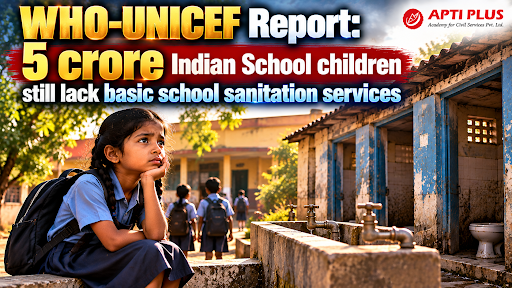
A report titled 'Progress on drinking water, sanitation and hygiene in schools 2015–2025', published by the WHO/UNICEF Joint Monitoring Programme (JMP), revealed that 50 million Indian schoolchildren lack access to basic sanitation services at school.
What Does the Report Measure?
The WHO-UNICEF JMP framework tracks whether educational institutions provide functional Water, Sanitation, and Hygiene (WASH) services meeting defined minimum standards, rather than merely counting constructed physical structures:
-
Drinking Water Services: Requires a functional, improved drinking water source located on school premises or within 500 meters.
-
Sanitation Services: Requires functional, single-sex (gender-segregated) toilets that are usable and available to students during school hours.
-
Hygiene Services: Requires handwashing stations equipped with both water and soap on site.
-
School WASH Integration: Encompasses safe drinking water, clean sanitation, handwashing facilities, and private menstrual hygiene management (MHM) infrastructure (such as disposal mechanisms and private changing spaces).
Key Findings About India
Global Burden Concentration: India accounts for 50 million (5 crore) out of 244 million school-age children worldwide who lack access to basic sanitation services—representing 20.5% of the global burden.
-
India is among the 28 out of 62 countries that are on track to achieve universal coverage of basic drinking water in schools by 2030.
Hygiene Infrastructure Deficit: Over 20 million Indian Schoolchildren attend schools without basic handwashing and hygiene facilities, creating severe public health risks.
Divergence Between Water and Sanitation: India achieved a 42 percentage point surge in basic school drinking water coverage, expanding from 55% in 2015 to 97% in 2025 and positioning the nation among 28 Countries on track for SDG Goal 6 targets.
Sanitation Coverage Trajectory: Basic school sanitation coverage increased by 19 percentage points, rising from 62% in 2015 to 81% in 2025, representing a 14% reduction in schools without sanitation services under the Swachh Bharat Mission (SBM).
Institutional Segregation Deficit: Out of 1.47 million schools nationwide, 97.3% feature functional girls' toilets, leaving 2.7% (39,729 schools) unserved, where 4,745 schools completely lack gender-segregated facilities.
Challenges
Gaps in Remote Belts: Peripheral and tribal schools in states like Jharkhand, Odisha, and Bihar suffer from severe construction delays and logistics bottlenecks.
Maintenance Deficit & Unusable Toilets: Physical construction does not guarantee usage. The 13th ASER (Rural) Survey revealed that 22.8% of rural school toilets were completely unusable due to structural decay, lack of maintenance, or missing running water, while 10.5% of girls' toilets remained locked.
Water Availability Deficits: Many constructed toilet blocks lack connected piped water or flushing facilities, rendering them unsanitary within months.
Hygiene Behaviour & Cultural Taboos: Low awareness regarding handwashing practices and entrenched social taboos surrounding menstrual health undermine facility utilization.
Rural-Urban and Intra-State Disparities: Rural and tribal institutions face far higher rates of non-functional infrastructure compared to urban centers.
Data Gaps in Hygiene Services: Significant data limitations across Central and Southern Asia (including India) prevent full assessment of handwashing facilities with soap and water beyond 2024.
Way Forward
Ensure Functional and Usable Toilets: Reorient policy metrics from counting constructed toilet blocks to enforcing daily operational functionality, cleanliness, and structural usability.
Guaranteed Piped Water Supply: Mandatory convergence between Samagra Shiksha and the Jal Jeevan Mission to connect every school toilet block to continuous piped water.
Strengthen Digital WASH Monitoring: Enhance real-time audit frameworks through UDISE+, geo-tagged photos, and Swachh Vidyalaya Puraskar inspections.
Integrate Hygiene & Menstrual Education: Incorporate standardized hygiene modules in curricula, establish Swachhata Clubs, and mandate sanitary pad vending machines and incinerators in all secondary schools.
Decentralized O&M Funding & Community Ownership: Transfer dedicated operational and maintenance funds directly to School Management Committees (SMCs) and Gram Panchayats to ensure routine cleaning and repair work.
Conclusion
The WHO/UNICEF report reveals that despite India boosting school drinking water coverage to 97%, severe sanitation gaps persist, leaving 50 million students without basic toilet access.
Source: THEHINDU
|
PRACTICE QUESTION Q. Sanitation in educational institutions is not merely an infrastructure requirement but a core determinant of gender equity and public health." Analyze. 150 words |