Why In News?
The Kerala High Court reaffirmed that a minor girl's consent in romantic love relationships holds zero legal validity under the strict liability mandate of the POCSO Act.
What is the POCSO Act?
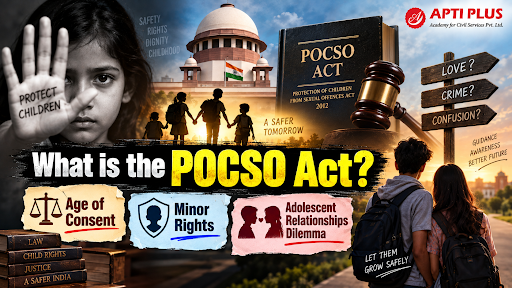
Protection of Children from Sexual Offences (POCSO) Act, 2012 was enacted as a specialized, gender-neutral statutory code to protect children from sexual abuse and exploitation.
-
Statutory Definition of Child: Defines a child as anyone under 18 years [Section 2(1)(d)].
-
Range of Sexual Offences: Covers offences from penetrative assault to verbal and digital abuse.
-
Sexual Assault Penalties: Sets strict minimum prison terms (Section 4), up to life imprisonment for aggravated assault (Section 6).
-
Harassment Safeguards: Criminalizes non-contact harassment like lewd gestures, stalking, and voyeurism (Sections 11 & 12).
-
Child Pornography Bans: Prohibits producing, sharing, publishing, or storing of child sexual abuse material (CSAM) under Section 14 and Section 15.
-
It operationalizes fundamental protections under Article 15(3) (special laws for children), Article 21 (right to dignity), and Article 39(f) (safeguarding youth against exploitation).
Why is Consent Irrelevant Under POCSO?
Statutory Age of Consent: Fixes eighteen years as the non-negotiable legal threshold below which free and informed sexual consent cannot legally exist.
Absence of Legal Capacity of a Minor: Assumes that minors lack cognitive maturity and full psychological agency to understand the long-term ramifications of sexual acts.
Paramount Child Protection Principle: Prioritizes absolute safeguarding of vulnerable children over individual contractual autonomy in line with the United Nations Convention on the Rights of the Child (UNCRC)1989.
Absolute Protection from Exploitation: Eliminates consent defenses to prevent adults from manipulating, coercing, or grooming young girls into sexual relations.
Strict Liability Legal Framework: Operates on statutory strict liability where proof of minority and sexual contact establishes criminal culpability regardless of willingness.
What are the Rights of Children Under POCSO?
Inviolable Right to Dignity: Guarantees that investigations and court trials treat minor victims with utmost compassion, avoiding hostile secondary trauma.
Right to Strict Identity Privacy: Strictly prohibits revealing a child's name, address, school, or photograph across police records and news media under Section 23.
Comprehensive Right to Protection: Entitles the child to emergency medical care, physical security, and safe shelter homes immediately after reporting an offense.
Right to Free Legal Assistance: Provides mandatory free legal counsel through the Legal Services Authority alongside trained support persons throughout trials.
Child-Friendly Judicial Procedures: Mandates Special Courts, in-camera trials, video conferencing, woman police officers in plain clothes, and bar on cross-examination by the accused.
What are the Major Legal Concerns?
Criminalisation of Consensual Relationships: Traps young adolescent peer lovers (aged 16–18) under severe anti-rape laws carrying mandatory twenty-year jail sentences.
Misuse Driven by Family Opposition: Parents frequently lodge false statutory rape FIRs to break inter-caste, inter-faith, or unapproved adolescent elopements.
Severe Distortion of Criminal Provisions: Diverts judicial resources away from prosecuting genuine predatory sexual predators toward adjudicating consensual love affairs.
Denial of Adolescent Autonomy: Treats older adolescents nearing adulthood as completely devoid of agency, ignoring natural emotional and psychological development.
Fundamental Tension Between Protection and Liberty: Creates a constitutional clash between the State’s duty to protect minors and adolescents' personal liberty under Article 21.
Way Forward
Introduce Judicial Discretion in Sentencing: Amend statutory provisions to grant Special Judges sentencing flexibility in genuine consensual adolescent cases.
Adopt a Close-in-Age Exemption Model: Enact 'Romeo and Juliet' clauses exempting consensual sexual acts between young peers with an age gap under two to three years.
Establish Pre-FIR Screening Committees: Mandate preliminary counseling and inquiries by Child Welfare Committees (CWCs) before registering statutory rape FIRs.
Institutionalize Comprehensive Sexuality Education: Impart age-appropriate awareness on consent, reproductive biology, digital privacy, and legal ramifications in schools.
Issue Standardized Bail Guidelines: Formulate Supreme Court guidelines to ensure routine grant of bail to young adolescent accused in consensual relationship cases.
Learn from Global Model
-
Romeo and Juliet Clauses in the United Kingdom: Sexual Offences Act 2003 differentiates exploitative adult statutory rape from consensual sexual exploration among peers aged 16 to 18.
-
South Africa’s Criminal Law (Sexual Offences) Framework: Constitutional Court decriminalized consensual sexual relationships between adolescents aged 12 to 16 where no power coercion existed.
Conclusion
Balancing uncompromising protection against sexual predators with compassionate decriminalization of consensual adolescent love is essential to preserve the constitutional spirit of the POCSO Act.
Source: THEHINDU
|
PRACTICE QUESTION Q1. Critically examine how the absolute irrelevance of consent under the POCSO Act criminalizes consensual adolescent relationships in India. (10 Marks, 150 Words) |