Why In News?
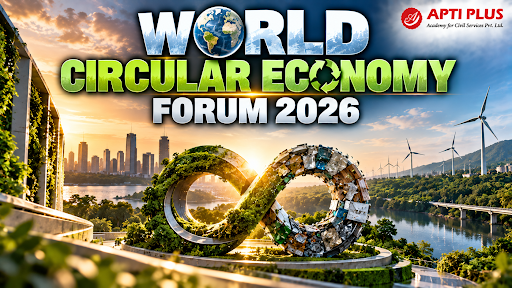
India is hosting the 10th edition of the World Circular Economy Forum (WCEF 2026) at Gandhinagar, Gujarat – marking the first time the global forum is being held in South Asia.
About World Circular Economy Forum (WCEF)
Origin: Launched in 2017 by the Finnish Innovation Fund Sitra, it convenes annually in different parts of the world.
Core Mission: It accelerates the shift from a traditional linear economy (take, make, dispose) to a circular economy that cuts waste, pollution, and carbon emissions.
2026 Theme: "Circular Economy: Transition for People and Prosperity"
What is a Circular Economy?
A circular economy is an industrial system that is restorative and regenerative by design, aiming to decouple economic growth from the consumption of finite resources.
It replaces the traditional “take‑make‑dispose” linear model with a “reduce‑reuse‑recycle” approach that keeps materials and products in use for as long as possible.
Key Principles
-
Reuse: Keeping products and components in productive use for their original purpose without intermediate reprocessing.
-
Repair: Restoring broken or malfunctioning products to working condition, extending their utility life and delaying disposal.
-
Refurbishment: Overhauling and upgrading aesthetic or technical components of machinery or electronics to near‑new quality.
-
Recycling: Reprocessing collected post‑consumer waste materials into secondary raw inputs for new manufacturing cycles.
-
Resource Recovery: Extracting useful materials, embedded energy, or chemical building blocks from waste streams.
Economic and Environmental Significance
-
Reduces resource extraction and pressure on ecosystems.
-
Minimizes waste generation and landfill dependency.
-
Creates green jobs in recycling, repair, and remanufacturing sectors.
-
Enhances industrial efficiency and supply‑chain resilience.
-
Supports climate goals by lowering carbon footprints across production cycles.

The concept is central to the UN SDG 12 (Ensure Sustainable Consumption and Production Patterns), and India’s initiatives like Mission LiFE, Swachh Bharat, and the Extended Producer Responsibility (EPR) framework.
How is Circular Economy Different from Linear Economy?
|
|
Linear Economy (Take-Make-Dispose) |
Circular Economy (Closed-Loop System) |
|
Operating Model |
Take-Make-Dispose: Unidirectional flow extracting virgin resources and dumping post-use discards. |
Closed-Loop Production: Regenerative model keeping materials circulating perpetually in biological/technical loops. |
|
Resource Extraction |
High & Finite: Relies on virgin mining, intensive fossil energy, and raw timber extraction. |
Minimal & Secondary: Maximizes secondary raw material utilization and urban mining feedstocks. |
|
Product Lifespan |
Short & Planned Obsolescence: Fast replacement design prioritizing rapid consumer turnover. |
Extended & Modular: Designed for long lifespans, repairability, ease of disassembly, and upgradability. |
|
Waste Dynamics |
End-of-Pipe Disposal: Massive municipal landfill dumping, ocean release, and toxic open incineration. |
Zero Waste by Design: Residual outputs of one industrial facility serve as raw inputs for another (Industrial Symbiosis). |
|
Economic Value |
Value Destructive: Embedded energy, mineral value, and labor are completely lost upon product disposal. |
Value Preserving: Preserves maximum embedded economic value across multiple cascaded product generations. |
What is the Importance of Circular Economy for India?
Resource Security: Reduces dependence on imported critical minerals like lithium, cobalt, and copper by promoting advanced battery and e‑waste recycling, ensuring long‑term resource sovereignty.
Waste Management: Addresses urban landfill saturation — India’s cities generate about 1.6 lakh tonnes of solid waste daily (CPCB data). Circular models enable segregation, reuse, and material recovery, minimizing landfill pressure.
Import Reduction: Lowers foreign‑exchange outflows on scrap metal, virgin coking coal, and synthetic plastic resins by substituting them with domestically recycled materials.
Employment Generation: The Ellen MacArthur Foundation estimates that circular models could create millions of formal green jobs by 2050, especially in recycling, repair, and remanufacturing sectors.
Sustainable Industrialisation: Enables manufacturing growth to decouple from carbon emissions, supporting India’s Net Zero by 2070 target through resource‑efficient production.
Climate Action: Cuts Scope 3 industrial emissions by replacing carbon‑intensive virgin metallurgy with energy‑efficient secondary recycling, aligning with India’s Nationally Determined Contributions (NDCs).
Resource Efficiency: Enhances India’s material productivity, which currently lags behind global industrial benchmarks (NITI Aayog Resource Efficiency Report).
Rural Livelihoods: Converts agricultural residues (parali) into bio‑pellets, compost, and bio‑plastics, generating rural income and reducing stubble‑burning pollution.
What are the Major Challenges?
Low Recycling Rates: Less than 20 % of electronic waste is scientifically recycled through formal channels. The rest is either landfilled or informally processed, leading to resource loss and pollution.
Informal Waste Sector: Over 90 % of waste collection and dismantling is done by informal waste pickers lacking safety gear, mechanization, and financial access — causing occupational hazards and inefficiency.
Poor Waste Segregation: Absence of rigorous household‑level segregation contaminates recyclables with wet organic waste, destroying their economic value and complicating downstream recovery.
Limited Recycling Infrastructure: India faces an acute shortage of computerized Material Recovery Facilities (MRFs) and industrial e‑waste smelting capacity, especially outside metro regions.
High Initial Investment: Circular technologies like robotic sorting lines, pyrolysis units, and effluent‑treatment systems are capital‑intensive, deterring MSME recyclers from entering the market.
Consumer Behaviour: Persistent use‑and‑throw habits and reluctance to pay premiums for recycled or repairable products hinder market demand for circular goods.
Weak Product Design: Electronics and packaging often use glued multi‑layer plastics, frustrating automated disassembly and material recovery. Design‑for‑recycling principles remain under‑adopted.
Fragmented Regulations: Gaps in cross‑state municipal enforcement, weak tracking of inter‑state scrap shipments, and delayed Extended Producer Responsibility (EPR) audits create compliance uncertainty.
India's Circular Economy Policy Framework
Component |
Policy |
Objective / Mechanism |
|
Extended Producer Responsibility (EPR) |
Plastic Waste, E‑Waste, Tyre, and Battery Rules |
Legally obligates producers to collect and recycle post‑consumer waste; ensures accountability across the product lifecycle. |
|
Plastic Waste Management Rules (2016, amended 2022) |
Ban on 19 single‑use plastic items; minimum recycled content in packaging |
Reduces virgin plastic use and promotes circular packaging systems. |
|
E‑Waste Management Rules (2022) |
Annual collection targets; safe extraction of metals |
Encourages formal recycling and recovery of gold, silver, copper, and rare earths. |
|
Battery Waste Management Rules (2022) |
Recovery targets for lithium, nickel, cobalt, lead |
Promotes closed‑loop recycling for EV and industrial batteries. |
|
Waste‑to‑Energy Initiatives |
SATAT (Sustainable Alternative Towards Affordable Transportation) & biomass co‑firing |
Converts organic waste into Compressed Biogas (CBG) and renewable energy. |
|
Resource Efficiency Action Plans (REAPs) |
11 sector‑specific plans by NITI Aayog |
Targets steel, aluminium, rubber, and electronics sectors for material efficiency. |
|
Sustainable Consumption |
Mission LiFE (Lifestyle for Environment) |
Mobilizes citizens for mindful consumption and behavioral change. |
Way Forward
Mandating Ecodesign and Durability Standards: Enforce Bureau of Indian Standards (BIS) norms penalizing planned obsolescence and requiring modular designs.
-
Example: The Right to Repair Portal India, enabling consumer access to repair manuals and original device components.
Mainstreaming and Formalising Informal Waste Workers: Integrate waste pickers into municipal collection systems with identity cards, health covers, and fair pay.
-
Example: Pune’s SWaCH Cooperative Model, integrating over 3,500 waste pickers into door-to-door collection with dramatic recycling gains.
Scaling Up Industrial Symbiosis in Special Economic Zones: Mandate waste and energy exchange infrastructure in all new industrial corridors and mega-parks.
-
Example: Gujarat’s Dahej Eco-Industrial Park, co-locating chemical units to exchange spent acids, fly ash, and steam.
Expanding Fiscal Incentives for Secondary Raw Materials: Reduce GST rates on verified recycled raw materials below virgin material rates to build price parity.
-
Example: NITI Aayog Circular Economy Action Plan for Metals, recommending tax exemptions on certified scrap handling.
Enforcing Mandatory Green Public Procurement (GPP): Require government bodies to purchase paper, office furnishings, and construction inputs with minimum recycled content.
-
Example: National Green Procurement Guidelines, prioritizing recycled fly ash bricks and crumb rubber in highway construction.
Conclusion
Hosting WCEF 2026 solidifies India's role as a bridge between global circular innovation and inclusive, labor-absorbing industrial models for the Global South.
Source: PIB
|
PRACTICE QUESTION Q. Evaluate how transitioning from a linear to a circular economic model can enhance resource security and generate green employment in India. (10 Marks, 150 Words) |