Why In News?
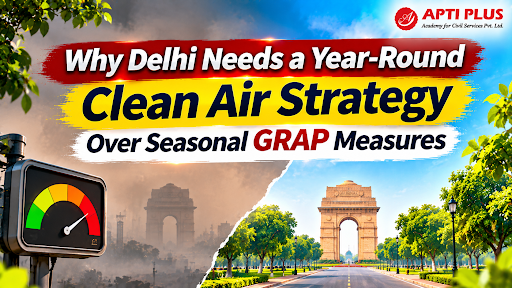
Worsening winter air quality in Delhi-NCR and the Indo-Gangetic Plain from 'very poor' to 'severe' led the Graded Response Action Plan (GRAP) to invoke GRAP Stage III, highlighting the need for a sustained, year-round clean air movement.
What Is Air Pollution?
Air pollution is the presence of harmful chemical, physical, or biological substances in indoor or outdoor air that alter the natural atmosphere and harm living organisms or the environment. According to the World Health Organization, nearly 99% of the global population breathes air that exceeds recommended pollutant limits.
Common Pollutants
-
Particulate Matter 2.5 (PM2.5): These are particles smaller than 2.5 micrometres, about 30 times thinner than a human hair. They enter the lungs and bloodstream and are the most harmful pollutant for health.
-
Particulate Matter 10 (PM10): These are coarser particles, mainly from road dust, construction and crop residue burning. The National Clean Air Programme (NCAP) tracks progress on this pollutant.
-
Gaseous Pollutants: Sulphur dioxide, nitrogen oxides, ozone and carbon monoxide come from power plants, vehicles and industry. They also react in the air to form secondary particles.
-
Air Quality Index (AQI): The index groups air quality into six bands, from 'good' to 'severe'. It is the trigger for GRAP, with Stage I at AQI 201–300 and Stage II at 301–400.
-
Standards Gap: The World Health Organization (WHO) guideline for annual PM2.5 is 5 µg/m³. India's national standard for PM10, at 60 µg/m³, dates from 2009.
|
Commission for Air Quality Management (CAQM)
|
Why Does India Need A Movement And Not Just Seasonal Emergency Measures?
-
Recurring Pattern: Delhi-NCR moved to GRAP Stage I on 21 October 2026, Stage II on 2 November and Stage III on 6 November. The same escalation has repeated every winter.
-
Seasonal Spotlight: Public attention peaks with winter smog and fades by spring. Yet PM2.5 exposure continues through the year in the Indo-Gangetic Plain.
-
Political Incentive Gap: A 2026 study by Singh and Thachil finds that clean air has not become an electoral issue. Benefits take years to appear, and parties shift blame across jurisdictions.
-
International Lesson: Cities such as Mexico City, London, New York, Beijing and Santiago cut pollution through sustained public demand, accountability for results and the participation of affected people.
What Does The Latest Global Data Say About Air Quality In India?
In the IQAir 2025 World Air Quality Report, India ranked as the 6th most polluted country out of 143 countries.
Key Findings for India
-
Pollution Levels: India's average PM2.5 level reached 48.9 µg/m³ (AQI of 134), showing a slight decrease from the previous year. The report highlighted that 66 of the world's 100 most polluted cities are in India.
-
Top Polluted Hubs: Uttar Pradesh's Loni topped the global rankings as the most polluted city (112.5 µg/m³), followed closely by Byrnihat (101.1 µg/m³) and Delhi (99.6 µg/m³). New Delhi maintained its position as the world's most polluted capital city for an eighth straight year.
-
Primary Contributors: Major sources include vehicle exhausts, industrial discharges, agricultural stubble burning, adverse weather conditions, and dust storms.
-
Concentration Of Hotspots: Five of the world's ten most polluted cities are in India: Loni, Byrnihat, Delhi, Ghaziabad and Ula. Only 14% of cities worldwide met the WHO guideline.
What Are The Major Sources Of Air Pollution In India?
-
Vehicular Emissions: In January 2026, the CAQM told the Supreme Court that vehicular pollution is the highest contributor to air pollution in Delhi-NCR. It recommended 15 long-term measures.
-
Coal-Based Power: Coal caused 3,94,000 air pollution deaths in India in 2022, of which 2,98,000 were linked to power plants. (Source: Lancet)
-
Petrol In Road Transport: Petrol use in road transport added another 2,69,000 deaths. Petrol vehicles release very fine particles that reach deep into the lungs.
-
Dust And Waste Burning: The Parliamentary Standing Committee on Science and Technology, Environment, Forests and Climate Change highlighted road dust, construction and demolition, waste burning and crop residue burning as significant contributors in Delhi-NCR.
-
Crop Residue Burning: The Decision Support System showed stubble burning at 15.3% of Delhi's pollution in early November 2026, against transport at 15.8%. On 31 October, its share was only 1.6%.
Why Does Pollution Peak In Winter In The Indo-Gangetic Plain?
-
Meteorology: Calm winds and temperature inversion trap pollutants close to the surface in winter. Low mixing height reduces the dispersal of emissions.
-
Festival And Farm Fire Overlap: Delhi's AQI deteriorated after Dussehra in October 2026, while stubble fires were reported in Punjab, Haryana and Uttar Pradesh. Fireworks and farm fires add short-lived peaks on top of year-round sources.
-
Persistence After Fire Season: December 2025 turned out more polluted than October and November, despite a drop in farm fires. This shows that local sources keep pollution high after the fire season ends.
What Is The Health Burden Of Air Pollution In India?
-
Deaths In 2022: More than 17.18 lakh deaths in India in 2022 were attributable to PM2.5 from human activity. This is a 38% rise since 2010. (Source: Lancet)
-
Fossil Fuel Share: Fossil fuels such as coal, liquid gas and petrol caused 7,52,000 of these deaths, or 44% of the total.
-
City-Level Burden: A Lancet Planetary Health study of 10 Indian cities found that over 33,000 deaths a year between 2008 and 2019 were linked to PM2.5 above the WHO limit. This was 7.2% of all deaths in those cities.
-
Delhi's Share: Delhi recorded 12,000 such deaths a year, or 11.5% of its total deaths, the highest among the cities studied.
-
Wider Estimate: The State of Global Air 2025 report estimated about 2 million air pollution deaths in India in 2023.
What Is The Economic Cost Of Air Pollution In India?
-
Output Loss: The monetised value of premature deaths from outdoor air pollution in India was USD 339.4 billion in 2022. This is equivalent to 9.5% of gross domestic product. (Source: Lancet)
-
Benefit Of Action: A 2026 study in the Proceedings of the National Academy of Sciences finds that achieving air quality standards, with lower household cooking emissions, could substantially cut mortality and improve the economy.
-
Research Gap: The Parliamentary Standing Committee on Health and Family Welfare recommended in 2025 that the Indian Council of Medical Research (ICMR) prepare a plan to study the health effects of air pollution. Pollution was long seen as a threat in only a few big cities.
Initiatives Taken By Government To Improve Air Quality In India
Legal and Institutional Frameworks
-
Air (Prevention and Control of Pollution) Act, 1981: Establishes CPCB and State Pollution Control Boards (SPCBs) to set emission standards and control air pollutants.
-
Environment (Protection) Act, 1986: Empowers the central government to notify standards, restrict industrial locations, and enforce environmental rules across sectors.
-
Commission for Air Quality Management (CAQM) Act, 2021: Created a statutory body replacing EPCA to coordinate air quality management in Delhi-NCR and adjoining areas (including parts of the Indo-Gangetic Plain), with powers to issue binding directions and impose penalties.
-
National Ambient Air Quality Standards (NAAQS): Notified under the Air Act for 12 key pollutants (including PM2.5, PM₁₀, SO₂, and NO₂).
Programmes and Emergency Plans
-
National Clean Air Programme (NCAP, 2019): Targets a 40% reduction in PM₁₀ (or achievement of NAAQS) by 2025–26 (revised from 20–30% by 2024 against a 2017 baseline) across 131 non-attainment and million-plus cities. Funded via performance grants and converged schemes, tracked on the PRANA portal.
-
Graded Response Action Plan (GRAP): A four-stage emergency response mechanism (Stages I–IV) for Delhi-NCR triggered by AQI thresholds, imposing escalating curbs on construction, vehicles, industries, and polluting activities.
-
Swachh Vayu Sarvekshan: Ranks NCAP cities on action plan implementation and air quality improvements.
Sectoral Measures and Technology
-
Transport: Leapfrogging directly to Bharat Stage VI (BS-VI) fuel and vehicle norms (10 ppm sulphur) in April 2020, alongside electric mobility pushes (such as FAME) and expanded CNG/public transport infrastructure.
-
Household & Rural Energy: Pradhan Mantri Ujjwala Yojana (PMUY) promotes clean cooking fuel (LPG) to cut indoor and biomass smoke.
-
Industry & Construction: Transition to cleaner fuels/piped natural gas, Retro-Emission Control Devices (RECDs) or dual-fuel kits on DG sets, dust mitigation mandates at construction and demolition (C&D) sites, and online continuous emission monitoring.
-
Agriculture & Monitoring: Subsidies for crop residue management and bio-decomposers (such as Pusa decomposer) to curb stubble burning, supported by an expanding ambient monitoring network, the SAMEER app, and forecasting systems.
What Are The Key Challenges In Delivering Clean Air In India?
Targets Are Being Missed Despite Rising Spending
-
Programme Outcome: Only 26 of the 130 NCAP cities reached the 40% reduction target in PM10, and 14 met the national standards. The Parliamentary Standing Committee noted in December 2025 that there had been little improvement in pollution levels despite programmes spanning over a decade.
-
Fund Utilisation: Nearly 30% of the funds released under NCAP remained unspent in 2025-26. Money reaches cities against action plans, but the targeted fall in PM10 has not followed in most cities.
-
Narrow Metric: Non-attainment cities were identified on PM10 levels, though PM2.5 is the more harmful pollutant for health. The programme therefore does not track the pollutant that causes most deaths.
Standards And Monitoring Are Outdated
-
Weak Benchmarks: The Committee observed that the national standards were last revised in 2009. It asked the Union government to prepare updated standards.
-
Monitoring Gaps: The Committee recommended upgrading all manual stations in Delhi-NCR to continuous ambient air quality monitoring systems. Manual stations give delayed readings that do not support real-time action.
Governance Is Fragmented Across Airsheds
-
Jurisdiction Limits: The CAQM's statutory remit covers Delhi-NCR and adjoining areas, while the Indo-Gangetic Plain is a single airshed that spans several States. Pollution from one State drifts into another.
-
Institutional Capacity: In December 2025, the Supreme Court examined vacancies in pollution control boards and poor enforcement in NCR States. It asked authorities to show why pollution remained high despite repeated action plans.
-
Political Blame: In December 2025, the Chief Justice of India warned against politicising stubble burning. States continue to trade blame while enforcement lags.
Transport And Fossil Fuels Remain Dominant Sources
-
Vehicle Fleet: In January 2026, the Supreme Court allowed action against pre-BS-IV vehicles in Delhi. The large legacy fleet remains the biggest source in the region.
-
Slow Public Transport Shift: No bus had been operationalised under PM-eBus Sewa till December 2025, against a sanction of 10,000 buses.
-
Coal Dependence: The CAQM's long-term roadmap has no firm completion dates for many proposals and leaves gaps on existing thermal power plants.
Crop Residue Burning Persists In A Narrow Window
-
Residual Fires: Despite the steep decline, Punjab still recorded 1,514 fires by 1 November 2026. Farmers have only a short gap between paddy harvest and wheat sowing.
-
Slow Use Of Funds: The Crop Residue Management scheme has supported over 3.23 lakh machines, but slow use of funds remains a concern.
Emergency Response Dominates Over Structural Action
-
Reactive Triggers: GRAP begins at AQI 201, which means curbs follow the pollution rather than prevent it. Stage III came only on 6 November, after Stage I and II had not held the AQI below 300.
-
Delayed Decisions: On 6 January 2026, the Supreme Court said that inordinate delay by the CAQM in finding solutions would lead to further complications. It refused long adjournments and set continuous hearings.
What Is The Way Forward For A Sustained Movement For Cleaner Air In India?
Set PM2.5-Based Targets And Expand Monitoring
-
Targets On The Harmful Pollutant: Beijing's 2013 Air Pollution Action Plan tightened emission caps and added PM2.5 concentration targets. India's next phase of NCAP should set city-wise PM2.5 targets alongside PM10.
-
Data Independence: The end of the United States State Department's air quality monitoring at embassies and consulates in March 2025 reduced data for millions of people worldwide. India needs a dense, publicly accessible monitoring network of its own.
Fix Accountability With Named Agencies And Deadlines
-
Agency-Wise Plans: The CAQM has identified the competent agency for each of its long-term measures. The Supreme Court asked each of them to file an action taken plan and said that it would not entertain objections to the recommendations.
-
Definite Timelines: The amicus curiae assisting the Court stressed the need for definite timelines for enforcing the CAQM's recommendations. Each measure should carry a completion date and a public progress report.
Shift Transport Away From Polluting Fuels
-
Price Signals: The CAQM has suggested costlier entry and faster exit for polluting vehicles. Graded entry fees and time-bound phase-out reduce the use of the oldest and dirtiest vehicles.
-
Emission Norms: The Parliamentary Standing Committee recommended a comprehensive review of India's emission standards and a push for electric vehicle adoption. Public transport expansion should be completed before restrictions on private vehicles are tightened.
Clean Up Power, Industry And Household Fuels
-
Lessons From China: China made its biggest gains by cracking down on coal-based heating, shifting households to cleaner fuels, shutting heavily polluting local industries and tightening vehicle rules. India can adapt each lever to its context.
-
Household Cooking: The 2026 study in the Proceedings of the National Academy of Sciences found that lowering household cooking emissions while meeting air standards would give the largest mortality gains. Clean cooking fuel needs to be paired with ambient standards.
-
Thermal Plants: The roadmap should set time-bound emission standards for existing thermal power plants in the region. This closes the gap that the CAQM's long-term measures leave open.
Move Farmers From Penalties To Incentives
-
Village-Level Rewards: The CAQM's 2026 plan promotes zero stubble burning villages through incentives. Haryana gives incentives to panchayats in red and yellow zones for reducing fires.
-
Proven Outcome: In Punjab, a disbursal of ₹395 crore for crop residue machinery led to a 53% decline in stubble burning cases in Kharif 2025. Similar front-loaded support can sustain the gains.
-
Paddy Straw Market: An Inter-Ministerial Committee formed in December 2023 coordinates ex-situ use of paddy straw. A supply chain for straw gives farmers a price for residue.
Protect Health And Livelihoods During Pollution
-
Income Support: The Supreme Court was informed in January 2026 about school closures and stipends for construction workers during curbs. Such support should be automatic when GRAP restrictions begin.
-
Health Integration: Air pollution should be built into the National Programme on Climate Change and Human Health, with district health advisories linked to the AQI.
-
Learn from Global Experience: Brazil's 2026 revamp of its national air pollution programme rests on broad participation and sustained public demand, which push policymakers to act. People breathing the most polluted air must help shape solutions.
Conclusion
India has laws, courts, a statutory commission and a national programme, but air quality improves only where action is sustained and measured. A year-round movement that links citizens, States and the Centre can turn emergency curbs into lasting clean air.
Source: THEHINDU
|
PRACTICE QUESTION Q. Critically evaluate the performance of the National Clean Air Programme and the governance gaps that limit its outcomes. (10 Marks, 150 Words) |