Why In News?
Experts argue that India's renewable push, now past 300 GW of non-fossil capacity, must balance mega solar parks with decentralised rooftop and farm solar as curtailment and transmission gaps widen.
Where Does India's Renewable Energy Capacity Stand?
-
Milestone of 300 GW: India's installed non-fossil capacity reached 300.50 GW on 31 July 2026, more than 60% of the way to the 500 GW target for 2030. The share of total installed capacity is over 54%.
-
Mix of sources: The 300.50 GW comprised 164.59 GW of solar, 58.14 GW of wind, 57.24 GW of hydro, 11.75 GW of bio-power and 8.78 GW of nuclear. Solar is now the largest source.
-
Record additions: In 2025-26, India added a record 55.29 GW of non-fossil capacity, including 44.6 GW of solar and 6 GW of wind. Additions are growing faster than demand.
-
Global standing: India ranks third in renewable capacity globally. The updated Nationally Determined Contribution targets 60% non-fossil capacity by 2035.
-
Peak demand: Peak demand reached 256.1 GW on 25 April 2026. Roughly one-third was met through renewable sources.
Why Did India Build Mega Solar Parks?
Launched in December 2014 under the Ministry of New and Renewable Energy (MNRE), the Solar Parks Scheme had 56 parks approved with 39,461 MW of sanctioned capacity as of October 2026.
Key Reasons Behind Mega Solar Parks
-
Economies of Scale & Lower Tariffs: Pooling capacity in large hubs lowers per-unit development and shared infrastructure costs. By 2025, utility-scale solar PV in India reached a Levelised Cost of Electricity (LCOE) of USD 35 per MWh, below the global average of USD 44 per MWh.
-
"Plug-and-Play" Speed: State agencies or developers handle land acquisition, clearances, transmission lines, water access, and road connectivity upfront. Solar developers can build plants faster without getting stalled by early-stage land and permitting delays.
-
Reduced Investor Risk: Centralizing clearances and grid connections lowers project delays and regulatory uncertainty, helping attract domestic and global capital
-
Use of Non-Agricultural Wasteland: Many parks sit on barren, arid, or non-arable land with high solar insolation—such as the Thar Desert in Rajasthan (home to the 2,245 MW Bhadla Solar Park) and Kutch in Gujarat—avoiding competition with farmland.
-
Energy Security & Climate Goals: Large-scale solar reduces reliance on imported fossil fuels and coal, cuts carbon emissions, and supports India's target of 500 GW of non-fossil fuel capacity by 2030.
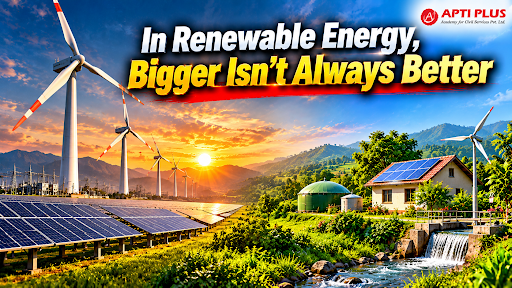
Bigger Isn't Always Better For India's Renewable Energy
|
What Are The Limits Of The Mega-Park Model?
Transmission cannot keep pace
-
Power lost before it reaches users: Ember estimated total renewable curtailment at around 470 GWh in the first quarter of 2026. About 300 GWh was due to transmission constraints and 170 GWh to system inflexibility. (Source: Ember)
-
Congestion at pooling stations: The concentration of capacity in Rajasthan and Gujarat is increasing congestion at key pooling stations, with 43.7 GW of solar and 12.5 GW of wind connected to the inter-State transmission system as of March 2026. (Source: Ember)
-
Weak delivery record: India has met only 80% of its transmission targets in recent years. ICRA estimates that about one-third of recently commissioned renewable capacity faces curtailment because transmission expansion lags.
Coal inflexibility and the midday glut
-
Emergency curtailment: Solar and wind curtailment under the emergency Tertiary Reserve Ancillary Service down mechanism exceeded 3,600 GWh by early June 2026. Ember estimated 2.3 TWh of solar was curtailed between May and December 2025.
-
Coal floor: By April 2026, coal was breaching its minimum technical floor in more than half of all midday dispatch intervals. Coal plants cannot ramp down far enough, so clean power is dropped.
-
Storage gap: Ember says around 10 GWh of storage charging at midday would have absorbed the surplus. It forecast that curtailment in October–November 2026 could exceed 2025 levels without storage.
Land, ecology and habitat
-
Habitat fragmentation: Studies by the Centre for Science and Environment on renewable parks list Khavda among sites of habitat fragmentation and ecological connectivity concerns.
-
Impact on endangered species: The Great Indian Bustard survives in only 16% of its historical potential habitat in the Thar. The Supreme Court in December 2025 fixed Revised Priority Areas of 14,013 sq km in Rajasthan and 740 sq km in Gujarat. It restricted new wind turbines and solar plants above 2 MW within them.
-
Environmental clearance gaps: Large solar parks were exempt from environmental clearance under the 2020 draft Environment Impact Assessment notification. Experts have warned about water use for panel cleaning in arid regions.
Community and distributional concerns
-
Weak consultation: Researchers say communities near large parks are rarely consulted or informed about plans or impacts. The Pavagada park in Karnataka covers 13,000 acres of fenced land.
-
Unfulfilled promises: India's biggest solar parks have fallen short on promises of jobs, hospitals, schools and water, according to researchers. Benefits flow to developers and distant consumers while costs fall locally.
Concentration risk
-
Geographic concentration: A few States host most utility-scale capacity. A single congested corridor or heatwave event can affect large volumes of generation.
-
Financial concentration: A small number of developers dominate very large parks. Delays or disputes at one site can stall national progress.
Arguments Supporting Distributed Renewable EnergyDistributed renewable energy (DRE) generates power close to where people use it, such as through rooftop solar, small wind, or local biomass systems.
|
Initiatives Taken By Government To Promote Distributed And Balanced Renewable Energy
Distributed Renewable Energy (DRE)
-
PM Surya Ghar: Muft Bijli Yojana: Supports residential rooftop solar adoption with central financial subsidies (up to 60% for systems up to 2 kW and 40% for 2–3 kW), enabling households to generate power and cut bills.
-
PM-KUSUM: Promotes solar pumps and decentralized solar power plants (up to 2 MW) on barren or fallow farmland to lower agricultural costs and create extra farmer income.
-
Targeted & Remote Access (PM JANMAN & DA-JGUA): Expands clean energy solutions to vulnerable tribal communities and remote, underserved areas where grid extension is difficult.
-
Bioenergy & Decentralized Alternatives: Supports biogas, compressed biogas (CBG), and biomass programs alongside distributed solar to diversify local energy sources.
Grid Balancing, Storage & Transmission
-
Grid-Scale Energy Storage VGF: A ₹14,500 crore viability gap funding scheme approved to build 92 GWh of grid-scale storage by 2030–31 (60 GWh hydro pumped storage, 30 GWh battery energy storage systems [BESS], and 2 GWh alternative storage) to manage peak demand and intermittency.
-
Green Energy Corridors (including Phase-III): Expands intra-state and inter-state transmission lines and integrates BESS (50 GWh in Phase-III) to evacuate renewable power and reduce grid congestion.
-
Firm Dispatchable Renewable Energy (FDRE) & Hybrids: Combines solar, wind, and storage with common control systems to deliver reliable, round-the-clock clean power.
Market, Policy & Manufacturing Support
-
ISTS Charge Waivers & RCO: Provides 100% inter-state transmission system (ISTS) charge waivers for eligible renewable, storage, and green hydrogen projects, backed by Renewable Consumption Obligation (RCO) trajectories through 2030.
-
PLI & Investment Incentives: Uses the Production-Linked Incentive (PLI) scheme for Solar PV modules, a 50 GW annual renewable bidding trajectory, and 100% FDI under the automatic route to scale domestic supply chains and attract capital.
What Are The Key Challenges In Balancing Mega Parks And Distributed Renewable Energy?
Grid and transmission readiness
-
Slow build-out: Transmission lines take years to build and face right-of-way delays. With only 80% of targets met, new generation waits for evacuation.
-
Distribution network weakness: Distribution transformers and feeders were designed for one-way flow. Heavy rooftop penetration can cause voltage and reverse flow problems.
-
Limited visibility: Utilities lack real-time data on small rooftop systems. This makes forecasting and dispatch harder.
Inflexibility of the power system
-
Coal rigidity: Coal plants often cannot reduce output below technical minimum levels. Ember finds that they breach this floor in more than half of midday intervals.
-
Shortage of storage: Battery capacity is far smaller than planners say is required. Solar capacity is expanding faster than demand.
-
Mismatch of timing: Solar peaks at midday while evening demand remains high. This leaves fossil plants running at night.
Implementation problems in distributed schemes
-
Slow farm solarisation: Under Component C, 5,223 feeder-level installations were sanctioned, but none had been installed as of 30 June 2026. Decentralised plants under Component A have not scaled as expected.
-
Shortfall against targets: Capacity under PM-KUSUM is 13.11 GW against a 34.8 GW target. Repeated timeline extensions show slow progress.
-
Uneven rooftop uptake: With 85% of rooftop capacity in ten States, many States depend on utility-led plans. Awareness and financing remain uneven.
Financial stress on distribution companies
-
Fragile recovery: Discoms' first profit in a decade followed years of heavy losses. Revenue loss from rooftop adopters, who are often better-off consumers, can slow recovery.
-
Payment risk for generators: Delayed payments by discoms raise risk premiums for renewable developers. This pushes up the cost of capital.
Environmental and social safeguards
-
Gaps in assessment: Limited environmental review for solar parks means habitat and water impacts may not be assessed. Cumulative effects across clusters are rarely studied.
-
Weak community voice: Local residents are rarely consulted. This leads to disputes over land, grazing and water.
Regulatory fragmentation
-
Different rules across States: Net-metering caps, banking rules and connectivity norms vary. This confuses consumers and investors.
-
Storage connectivity rules: Ember argues that batteries charging from excess solar should not face the same restrictions as other grid drawal. Unclear treatment raises costs.
Supply chain and quality concerns
-
Dependence on imported inputs: Cells, wafers and batteries depend on imports in many cases. Price and supply shocks can affect schemes.
-
Standards and after-sales service: Poor installations and weak service reduce consumer trust. This can slow adoption of rooftop and pump schemes.
What Is The Way Forward For A Balanced And Resilient Renewable Energy System?
Plan generation and transmission together
-
Link auctions to evacuation readiness: Capacity should be tendered only where transmission is assured. This avoids stranded assets and curtailment.
-
Meet transmission targets: Delivery of the planned network should be tracked publicly. Ember notes that annual additions of around 24,000 circuit km are needed.
Make flexibility a priority
-
Deploy storage at scale: Ember estimates that about 10 GWh of batteries would have avoided 2026 curtailment. Storage should be built at pooling stations and substations.
-
Reform coal operation: Coal units should be retrofitted for lower minimum loads. Flexibility payments can reward ramping.
-
Time-based pricing: Time-of-day tariffs and demand response can shift load to midday. Smart meters make this possible.
Scale distributed generation systematically
-
Complete PM Surya Ghar: The target of 1 crore households requires faster approvals and financing. The Minister has said installations should reach 75 lakh households by December 2026.
-
Fix farm solarisation: PM-KUSUM 2.0 should prioritise feeder-level projects with storage. Clear timelines and State accountability are needed.
-
Widen the geography: Support should target States with low rooftop uptake and low-income households. Utilities should lead aggregated installations.
Strengthen distribution networks
-
Upgrade feeders and transformers: Investment in smart grids and inverters with grid-support functions can handle two-way flows. Utilities need real-time monitoring of rooftop systems.
-
Protect discom finances: Fair net-metering and grid-support charges can balance consumer savings and utility costs. Dues to generators must be paid on time.
Site large projects carefully
-
Avoid sensitive habitat: Parks should avoid priority habitat, grasslands and corridors, following the Supreme Court's priority-area framework. Cumulative impact assessments should cover whole clusters.
-
Use degraded land and built-up area: Canal tops, reservoirs, mine sites and rooftops should be preferred. Agrivoltaics can combine crops and power.
-
Local benefit-sharing: Land leases, local employment and community funds should be agreed with Gram Sabhas and local bodies. This reduces conflict.
Harmonise regulation
-
Uniform national norms: Common net-metering, connectivity and storage rules should be adopted across States. The Ministry's call to remove rooftop caps shows the need.
-
Clear rules for storage: Batteries should be treated as grid assets, not as ordinary consumers. This lowers cost and speeds deployment.
Build capacity and trust
-
Skilled workforce: Training of installers and utility staff supports quality. Certification can raise confidence in small systems.
-
Transparent data: Public dashboards on curtailment, transmission delays and installation quality improve accountability. They also guide investment decisions.
Conclusion
India's renewable story has reached a stage where how and where power is produced matters as much as how much. Mega parks will remain important, but distributed solar, storage and a stronger grid are needed to make full use of clean power. A balanced mix will deliver energy security, local benefit and ecological protection together.
Source: INDIAN EXPRESS
|
PRACTICE QUESTION Q. In renewable energy, bigger is not always better. Examine this statement in the context of India's mega solar parks and distributed solar. (10 Marks, 150 Words) |