Why In News?
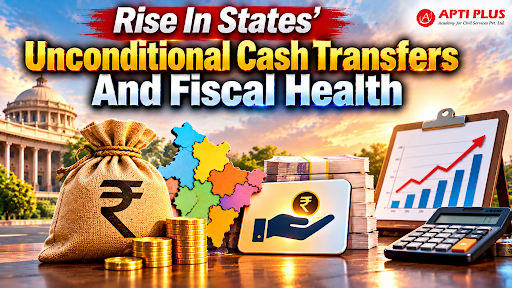
Indian states are projected to spend Rs 4 lakh crore (1% of GDP) on unconditional cash transfers in FY27—more than double the FY23 levels—raising serious concerns about rising fiscal deficits, elevated debt burdens, and the crowding out of essential infrastructure investments.
What Are Unconditional Cash Transfers (UCTs)?
-
Meaning: A UCT is a direct payment to a household or person with no condition on use or behaviour. This differs from conditional transfers tied to school attendance, vaccination or institutional delivery.
-
Typical Design: Most state schemes pay women ₹1,000 to ₹2,500 a month. Madhya Pradesh's Ladli Behna, Jharkhand's Maiya Samman and Tamil Nadu's Magalir Urimai Thogai follow this pattern.
-
Modern Wave: The current wave began with Assam's Orunodoi in 2020. It spread to West Bengal's Lakshmir Bhandar, Karnataka's Gruha Lakshmi and Maharashtra's Ladki Bahin.
-
Reach: Women-focused UCTs reach close to 12 crore women at a cost of about ₹1.7 lakh crore. (Source: Economic Advisory Council)
-
Older Conditional Models: Haryana's Apni Beti Apna Dhan (1994) and the National Social Assistance Programme (1995) were early transfers with targets. They set the base for later direct payments.
-
Legislative Space: Cash transfer schemes fall under both the State List and the Concurrent List, depending on design. States are therefore competent to run them.
-
Delivery Backbone: Direct Benefit Transfer, Aadhaar and bank accounts make monthly payments cheap to deliver. This lowers the cost of scaling such schemes.
How States Expanded Cash Transfers?
-
Number Of States: Only two states ran such programmes three years ago, but 12 states do now. They will together spend ₹1.68 lakh crore on women's UCTs in 2025-26. (Source: PRS)
-
Fivefold Rise: The number of states with UCTs rose fivefold between FY23 and FY26.
-
Annual Growth: Cash transfers grew at 24% a year in the five years up to 2023-24. This outpaced revenue receipts.
-
Scale Of Schemes: The latest state finance review identifies 128 UCT schemes across states and Union Territories. Their listed charts cover 30 states and UTs.
-
Share Of Revenue: Nine states spend over 10% of their revenue receipts on UCTs, including West Bengal, Andhra Pradesh and Telangana.
-
Share Of GSDP: Spending on cash assistance ranges from 0.19% to 1.25% of Gross State Domestic Product (GSDP). (Source: Economic Survey 2025-26)
-
Comparison With MGNREGA: The 12-state outlay of ₹1.68 lakh crore is nearly double the Union allocation of ₹86,000 crore for the rural jobs scheme in the same year. (Source: Union Budget 2025-26)
-
Newer Entrants: Delhi launched the Lakshmi Yojana in August 2026, paying ₹2,500 a month to eligible women. Punjab and Kerala have also added or expanded women's schemes in 2026-27.
Why Are States Expanding Cash Transfers?
-
Electoral Returns: Large transfers before polls have raised women's turnout in Karnataka, Maharashtra, Delhi and Bihar. Cash transfers to women were seen as a decisive factor in the NDA's win in Bihar.
-
Pre-Poll Payments: Bihar's Mukhyamantri Mahila Rozgar Yojana paid ₹10,000 each to 21 lakh women weeks before the 2025 election. It promises up to ₹2 lakh in later support.
-
Cross-Party Appeal: Parties across the spectrum have adopted such schemes. This shows that the trend is structural and not tied to one ideology.
-
Scale Of A Single Scheme: Maharashtra's Ladki Bahin planned ₹46,000 crore, about 0.8% of GSDP, for ₹1,500 a month to 2.6 crore women. It was the tenth state scheme of its kind.
-
Punjab's Entry: Punjab earmarked ₹9,300 crore in 2026-27 for a near-universal women's transfer. Its Finance Minister called it the world's first universal cash transfer for women.
-
Weak Revenue Growth: Revenue growth has lagged nominal GDP growth, so states feel squeezed. Cash transfers are a politically visible use of limited funds.
-
Fall In Central Grants: The RBI links the 2024-25 deficit rise partly to lower central grants, including GST compensation and revenue deficit grants. States have less cushion against new spending.
What Is The Current State Of State Finances?
-
Deficit Crossing 3%: The combined fiscal deficit of states rose to 3.3% of GDP in 2024-25, crossing 3% after three years. (Source: RBI)
-
Budgeted Pressure: Sixteen states budgeted a deficit above 3% of GSDP for 2025-26, and 13 of them above 3.5%.
-
Loan-Driven Deficit: The RBI says the higher deficit mainly reflects 50-year interest-free loans from the Centre for capital investment. These come on top of normal borrowing limits.
-
Revenue Deficit: The combined revenue deficit was 0.71% of GDP in 2025-26 and is budgeted at 0.2% (₹81,004 crore) for 2026-27. Twelve states budgeted a revenue deficit. (Source: PRS)
-
Fiscal Deficit Now: The 2026-27 fiscal deficit is 3.2% of GDP with Special Assistance to States for Capital Investment loans and 2.9% without them. Nine states exceed the 3% limit recommended by the 16th Finance Commission.
-
Debt: Aggregate liabilities were 28% of GDP in March 2026. Six states were above 35% of GSDP in 2025-26.
-
Capital Spending: States plan capital expenditure of about 2.9% of GDP, or ₹12,42,520 crore, in 2026-27. This is about 17% of total expenditure.
-
Rigid Spending: Salaries, pensions and interest take 52% of revenue receipts in 2026-27. Subsidies and transfers rose from 16% of revenue receipts in 2018-19 to 21% in 2023-24.

How Are Cash Transfers Affecting Fiscal Health?
-
Half In Revenue Deficit: About half of the states with UCTs are estimated to be in revenue deficit. Six of the 12 women-scheme states budgeted revenue deficits for 2025-26. (Source: Economic Survey 2025-26)
-
Adjusted Position: Without UCT spending, the revenue balances of these states improve. This shows that transfers account for much of the strain.
-
Karnataka: The state has moved from revenue surplus to deficit. Subsidies were 18.6% of its revenue receipts in 2024-25, mostly in women's schemes.
-
West Bengal: Its women's scheme alone takes about 11% of revenue receipts, the highest among states. Unconditional transfers were 61% of its subsidies and transfers in 2023-24.
-
Punjab: Subsidies were 19.3% of revenue receipts in 2024-25, with 94% going to power. The 2026-27 fiscal deficit is 3.4% of GSDP and debt exceeds 40%.
-
Maharashtra: Its revenue balance was -0.6% of GSDP in 2025-26, even though debt stays below 20% of GSDP. This shows strain even in a low-debt state.
-
Tamil Nadu And Kerala: Committed expenditure exceeds 60% of revenue receipts in both states. Kerala's guarantees are about 6% of GSDP.
-
Bihar: About 73% of Bihar's revenue receipts come from central assistance. Its own resources limit how long a large women's scheme can last.
What Do Supporters Say In Favour Of Cash Transfers?
-
Immediate Income Support: Even the Survey accepts that transfers give women immediate income support. This helps in times of price rise and job loss.
-
Weight In Household Income: Across seven states, transfers made up 11% to 24% of monthly income for female casual labourers. For some self-employed women the share was far higher.
-
Women's Agency: Direct payments to women's bank accounts give control over spending. This can improve household bargaining power.
-
Low Leakage: Direct Benefit Transfer reduces middlemen and delivers money in a few clicks. Administrative cost is small compared to in-kind schemes.
-
Local Demand: Payments are spent on food, school costs and small purchases. This supports local markets in poorer districts.
-
Rising Voice For Women: Women's turnout has risen in several states. Supporters see this as deeper democratic participation.
-
Policy Flexibility: States are adjusting designs under cost pressure, which shows learning. Maharashtra reduced payouts in April 2025.
Framework Governing State Borrowing And Freebies
|
Initiatives Taken To Balance Welfare And Fiscal Discipline
Sixteenth Finance Commission Limit: The Commission recommends a 3% fiscal deficit limit for states. This gives a clear benchmark against which cash transfer spending can be judged.
Special Assistance To States For Capital Investment (SASCI): The Centre gives 50-year interest-free loans for capital projects over and above normal borrowing limits. The scheme protects capital spending, but its loans add to the reported deficit.
RBI's Annual State Finances Report: The RBI publishes a yearly study of state budgets and flags risks from transfers, guarantees and debt. Its January 2026 edition urged a debt consolidation glide path.
Direct Benefit Transfer Architecture: The Centre's DBT platform moves money to verified accounts and reduces leakage. States use it to run cash schemes at low cost.
PM-KISAN: The scheme pays ₹6,000 a year to farmer families in three installments. It is the Centre's own direct transfer and shows the national scale of such payments.
Pradhan Mantri Matru Vandana Yojana: It pays ₹5,000 to pregnant and lactating women on conditions of registration and health check-ups. It is the main central model of a conditional transfer for women.
Deendayal Antyodaya Yojana-National Rural Livelihoods Mission: It organises women into self-help groups and offers credit. Bihar's Jeevika Didi and the Lakhpati Didi target tie income support to enterprise.
Beneficiary Verification By States: Maharashtra cut its scheme allocation from ₹46,000 crore to ₹36,000 crore after verification dropped ineligible women. Haryana added eligibility riders to its scheme.
Economic Survey Guidance: The Survey asks states to link transfers to health, education and skills and to reprioritise budgets. It gives a policy direction without limiting state autonomy.
What Are The Key Challenges In Managing Cash Transfers And State Finances?
Rising Revenue Deficits
-
Deficit In Revenue Account: Twelve states budgeted a revenue deficit for 2026-27. Borrowing for current spending leaves nothing for assets.
-
Persistent Strain: Half of states with UCTs were estimated to be in revenue deficit. The strain can grow when new schemes start in election years.
Crowding Out Of Capital Spending
-
Thin Capital Share: Capital expenditure is only 17% of total spending. This limits roads, irrigation and power that raise future growth.
-
Weak Growth Spending: West Bengal's capital outlay is just 1.9% of GSDP, while social services take over 52% of revenue spending.
-
Investment Risk: The RBI warns that such schemes run the risk of crowding out investment.
Rigid Committed Expenditure
-
Fixed Obligations: Salaries, pensions and interest take 52% of revenue receipts. Tamil Nadu and Kerala exceed 60%.
-
Little Room To Adjust: A new transfer must come from a shrinking share of free money. Most of the budget is already pre-committed.
High Debt And Hidden Liabilities
-
Debt Concentration: Six states carry debt above 35% of GSDP, and Punjab is above 40%. Interest consumes funds that could finance welfare.
-
Guarantees: Kerala's guarantees are about 6% of GSDP. Such off-budget liabilities hide the true burden.
Weak Targeting And Fiscal Reversals
-
Reduced Benefits: Maharashtra cut benefits from ₹1,500 to ₹500 for women already getting ₹1,000 under another scheme. Such cuts show that promises exceeded affordability.
-
Promise-Delivery Gap: Eligibility riders after launch cause exclusion. Many women were dropped from lists in Maharashtra.
Electoral Competition And Ratchet Effect
-
Bidding War: Parties compete with larger monthly payouts before elections. Once started, a scheme is politically hard to reduce.
-
Pre-Poll Timing: Payments made weeks before voting blur the line between welfare and inducement.
Limited Evidence On Outcomes
-
Uncertain Gains: The Survey finds limited evidence of improved nutrition, education and work participation. Without conditions, money may not change long-term outcomes.
-
Work Participation: Open-ended transfers may reduce incentive to seek paid work in low-income households. This needs state-level evaluation.
What Is The Way Forward For Balancing Cash Transfers And Fiscal Health?
Link Transfers To Verifiable Outcomes
-
Light Conditions: Tie part of the transfer to antenatal care, school retention for girls and skill enrolment. The Survey recommends such links.
-
Graded Payouts: Pay a base amount plus a bonus for outcomes. This protects the poorest while rewarding results.
Target Better And Use Verification
-
Exclusion Of Better-Off Households: Use income and asset data to limit payments to those who need them. Maharashtra's verification shows both the need and the risk of exclusion.
-
Avoid Duplication: Integrate state transfers with PM-KISAN and pensions. This stops overlap such as the Ladki Bahin cut.
Ring-Fence Capital Expenditure
-
Capex Floor: States can set a floor of about 3% of GSDP for capital spending in their fiscal laws. This guards growth spending.
-
Use Of SASCI: Direct 50-year interest-free loans to projects with clear returns. Do not divert them to current schemes.
Adopt A Debt Glide Path And Fiscal Disclosure
-
Debt Consolidation: High-debt states such as Punjab should follow a stated path to a lower debt ratio. The RBI recommends this.
-
Disclose Guarantees: Report off-budget liabilities and the cost of every new scheme in budget papers. This improves accountability.
-
Fiscal Council: Independent state fiscal councils can review cost estimates. This follows good practice in other federations.
Raise Own Revenue And Improve Spending Quality
-
Buoyant Taxes: Improve GST compliance, property tax and non-tax revenue. Better revenue lowers dependence on borrowing.
-
Rationalise Subsidies: Merge overlapping free power and cash schemes. Subsidies took 11% of revenue receipts in 2024-25.
Strengthen Electoral And Legal Safeguards
-
Costed Manifestos: Require parties to publish the cost and funding of promises, as the Election Commission has suggested.
-
Clear Standard: The Supreme Court can settle a test on freebies to give states certainty. This keeps debate within constitutional limits.
Build Evidence And Link To Women's Employment
-
Impact Evaluation: Study effects on nutrition, schooling and work in each state. Publish results to guide design.
-
Livelihood Link: Connect payments to self-help groups, credit and skills, as in Bihar's Jeevika model. This moves women from support to enterprise.
Learn From Global Conditional Models
-
Brazil's Bolsa Familia: It pays poor families on condition of school attendance and health check-ups. It is a model of linking income support to human capital.
-
Mexico's Progresa: Mexico's programme, begun in 1997, tied payments to children's schooling and clinic visits. Evaluations showed gains in enrolment and health.
-
Mongolia's Experience: Mongolia's universal cash handout in 2010 was financed by mining revenue. It was scaled back when revenue fell.
-
Kenya's Unconditional Trials: Randomised trials of unconditional transfers in Kenya found gains in assets and consumption. These results depended on targeting very poor households.
-
Alaska Permanent Fund: Alaska pays a yearly dividend from a sovereign resource fund. Such funding is not tied to annual tax revenue.
-
Indian Lesson: India's transfers draw on current revenue and borrowing. Without a dedicated fund, each rise in payout increases the deficit.
Conclusion
Cash transfers give women real income, but their rapid growth strains state finances and capital spending. States should link payouts to outcomes, improve targeting and follow a clear debt path.
Source: INDIANEXPRESS
|
PRACTICE QUESTION Q. Unconditional cash transfers give women income support but weaken the fiscal health of States. Critically Analyze (15 Marks, 250 Words) |