Why In News?
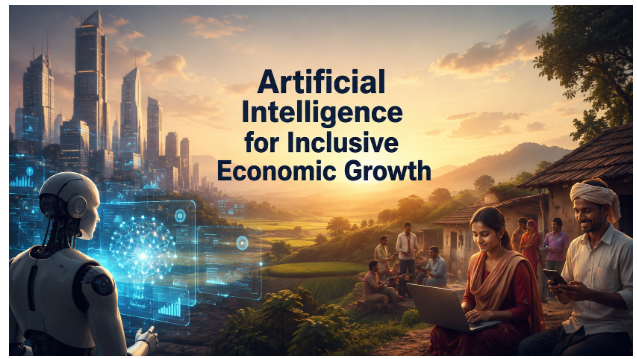
At the ET World Leaders Forum 2026, industry leaders and Google India stressed for inclusive, sovereign AI to support farmers, small businesses, and workers.
Highlights of the ET World Leaders Forum 2026
Empowering the "Torso and Long Tail" of the Economy
Leaders stressed that India's digital future depends on small enterprises, farmers, and gig workers in Tier-2, Tier-3, and rural regions, rather than concentrating technological dividends among a chosen few.
Transition from Experimentation to Full-Scale Deployment
Indian industry has moved beyond pilot experiments into active production deployment, demonstrated by Tata Steel deploying over 300 specialized AI agents for factory shop-floor worker safety, logistics optimization, and automated invoicing.
AI as a Force Multiplier for National Cybersecurity
Emerging AI technologies provide defensive security shields, enabling offline enterprise data protection and blocking billions of fraudulent network attacks on Android devices across vulnerable rural consumers.
Sovereign AI as Strategic Autonomy
Defined sovereign AI as national control and choice over foundational data, compute infrastructure, and domestic algorithmic development under the ₹10,372 crore IndiaAI Mission.
Evolution of Artificial Intelligence
Symbolic & Rule-Based AI (1950s–1980s): Relied on deterministic, hand-coded "if-then" rules and expert systems; struggled with complex real-world ambiguity and unformatted data.
Statistical Machine Learning (1990s–2000s): Shifted to statistical pattern recognition, decision trees, and regression algorithms trained on structured databases.
Deep Learning & Artificial Neural Networks (2010s): Leveraged multi-layered neural networks, backpropagation, and Graphics Processing Units (GPUs) to master image recognition, natural language processing, and speech synthesis.
Generative AI & Large Language Models (Early 2020s): Introduced self-attention transformer architectures (LLMs like GPT and Gemini) capable of generating human-like text, high-resolution imagery, and software code from massive global text corpora.
Multimodal, Edge-Based & Agentic AI (2024–2026+): Transitions to multi-modal reasoning (combining text, speech, satellite imagery, and sensor data) and autonomous Agentic AI capable of executing complex workflows, operating locally via Small Language Models (SLMs) on low-cost smartphones without constant cloud connectivity.
What is Inclusive AI?
Inclusive AI refers to the design, development, and deployment of artificial intelligence systems that are accessible, affordable, culturally representative, linguistically diverse, and non-discriminatory, ensuring that technological progress directly benefits underserved populations regardless of geographic location, gender, literacy level, or income.
Fundamental Principles:
-
Linguistic Parity: Voice-first interfaces supporting non-English and regional dialects.
-
Democratized Access: Low computational footprints operating seamlessly on basic hardware and 4G networks.
-
Algorithmic Fairness: Training datasets scrubbed of socio-economic and gender biases.
-
Augmentation over Displacement: Enhancing the productivity of human workers (farmers, teachers, healthcare workers) rather than replacing jobs.
Why Inclusive AI is Critical for India?
Linguistic Diversity & Illiteracy Barriers
Over 90% of India's population communicates in non-English languages; voice-first vernacular AI breaks traditional text-literacy barriers (like Bhashini), allowing illiterate and semi-literate citizens to interact with government welfare schemes effortlessly.
Transforming Agriculture & Smallholder Livelihoods
Empowers 14+ crore farming households (as per the Agriculture Census) with real-time, hyperlocal AI advisories on soil moisture, pest outbreaks, and weather predictions via satellite analytics, reducing crop loss.
Bridging the Rural Healthcare Gap
Overcomes the severe shortage of specialist doctors in rural India by deploying AI diagnostic imaging for diabetic retinopathy, tuberculosis screening from chest X-rays, and cervical cancer detection in remote Ayushman Arogya Mandirs (PHCs).
Unlocking MSME Productivity
Provides 6.3+ crore Micro, Small, and Medium Enterprises (MSMEs) in Tier-2/Tier-3 towns with automated financial bookkeeping, localized inventory management, and digital marketing tools to scale their businesses globally.
Personalized Vernacular Education
Delivers adaptive learning tools that adjust to each student's pace, as seen in the SATHEE portal (developed by IIT Kanpur), ensuring children in remote government schools access premier IIT/AIIMS pedagogical instruction for free.
Government Initiatives Supporting Inclusive AI
IndiaAI Mission (₹10,372 Crore Outlay): Approved by the Union Cabinet to deploy 10,000 to 38,000+ subsidized GPUs for startups, build indigenous foundational models, and finance deep-tech grassroots AI applications.
Digital India Bhashini (National Language Translation Mission): Voice-first open AI platform supporting over 36 text languages, 22 voice languages, and 350+ AI language models, enabling multilingual public service delivery.
AIKosh National Datasets Platform: A unified national repository under IndiaAI hosting 15,000+ curated datasets, 300+ open-source AI models, and 30+ developer toolkits, providing anonymized non-personal data for social welfare research.
AI for Farmers: Kisan e-Mitra & National Pest Surveillance: The voice-based Kisan e-Mitra AI chatbot answers PM-KISAN and PM Fasal Bima queries in 11 regional languages, handling over 20,000 daily queries and resolving 92+ lakh farmer issues. (Source: PIB)
YUVAi & FutureSkills Skilling Programs: Nationwide skilling drives implemented by MeitY and NeGD empowering school students across government and rural schools in Tier-2/Tier-3 towns with foundational AI literacy and ethical programming skills.
|
Key Reports
|
Challenges in Scaling Inclusive AI
Severe GPU Hardware Bottlenecks and Import Dependence: Complete reliance on imported advanced graphics processors (NVIDIA, AMD) and foreign semiconductor foundries creates high computing costs that exclude rural startups and academic institutions.
Persistent Rural Digital & Device Divide: Disparities in smartphone ownership (30% of rural women using smartphones compared to 45% of men), high-speed broadband availability, and digital literacy in remote tribal and agrarian pockets restrict smooth adoption of AI tools.
Scarcity of High-Quality Vernacular Data Corpora: Most global training data is in English; Indian languages suffer from uncurated text and voice datasets, leading to high error rates and algorithmic hallucinations in regional languages.
Energy, Power & Water Intensity of Hyperscale Data Centers: Massive AI computing facilities consume vast electrical power and millions of liters of cooling water, posing severe environmental sustainability challenges.
Algorithmic Bias, Deepfakes & Misinformation Scams: Proliferation of voice-cloning financial fraud, non-consensual synthetic media, and skewed predictive models disproportionately victimize digitally vulnerable rural citizens.
Risk of Job Displacement in Routine Service Sectors: Rapid automation of entry-level business process outsourcing (BPO), basic coding, and administrative jobs creates transition frictions for Tier-2 and Tier-3 youth.
Way Forward
Democratize Subsidized GPU Compute Infrastructure
Operationalize common-access sovereign compute clusters under the IndiaAI Mission, offering subsidized cloud credits to non-metro startups, agricultural innovators, and rural colleges.
Expand Open-Source Vernacular Voice Datasets via AIKosh
Institutionalize nationwide crowd-sourced voice collection drives under Digital India Bhashini to enrich linguistic AI training data across all dialects.
Embed AI Directly into Digital Public Infrastructure (DPI)
Integrate voice-based AI layers into UPI, DigiLocker, PM-KISAN, and Ayushman Bharat to enable seamless conversational governance for illiterate citizens.
Incentivize On-Device Small Language Models (SLMs)
Partner with domestic hardware manufacturers under the Production Linked Incentive (PLI) scheme to deploy lightweight, offline-capable AI models on sub-₹10,000 smartphones.
Establish Independent Statutory Algorithmic Audit Boards
Create ethical compliance boards under MeitY to audit high-stakes welfare and healthcare algorithms for demographic bias, fairness, and explainability.
Mandate Solar-Powered Green Data Centers
Provide fiscal incentives for establishing renewable-powered, liquid-cooled data center parks to decouple AI expansion from carbon emissions.
Scale Grassroots Community AI Literacy via Common Service Centres (CSCs)
Utilize the network of 5+ lakh CSC village-level entrepreneurs to train rural women, farmers, and artisans in utilizing AI tools for enterprise management.
Conclusion
By channeling the power of artificial intelligence to empower Tier-2, Tier-3, and rural Bharat, India transforms AI from an elite technological privilege into a universal public good, realizing the visionary goal of #AIforAll.
Source: ECONOMICTIMES
|
PRACTICE QUESTION Q. "The true measure of technological innovation lies not in the sophistication of its algorithms, but in its ability to uplift the most vulnerable citizen at the last mile." Discuss (15 Marks, 250 Words) |