Why In News?
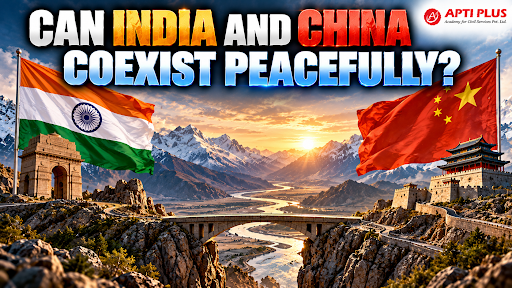
India-China relations remain a fragile, managed coexistence, where unresolved Line of Actual Control boundary disputes and historical mistrust risk turning minor patrolling friction into diplomatic and military standoffs.
What Is the Historical Background of India-China Relations?
Establishment of Diplomatic Relations in 1950
-
Non-Communist Recognition: India became the first non-socialist bloc country in Asia to establish formal diplomatic relations with the People’s Republic of China (PRC).
-
Early Bilateral Goodwill: India supported Beijing’s legitimate representation in the United Nations (UN) and recognized Chinese sovereignty over the Tibet Autonomous Region via the 1954 Sino-Indian Agreement.
Panchsheel Agreement, 1954
-
Codification of Peaceful Coexistence: Signed as the Agreement on Trade and Intercourse between Tibet Region of China and India, it established the Five Principles of Peaceful Coexistence (Panchsheel):
-
Mutual respect for each other’s territorial integrity and sovereignty.
-
Mutual non-aggression.
-
Mutual non-interference in each other’s internal affairs.
-
Equality and mutual benefit.
-
Peaceful coexistence.
-
Constitutional and Foreign Policy Baseline: These principles directly informed India’s foreign policy orientation under Article 51 of the Constitution of India (Promotion of international peace and security) and the Non-Aligned Movement (NAM).
Hindi-Chini Bhai-Bhai Phase
-
Post-Colonial Asian Solidarity: The mid-1950s witnessed high-level diplomatic warmth encapsulated by the slogan "Hindi-Chini Bhai-Bhai", projecting third-world solidarity at the Bandung Conference (1955).
-
Emergence of Latent Friction: Disputes over the un-demarcated boundary, China’s covert construction of the Western Tibet–Xinjiang Highway (G219) through Aksai Chin, and India granting political asylum to the 14th Dalai Lama in 1959.
India-China War of 1962
-
Territorial Flashpoint and Forward Policy: Border friction culminated in open warfare from 20 October to 21 November 1962 along the North-East Frontier Agency (NEFA) and Aksai Chin.
-
Unilateral Ceasefire and Strategic Trauma: Conflict ended with China declaring a unilateral ceasefire after capturing 38,000 sq km in Aksai Chin and advancing past the McMahon Line before pulling back in the east. This shattered bilateral trust and led to the severance of ambassadorial ties.
Restoration of Diplomatic Relations in 1976
-
Resumption of Ambassadorial Representation: Following a 14-year hiatus, full ambassadorial-level relations were formally restored in 1976 through mutual diplomatic initiatives.
-
Decoupling Disputes from Functional Engagement: The visit of External Affairs Minister Atal Bihari Vajpayee in 1979 paved the way for eight rounds of official border talks between 1981 and 1987.
Rajiv Gandhi's Visit to China in 1988
-
The Historic Modus Vivendi: Prime Minister Rajiv Gandhi’s visit in December 1988 established a strategic breakthrough with Deng Xiaoping.
-
Institutionalizing the Joint Working Group (JWG): Both sides agreed to set aside the boundary dispute while normalizing trade, cultural, and scientific exchanges, institutionalized through the India-China Joint Working Group on the Boundary Question.
-
Legal CBM Frameworks: This visit led to the 1993 Border Peace and Tranquility Agreement (BPTA) and the 1996 Agreement on Military Confidence Building Measures, prohibiting the use of firearms along the Line of Actual Control (LAC).
Strategic and Cooperative Partnership, 2005
-
Upgrading Bilateral Status: During Chinese Premier Wen Jiabao’s visit to New Delhi in April 2005, ties were elevated to a "Strategic and Cooperative Partnership for Peace and Prosperity".
-
Political Parameters and Guiding Principles: Two nations signed the Agreement on the Political Parameters and Guiding Principles for the Settlement of the India-China Boundary Question (2005), agreeing that boundary settlement must safeguard settled populations.
-
Special Representatives (SR) Mechanism: Institutionalized SR Mechanism, established in 2003, held over 22 formal rounds of boundary negotiations.
Informal Summits at Wuhan (2018) and Chennai (2019)
-
Post-Doklam Reset: Following the 73-day military standoff at the Doklam Plateau in 2017, Prime Minister Narendra Modi and President Xi Jinping held the first Informal Summit in Wuhan (April 2018) to provide strategic guidance to their respective militaries.
-
Chennai Connect: The second Informal Summit at Mamallapuram (Chennai, October 2019) focused on rules-based trade, establishing a High-Level Economic and Trade Dialogue, and cultural tourism connectivity.
Galwan Valley Clash, 2020
-
Violent Rupture of the 45-Year Peace: In June 2020, violent hand-to-hand combat in the Galwan Valley (Eastern Ladakh) resulted in the deaths of 20 Indian soldiers and at least 4 Chinese soldiers.
-
Systemic Standoff and Economic Sanctions: Clash breached the 1993/1996 bilateral CBMs, freezing political ties and prompting India to deploy counter-measures:
-
Emergency military mobilization and mirror deployments along the LAC.
-
Blocking over 200 Chinese mobile applications under Section 69A of the Information Technology Act, 2000.
-
Restricting capital inflows through Press Note 3 (2020 Series) by the DPIIT.
-
October 2024 Border Disengagement: Following prolonged military and diplomatic rounds under the Working Mechanism for Consultation and Coordination (WMCC), both nations established a consensus restoring coordinated patrolling rights in Depsang Plains and Demchok.
What are the Major Areas of Cooperation between India and China?
Bilateral Trade and Investment
-
Expanding Trade Volumes: Bilateral commerce crossed USD 151 billion in 2025–26, with China remaining one of India's largest trading partners despite strategic frictions.
-
Crucial Industrial Inputs: Trade provides cost-effective intermediate goods, machinery, and capital equipment that sustain domestic manufacturing and consumer markets.
Multilateral Cooperation through BRICS
-
Institutional Development Financing: Both nations are co-founders of the New Development Bank (NDB) under the 2014 Fortaleza Agreement, mobilizing equal voting shares to fund sustainable infrastructure across emerging economies.
-
Alternative Payment Plumbing: Functional coordination focuses on local-currency invoicing, cross-border payment interoperability, and reducing transaction costs in emerging markets.
Shanghai Cooperation Organisation (SCO)
-
Regional Security and Counter-Terrorism: Cooperation operates through the Regional Anti-Terrorist Structure (RATS-SCO) to coordinate intelligence on extremism, separatism, and terrorism across Eurasia.
-
Connectivity and Energy Dialogues: The SCO serves as an institutional platform for high-level bilateral sideline discussions (e.g., Tianjin SCO Summit 2025).
G20 Cooperation
-
Global South Alignment: Coordination focuses on multilateral development bank (MDB) reform, sovereign debt restructuring for low-income nations, and sustainable development finance.
-
Consensus Building: Mutual engagement enabled adoption of the New Delhi Leaders' Declaration (2023) on digital public infrastructure and climate finance.
Climate Change Negotiations
-
BASIC Coalition Solidarity: India and China collaborate within the BASIC grouping (Brazil, South Africa, India, China) and Like-Minded Developing Countries (LMDC) at UNFCCC COP summits.
-
Common but Differentiated Responsibilities (CBDR): Both demand equitable carbon space, climate finance delivery from historical polluters, and push for a phased reduction of all fossil fuels rather than coal-only phase-outs.
World Trade Organisation (WTO)
-
Defense of Special and Differential Treatment (S&DT): Joint advocacy protects development flexibilities and policy space for emerging economies against plurilateral tariff pressures.
-
Agricultural Protection and Public Stockholding: Cooperation resists Western attempts to dismantle farm subsidies and supports a permanent solution for Public Stockholding for Food Security Purposes (PSH).
Cooperation among Developing Countries
-
Voice of the Global South: Mutual positions emphasize non-interference, state sovereignty, and equitable technology transfer in international forums.
-
South-South Institutional Platforms: Engagement spans the G77+China, Asian Infrastructure Investment Bank (AIIB)—where India is the second-largest shareholder after China—and South-South development funds.
People-to-people and Cultural Exchanges
-
Civilizational and Religious Linkages: Shared historical legacy through the transmission of Buddhism via ancient scholars (e.g., Xuanzang, Bodhidharma).
-
Institutional CBMs and Pilgrimages: Traditional border trade and pilgrimages include the Kailash Mansarovar Yatra across Lipulekh and Nathu La passes.
Cooperation on Global Governance Reforms
-
Reforming Bretton Woods Institutions: Joint insistence on quota formula revisions in the International Monetary Fund (IMF) and World Bank to reflect shifting economic weight.
-
Democratization of International Law: Opposition to unilateral economic sanctions, extraterritorial legal coercion, and weaponized trade mechanisms.
What are the Major Areas of Conflict between India and China?
Unresolved Boundary Dispute
-
Lack of Demarcation: The 3,488-km Line of Actual Control (LAC) remains un-demarcated on the ground and un-delineated on official maps across Western, Middle, and Eastern sectors.
-
Overlapping Perceptions: Conflicting claim lines generate frequent operational frictions, patrolling face-offs, and accidental escalations.

Chinese Claims over Arunachal Pradesh
-
Cartographic Aggression: China claims 90,000 sq km of Arunachal Pradesh, terming it "Zangnan" (South Tibet), refusing to recognize the McMahon Line agreed at the Simla Convention (1914).
-
Sovereignty Subversion: Beijing repeatedly issues standardized Chinese place names for geographical features, grants stapled visas to residents, and objects to visits by Indian constitutional leaders.
Aksai Chin Territorial Dispute
-
Illegal Occupation: China illegally occupies approximately 38,000 sq km of Aksai Chin in the Western Sector, providing strategic connectivity between Tibet and Xinjiang via the G219 Highway.
-
Ceded Territory: China exercises control over 5,180 sq km of northern Kashmir in the Shaksgam Valley, illegally ceded by Pakistan under the 1963 Sino-Pakistan Boundary Agreement.
Chinese Military Infrastructure near the LAC
-
Dual-Use Frontier Fortifications: Rapid construction of forward helipads, subterranean ammunition depots, heavy surface-to-air missile (SAM) sites, and twin bridges across Pangong Tso.
-
Xiaokang Border Villages: Construction of over 628 dual-use border model villages along the frontier to alter demographic facts and serve as forward logistics hubs.
China-Pakistan Strategic Partnership
-
"All-Weather Strategic Cooperative Partnership": Deep military and intelligence coordination directed against India, creating a persistent two-front security dilemma.
-
China-Pakistan Economic Corridor (CPEC)
-
Direct Sovereignty Violation: A USD 62 billion project under the Belt and Road Initiative (BRI), CPEC runs directly through Pakistan-occupied Kashmir (PoK / Gilgit-Baltistan), violating India's territorial sovereignty.
-
China's Support to Pakistan at International Forums: Frequent use of China’s veto as a Permanent Member (P5) to place technical holds on UNSC Resolution 1267 Al-Qaeda and ISIL Sanctions Committee listings of Pakistan-based terrorists (e.g., Jaish-e-Mohammed and Lashkar-e-Taiba leaders).
China's Growing Presence in the Indian Ocean Region (IOR)
-
String of Pearls and Dual-Use Ports: Commercial control and operational access across regional maritime nodes:
-
Hambantota Port (Sri Lanka – 99-year lease).
-
Gwadar Port (Pakistan).
-
Kyaukpyu Deep-Sea Port (Myanmar).
-
Military and Spy Ship Deployments: Permanent PLA Navy anti-piracy task forces, nuclear-powered attack submarines (SSNs), and dual-use space/satellite tracking research vessels (e.g., Yuan Wang series) surveying the Bay of Bengal.
-
Overseas Base: Operationalization of China's first overseas military base at Djibouti near the Bab-el-Mandeb strait.
Trade Imbalance
-
Chronic Asymmetry: India's merchandise trade deficit with China crossed $112.2 billion in FY25.
-
Structural Divergence: India exports low-value primary commodities (iron ore, cotton, granite) while importing high-technology capital goods, active pharmaceutical intermediates, and telecom hardware.
Competition for Regional Influence in South Asia
-
Erosion of India's Traditional Primacy: Beijing leverages massive state-backed loans, infrastructure investments, and defense pacts to pull South Asian neighbors (Nepal, Maldives, Sri Lanka, Bangladesh) into its strategic orbit.
-
Strategic Leverage: Debt-trap vulnerabilities in neighboring states create military footholds that constrain India’s regional security perimeter.
China's Opposition to India's NSG Membership
-
Multilateral Stonewalling: Beijing vetoes India’s entry into the Nuclear Suppliers Group (NSG), citing India’s non-signatory status to the Non-Proliferation Treaty (NPT).
-
Equating with Pakistan: Insists on a criteria-based approach explicitly designed to link India’s membership with Pakistan’s application.
What is the Strategic Significance of China for India?
India's Largest Neighbouring Economy
-
Economic Scale Differential: China's $21.5 trillion GDP is nearly 5 times larger than India's, making it the most consequential external economic actor shaping regional stability.
-
Global Market Driver: As the world's second-largest economy, its growth trajectories, fiscal policies, and domestic demand directly dictate international commodity prices, global inflation, and shipping costs.
Major Trading Partner
-
Crucial Industrial Sourcing: Bilateral trade provides cost-effective capital goods and technology inputs essential for India's service and manufacturing competitiveness.
-
Export Market: China remains a major destination for Indian primary commodities, marine products, and specialty chemicals.
Influence in South Asia
-
Contested Neighborhood: China’s extensive investments across the Himalayan belt and the Indian Ocean littoral mean New Delhi cannot formulate regional foreign policy without factoring in Chinese balance-of-power initiatives.
-
Security Buffer Erosion: Strategic developments in Nepal, Bhutan, and Myanmar alter traditional northern geographic security buffers.
Strategic Presence in the Indian Ocean
-
Maritime Chokepoint Overlap: Over 80% of China's crude oil imports transit the Malacca Strait and the IOR, overlapping directly with India’s primary maritime interest zones and security lanes.
-
Force Projection Balance: Chinese naval expansion compels the Indian Navy to transition from coastal brown-water defense to comprehensive blue-water power projection and maritime domain awareness (MDA).
Influence over India's Neighbouring Countries
-
Checkbook Diplomacy: Beijing's financing capacity fills infrastructure deficits in regional countries, offering an alternative to Indian developmental assistance.
-
Domestic Political Sway: Shifts in regime alignment in Male, Colombo, and Kathmandu frequently pivot around balancing relations between New Delhi and Beijing.
Manufacturing and Supply Chain Dominance
-
Upstream Industrial Monopolies: China controls 70% of global rare earth processing, 85% of solar photovoltaic components, and 75% of lithium battery manufacturing.
-
PLI Scheme Dependency: India’s Production-Linked Incentive (PLI) schemes rely heavily on imported sub-assemblies and intermediate inputs manufactured in Chinese industrial clusters.
Permanent Membership of the UN Security Council
-
Multilateral Veto Power: As a P5 member, China wields veto authority on critical security matters affecting India’s sovereign interests, territorial claims, and cross-border terrorism declarations.
-
UNSC Restructuring Blockade: Beijing remains the primary institutional roadblock preventing India’s permanent accession to an expanded UN Security Council.
Influence in Global Multilateral Institutions
-
Institutional Leadership: Beijing heads and finances key non-Western frameworks, including the AIIB, SCO, and the expanded BRICS+ architecture.
-
Norm-Setting Authority: Plays an influential role in framing standards for the digital economy, cross-border payment platforms, international green transition standards, and space exploration.
What are the Major Challenges to Peaceful Coexistence?
Lack of Mutual Strategic Trust
-
Civilizational Hegemony vs Multipolarity: China seeks a unipolar Asia with Beijing at the center, viewing India through the prism of its broader competition with the United States. India insists on a multipolar Asia as an indispensable condition for a multipolar world.
-
Status Incongruence: Beijing’s refusal to treat India as an equal peer state fuels a profound security dilemma.
Unresolved Boundary Dispute
-
Perceptual Divergences: The existence of multi-sectoral territorial disputes without agreed coordinates leaves the border vulnerable to periodic localized crises.
-
Three-Step Roadblock: Diplomatic consensus at Depsang and Demchok marks only initial tactical disengagement; comprehensive de-escalation and permanent military de-induction remain unachieved.
Military Infrastructure Competition
-
Infrastructure Arms Race: India’s construction of the Darbuk–Shyok–Daulat Beg Oldi (DS-DBO) Road, strategic tunnels (Sela, Atal), and advanced landing grounds (ALGs) matches China’s highway, railway, and airbase upgrades along the Tibetan plateau.
-
Mutual Threat Perception: Infrastructure built for defensive frontier management is interpreted by the other side as offensive mobilization capability.
China's Strategic Partnership with Pakistan
-
Structural Collusion: The deep institutionalized defense and intelligence nexus institutionalizes a two-front conventional war threat for India.
-
Nuclear and Missile Proliferation: Historical and ongoing transfers of dual-use missile delivery systems and enrichment components consolidate a hostile nuclear perimeter.
Competition for Regional Dominance
-
Zero-Sum Geopolitics: Both states view infrastructure financing and political partnerships in South Asia through a zero-sum strategic lens.
-
Institutional Counter-Balancing: India deepens alignment with the Quad (India, US, Japan, Australia) to balance Chinese maritime power, while China views the arrangement as an "Asian NATO" designed to contain its rise.
Differing Perceptions of the Indo-Pacific
-
Geopolitical Nomenclature: India champions a "Free, Open, and Inclusive Indo-Pacific" rooted in international law (UNCLOS); Beijing rejects the term "Indo-Pacific" as a US-led geopolitical construct targeting China.
-
Freedom of Navigation: China contests Indian naval deployments and commercial oil exploration blocks in the South China Sea, while India monitors Chinese dual-use vessels entering the IOR.
Water Security Concerns
-
Upstream Hydro-Hegemony: China controls the headwaters of vital transboundary river systems, most notably the Yarlung Tsangpo (Brahmaputra) and the Sutlej.
-
Mega-Dam Construction: Construction of the 60-gigawatt Medog Mega-Dam on the Great Bend of the Yarlung Tsangpo raises severe risks of water diversion, flash floods, silt deprivation, and ecological destruction in Assam and Arunachal Pradesh.
-
Data Withholding: Absence of a comprehensive bilateral water-sharing treaty; hydrological data sharing remains ad-hoc and subject to political suspension during standoffs.
Domestic Political and Nationalist Pressures
-
Hyper-Nationalist Narratives: Intense media coverage and heightened popular nationalism in both countries restrict diplomatic flexibility and penalize political compromise.
-
Legislative and Policy Hardening: Indian parliamentary oversight and domestic calls for economic boycotts limit the executive's capacity to normalize commercial ties without verified border resolution.
Lack of Progress on Boundary Settlement
-
Stagnant SR Framework: Despite more than two decades of talks, the Special Representatives mechanism has failed to transition from identifying principles to actual map clarification or ground demarcation.
-
Salami Slicing Tactics: Persistent low-level tactical incursions by the PLA gradually alter baseline territorial realities in friction areas.
What is the Way Forward for Peaceful India-China Coexistence?
Maintain Peace and Tranquillity along the LAC
-
Adherence to Bilateral Accords: Strictly uphold the foundational principles of the 1993, 1996, and 2005 border agreements, completely prohibiting aggressive forward patrolling and unilateral status-quo alterations.
-
Operational Buffer Stabilization: Maintain temporary mutual buffer zones in completed friction points without relinquishing sovereign territorial claims, preventing physical combat.
Resolve Boundary Disputes through Diplomatic Dialogue
-
Re-energize the Special Representatives (SR) Talks: Transition the SR framework from process management to substantive delineation of the Line of Actual Control on agreed maps.
-
Sectoral Boundary Clarification: Clarify coordinates sector-by-sector (starting with the least contested Middle Sector) to eliminate overlapping patrol points.
Strengthen Military Confidence-Building Measures (CBMs)
-
Modernized Protocols: Formulate updated Standard Operating Procedures (SOPs) reflecting modernized drone surveillance, high-altitude cameras, and mechanised movements.
-
Hotlines and Command Meetings: Establish a functional, secure hotline between the Director General of Military Operations (DGMO) of the Indian Army and the PLA Western Theater Command, supplementing institutional Border Personnel Meetings (BPMs).
Prevent Border Incidents and Miscalculations
-
Joint Aerial and Drone Guidelines: Institute clear flight-buffer zones for unmanned aerial vehicles (UAVs) and combat aircraft along the LAC to prevent mid-air escalation.
-
Coordinated Patrolling Frameworks: Systematically execute the October 2024 Patrolling Consensus with pre-scheduled timings and mutual real-time verifications.
Improve Economic Reciprocity
-
Removal of Non-Tariff Barriers: Press Beijing for transparent market access in sectors where India holds global export competitiveness, including generic pharmaceuticals, IT services, and agricultural products.
-
Addressing Dumping: Strengthen targeted, evidence-based anti-dumping investigations through the Directorate General of Trade Remedies (DGTR) under WTO rules to safeguard domestic micro, small, and medium enterprises (MSMEs).
Reduce Critical Import Dependence
-
Targeted Industrial Substitution: Fully execute the Production-Linked Incentive (PLI) Schemes across active pharmaceutical ingredients, semiconductor fabrication, solar photovoltaic modules, and electronics hardware.
-
Supply Chain Diversification: Accelerate friend-shoring partnerships through the Supply Chain Resilience Initiative (SCRI) with Japan and Australia, expanding trade with ASEAN, the EU, and the United States.
Strengthen Strategic Communication
-
Institutionalize Regular Political Dialogues: Re-establish structured political-level dialogues and bilateral summits alongside multilateral summits (BRICS, SCO, G20).
-
Multi-Tiered Channels: Maintain uninterrupted engagements between National Security Advisors, Foreign Ministers, and the Working Mechanism for Consultation and Coordination (WMCC).
Promote Transboundary River Cooperation
-
Comprehensive Water Treaty: Pursue a formal, legally binding bilateral treaty on transboundary river management, transcending ad-hoc flood-season data sharing.
-
Joint Hydrological Monitoring: Establish institutional mechanisms under the Expert-Level Mechanism (ELM) for real-time data sharing and joint environmental impact assessments on the Yarlung Tsangpo / Brahmaputra River.
Expand People-to-People Exchanges
-
Facilitate Regulated Mobility: Resume direct commercial flights, ease business visas, and re-establish scientific, academic, and track-II diplomatic dialogues.
-
Cultural and Youth Connectivity: Expand tourism linkages, restore traditional religious yatras, and promote educational language exchanges under strict regulatory oversight.
Strengthen Multilateral Cooperation
-
Pragmatic Alignment on Non-Strategic Issues: Maximize functional cooperation within BRICS, the New Development Bank (NDB), the AIIB, and the WTO on climate finance, sovereign debt relief, and Global South representation.
-
Prevent Institutional Hegemony: Resist attempts to transform developmental platforms into anti-Western coalitions, safeguarding balanced multilateralism.
Maintain Strategic Autonomy
-
Multi-Alignment Foreign Policy: Calibrate external partnerships without entering formal military alliances; balance constructive participation in BRICS and the SCO with proactive engagement in the Quad and Western technology partnerships (iCET).
-
Internal Balancing Primacy: Build domestic economic resilience, industrial prowess, and defensive military deterrence as the primary guarantee of national security.
Follow the Principles of Mutual Respect, Mutual Sensitivity, and Mutual Interest
-
The "Three Mutuals" Doctrine: Anchor all future bilateral normalization strictly on the framework articulated by India:
-
Mutual Respect: Full recognition of each other’s territorial sovereignty and equality as emerging civilizational powers.
-
Mutual Sensitivity: Respecting core national redlines (Tibet and Taiwan for China; Jammu & Kashmir, Ladakh, and Arunachal Pradesh for India).
-
Mutual Interest: Constructing an equitable, mutually beneficial relationship where legitimate developmental and security interests are accommodated.
Conclusion
Achieving peaceful coexistence with China requires India to strengthen domestic manufacturing and border defense while maintaining mutual respect through strategic, balanced diplomacy.
Source: THEHINDU
|
PRACTICE QUESTION Q. India and China are both strategic competitors and potential partners in an increasingly multipolar world. Examine. 250 words |