DOWN TO EARTH: Can cash transfers empower women? | NOVEMBER 23, 2026
-
Unconditional Cash Transfers (UCTs) now cover 15 states and one union territory, up from a single state in 2020. They reach about one-fifth of the female population, with an estimated spend of ₹1.7 lakh crore for 12 crore women in 2025-26. Examples include Annapurna Bhandar (West Bengal), Ladli Behna Yojana (Madhya Pradesh) and Subhadra Yojana (Odisha). Evidence suggests transfers strengthen women's bargaining power, savings, consumption and financial inclusion. They also improve household nutrition and spending on education and healthcare. Amartya Sen's capability approach views cash as a means to expand women's real freedoms.
-
Cash alone cannot deliver durable economic independence. Female LFPR was 34.6% in September 2026, and India's economic participation parity score in the Global Gender Gap Report 2026 is 41.2%, below its 2013 peak of 44.6%. The male–female workforce participation gap is 40.8 percentage points.
-
Transfers address the consequence of exclusion, not its causes: childcare burdens, social norms, unsafe transport and a lack of suitable jobs. They can also reinforce dependency if they substitute for employment, assets, public services and institutional reform. The way forward is to link transfers to outcome-based indicators such as reduced stunting and anaemia, and to use them as a platform for capability expansion. Supporting efforts include 70 central and 400 state schemes for women entrepreneurs, a 429% rise in gender budgets (2013-14 to 2025-26), and women's 68% share of MUDRA loan accounts.
GS I/II: Q. Do unconditional cash transfers lead to genuine empowerment of women? Critically examine. (150 words)
THE HINDU: Core accountability: On core sector performance | NOVEMBER 23, 2026
-
Core sector growth of 10.9% in October 2026 is a series high, but it owes more to a low base effect than to underlying strength. The index had grown just 0.8% in October 2025.
-
Coal grew 23% after contracting about 8.5% last October, and electricity grew nearly 22% after a near-7% contraction. Differences in the timing of the festive season likely distort the base, so November data will give a more accurate picture. Construction-related sectors show genuine growth, reflecting the infrastructure push. Iron ore grew 26.4% (8.7% last year), cement 15.4% (5.2%) and steel 7.3% (9.5%). Dependence on government spending is likely to continue as higher costs squeeze corporate margins. Crude oil contracted 4.1%, its 22nd straight month of decline, and natural gas contracted 7.6%, a series-worst and 28th straight month of decline. Falling output and rising import dependence are a major driver of high inflation.
-
The editorial wants the Petroleum Ministry to explain the decline to Parliament or the public, and to fix accountability for the underperformance of oil and gas PSUs.
GS III: Q. Statistical base effects can distort the assessment of economic performance. Discuss with reference to India's core sector growth. (150 words)
THE HINDU: Paper tiger: On the Green India Mission | NOVEMBER 23, 2026
-
Following a CAG report, the Public Accounts Committee (PAC) on November 19 criticised the Environment Ministry for the Mission's virtual failure and for not issuing implementation guidelines for its revised form.
-
The original vision was to expand forest and tree cover by 5 mha, improve forest quality on another 5 mha, improve livelihoods for 3 million households and sequester up to 60 million tonnes of CO₂ a year, with an outlay of ₹46,000 crore. In 2014 the Cabinet approved ₹13,000 crore, with 81.5% to come from CAMPA, NAP and MGNREGS funds.
-
The financial design was flawed from the start, and the Ministry of Rural Development had objected to it. The 2021 revision kept the same arrangement. The mid-2025 revision targets 25 mha by 2030 with ₹12,190 crore, of which 24 mha is to come through other schemes, leaving the Mission responsible for only 1 mha. Because the promised funds never materialised, forest quality and forest cover targets have fallen short by 91.8% and 97.5% respectively against the 2014 targets. The government has repeatedly launched programmes that rely on funds from existing schemes, as with Jal Shakti Abhiyan (2019) and Dharti Aaba Janjatiya Gram Utkarsh Abhiyan (2024). Climate action needs adequate dedicated resources, clear division of responsibilities and monitoring. Shifting financial responsibility to States under VB-G RAM G also undermines climate justice.
GS III: Q. The failure of the Green India Mission highlights deeper flaws in the financing and implementation of climate programmes in India. Discuss. (150 words)
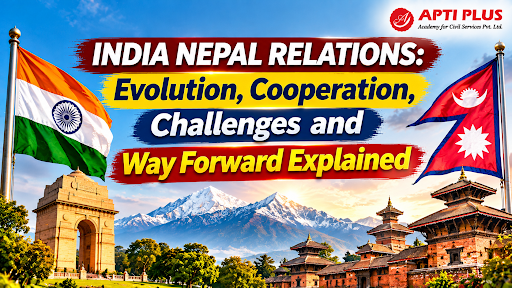
THE INDIAN EXPRESS: With Balen Shah in India, Delhi must size up new Kathmandu, speak to it | NOVEMBER 23, 2026
-
Nepal's Prime Minister Balendra Shah is on his first official visit to India, and his first bilateral visit abroad since taking office in March 2026. He came to power on a Gen Z-led uprising that toppled the K P Sharma Oli government, with the Rastriya Swatantra Party winning a mandate against the traditional political establishment. India is Nepal's largest trading partner and an important source of investment, development assistance and employment. Nepal's concerns about dependence on Indian transit routes and economic asymmetry have often strained ties. The Lipulekh Pass dispute in May is a recent example. India and China agreed to resume the Kailash Mansarovar pilgrimage via the route without consulting Kathmandu. Shah's "Nepal First" doctrine means India must respect Nepal's political choices, though without compromising its own national interests. Flood reconstruction offers an immediate opening to build trust, with a financial assistance package reportedly on the agenda. Hydropower needs market access, investment-friendly policies and transmission infrastructure. Connectivity by road, rail and air matters, including Nepal's demand for additional air-entry routes, which India has resisted over security and air traffic management concerns.
-
India should deepen cooperation in areas like the start-up ecosystem to meet the aspirations of Nepal's youth. Ties between unequally sized neighbours cannot be sustained by deference alone.
GS II: Q. Political change in Nepal calls for a recalibration of India's approach to the relationship. Discuss. (150 words)