Why In News?
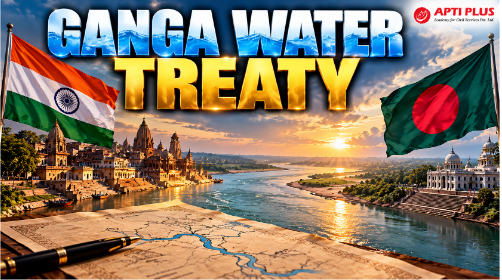
The Ganga Water Treaty 1996 between India and Bangladesh will reach its 30-year term on 12 December 2026, forcing bilateral renegotiations alongside domestic demands from Bihar and West Bengal for structural treaty updates.
What Is The India-Bangladesh Ganga Water Sharing Treaty Of 1996?
The Ganga Water Treaty 1996 was signed on 12 December 1996 by former Indian Prime Minister H.D. Deve Gowda and Bangladeshi Prime Minister Sheikh Hasina to govern dry-season water allocation (1 January to 31 May) at Farakka Barrage across 10-day cycles for a 30-year tenure expiring on 12 December 2026.
-
Water allocation is calculated using historical hydrological flow data recorded between 1949 and 1988 at Farakka Barrage.
-
If river discharge at Farakka Barrage exceeds 75,000 cusecs, India receives a fixed share of 40,000 cusecs, with the remaining balance going to Bangladesh.
-
When river flow fluctuates between 70,000 and 75,000 cusecs, Bangladesh receives 35,000 cusecs and India retains the remaining flow.
-
For total discharge falling below 70,000 cusecs, water is divided on an equal 50:50 baseline.
-
The agreement is monitored through a bilateral Joint Committee alongside the Joint Rivers Commission established in 1972.
Ganga River Basin
|

What Are The Major Concerns With The Existing 1996 Framework?
Outdated Hydrological Baselines: Allocations rely strictly on historical flow records from 1949–1988, ignoring post-1990 climate change and upstream water withdrawals
Neglect Of Ecological Flows: The treaty focuses exclusively on volumetric water division without incorporating environmental flow requirements or water quality standards.
Absence Of Binding Arbitration: Article VII restricts dispute resolution to political consultations between governments, lacking binding third-party arbitration mechanisms.
Unfulfilled Infrastructure Commitments: Bangladesh highlights unkept assurances regarding technical assistance for constructing a downstream barrage on the Padma River.
Climate Change Altering The Ganga Basin's Hydrology
-
Accelerating Himalayan glacial melt and shifting monsoon precipitation patterns generate extreme flow variability across the basin.
-
Prolonged dry-season droughts and intense monsoon floods destabilize static 10-day water allocation schedules.
-
Intensified water stress across agricultural deltas accelerates salinity intrusion in the Sundarbans mangrove ecosystem.
Absence of Multilateral Approach
-
The Ganga is a shared transboundary system where Nepal contributes vital lean-season snowmelt through upper tributaries.
-
Managing river flows solely at Farakka Barrage ignores upstream abstractions, catchment degradation, and groundwater-surface water interactions across the entire basin.
-
Expanding bilateral channels into a trilateral Ganges-Brahmaputra-Meghna (GBM) framework involving Nepal, India, and Bangladesh aligns with holistic river basin management.
What Are Bangladesh's Major Concerns Regarding Water Availability?
Dry-Season Flow Shortfalls & Unfulfilled Quotas: Hydrological assessments from 1997 to 2016 show that Bangladesh failed to receive its stipulated water allocation in 39 out of 60 critical dry-season 10-day cycles.
Impact on Agricultural & Economic Livelihoods: Decreased lean-season water supply impairs Boro rice cultivation, disrupts inland river navigation, and degrades freshwater fisheries vital to coastal and deltaic communities.
Ecological Degradation & Sundarbans Salinity: Reduced upstream freshwater flows accelerate saltwater intrusion across the Sundarbans delta, threatening mangrove biodiversity, soil fertility, and ecosystem stability.
Structural Shortcomings of the 1996 Treaty:
-
Absence of a Minimum Guarantee Clause: If total discharge at Farakka Barrage falls below 50,000 cusecs, the treaty lacks an absolute floor, mandating only immediate diplomatic consultations under Article II without guaranteed release volumes.
-
Neglect of Ecological Flow & Water Quality: Agreement focuses strictly on volumetric division at a single point, omitting environmental flow standards and ignoring water pollution caused by urban, industrial, and agricultural runoff.
-
Lack of Binding Arbitration: Article VII restricts conflict resolution to mutual diplomatic discussions, lacking an independent arbitration mechanism or tribunal to resolve deadlocks.
-
Unfulfilled Infrastructure Commitments: Bangladesh highlights that assurances regarding technical support to build a downstream barrage on the Padma River inside Bangladeshi territory were never realized.
Outdated Baselines & Exclusion of Upstream Riparians: Allocations remain tied to historical flow data recorded between 1949 and 1988, failing to account for post-1990 climate change, glacial melt, or snowmelt contributions from Nepal's tributaries (Ghaghara, Gandaki, and Koshi)
What Are India's Strategic Interests And Domestic State Priorities?
Navigability of Kolkata Port & Regional Water Security: India's primary operational goal at Farakka Barrage since 1975 has been diverting 40,000 cusecs into the Hooghly River to prevent siltation, preserve the navigability of Kolkata Port, and supply drinking and industrial water across West Bengal.
Federal Pressures (Bihar)
-
Leaders in Bihar contend that backwater effects created by Farakka Barrage trap heavy sediment, raise the Ganga riverbed height upstream, and turn seasonal monsoons into severe inundations.
-
Bihar reports that during dry months, entry flows at Buxar drop to barely 400 cumecs, leaving domestic irrigation needs unmet while substantial flows are committed downstream. State leaders have called for the treaty to lapse or be fundamentally restructured.
Federal Pressures (West Bengal):
-
West Bengal demands dedicated allocations to meet expanding urban drinking water and industrial requirements post-2026, insisting that treaty terms not be altered without state concurrence.
-
Historical precedents—such as West Bengal's intervention stalling the Teesta River water-sharing agreement in 2011—underscore the influence of state-level priorities on international negotiations.
Regional Hydro-Diplomacy & Stability: Maintaining a predictable, legally sound water-sharing agreement with Bangladesh remains essential for South Asian diplomatic relations, maritime connectivity, and cross-border security cooperation.
Which International Legal Principles Apply To Transboundary Water Sharing?
Equitable And Reasonable Utilization: Codified under Article 5 of the UN Watercourses Convention 1997, requiring optimal and sustainable water utilization considering all socio-hydrological factors.
Obligation Not To Cause Significant Harm: Codified under Article 7 of the UN Watercourses Convention 1997, establishing a due diligence standard to prevent transboundary ecological damage.
Limited Territorial Sovereignty: Rejects absolute sovereignty (Harmon Doctrine) and absolute integrity, establishing shared rights over transboundary rivers.
|
Static Volumetric Allocation (Ganga Treaty 1996) |
Adaptive Basin Governance (Proposed 2026 Framework) |
|
• Legal Foundation: Bilateral accord governed under Article XII sunset clause. • Baseline Data: Fixed allocations derived from 1949–1988 hydrological records. • Guarantees: Lacks an absolute minimum guarantee clause when flow falls below 50,000 cusecs. • Dispute Resolution: Relies on political consultations via Joint Rivers Commission without binding arbitration. • Scope: Ignores water quality, sedimentation, climate change, and sub-national state rights. |
• Legal Foundation: Trilateral basin agreement aligning with UN Watercourses Convention 1997 principles. • Baseline Data: Dynamic real-time flow modeling incorporating climate variability. • Guarantees: Embedded ecological flow floors and drought-sharing protocols. • Dispute Resolution: Binding three-tier arbitration tribunal linked to the Permanent Court of Arbitration. • Scope: Holistic basin management integrating Nepal, Bihar, and West Bengal under Article 253. |
What Challenges are hindering Effective River Governance?
Absence Of Minimum Flow Guarantees And Binding Arbitration: Agreement lacks a minimum guarantee clause when total river discharge at Farakka Barrage drops below 50,000 cusecs, causing legal ambiguity during droughts.
-
Example: Joint Rivers Commission Hydrological Assessment (1997–2016), monitoring showed Bangladesh received less than its mandated share in 39 out of 60 dry-season cycles due to the absence of a minimum guarantee clause when discharge dropped below 50,000 cusecs.
Upstream Sedimentation And Regional Inundation Risks: Sediment trapping behind upstream barrages elevates riverbed levels, exacerbating backwater flooding in upper-riparian states.
-
Example: Bihar Water Resources Department Report (2026), sediment traps created by upstream barrage infrastructure elevated riverbed levels across Bihar, aggravating monsoon inundations while reducing lean-season entry flow at Buxar to barely 400 cumecs
Institutional Fragmentation And Sub-National Veto Pressures: Sub-national state priorities create domestic-diplomatic friction during international treaty negotiations.
-
Example: West Bengal Inter-Ministerial Stakeholder Consultation (2024–2026), domestic state objections over Kolkata Port flushing requirements and drinking water needs created federal friction with Union negotiation objectives under Article 253 of the Constitution of India.
Way Forward
Transition To Multi-Tiered Dynamic Flow Baselines: Replace rigid tables with adaptive sharing tiers that adjust allocation dynamically based on real-time climate and runoff data.
-
Example: Mekong River Commission (MRC) Water Utilization Program, operationalized real-time hydrological modeling and multi-tiered flow rules across four riparian states to dynamically adjust allocations during droughts and monsoon surges.
Establish Binding Dispute Resolution And Trilateral Integration: Expand bilateral channels into a trilateral Ganges-Brahmaputra-Meghna (GBM) framework including Nepal, backed by an independent tribunal.
-
Example: Mahakali Treaty Article 11 Arbitration Framework, established an independent three-member tribunal linked to the Permanent Court of Arbitration at The Hague to issue final and binding rulings on transboundary disputes.
Institutionalize Formal Federal-State Consultative Panels: Include riparians like Bihar and West Bengal in international consultation processes under Article 253 of the Constitution of India.
Example: Jal Shakti Inter-Ministerial Consultative Mechanism, integrated representatives from Bihar and West Bengal into Union delegations to align domestic water security priorities with foreign policy goals under Article 253.
Conclusion
Renegotiating the Ganga Water Treaty 1996 offers an opportunity to replace rigid volumetric quotas with a climate-resilient, trilateral basin management framework. Integrating sub-national federal concerns and binding arbitration mechanisms will ensure long-term regional hydro-security across South Asia.
Source: THEHINDU
|
PRACTICE QUESTION Q. The expiry of the 1996 Ganga Water Sharing Treaty provides an opportunity to shift from a fixed water-sharing formula to climate-resilient and basin-wide river governance.” Discuss. 250 words |