Why In News?
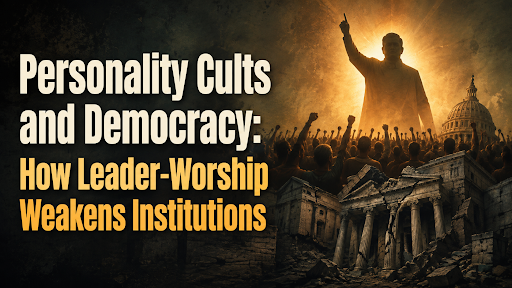
The V-Dem Institute's Democracy Report 2026 finds that the world now has more autocracies (92) than democracies (87) for the first time in over 20 years, with 74% of the global population living under autocratic rule — the highest share since 1978.
What Is a Personality Cult?
A cult of personality happens when a public figure uses mass media, propaganda, and grand spectacles to create a larger-than-life image. This causes followers to show intense, unquestioning devotion and treat the leader as a superhuman hero who can do no wrong.
How Does a Personality Cult Develop?
Personalised Campaigning
Campaigns increasingly centre on a single leader rather than party ideology, manifesto or collective leadership, converting electoral competition into leader-centric mobilisation.
Emotional Mobilisation
Identity, charisma and leader loyalty can overshadow governance performance, creating a direct leader–voter relationship that weakens intermediary party institutions.
Communication Concentration
Social media enables leaders to bypass traditional party structures and communicate directly with voters; University of Texas research on Indian political campaigning identified 3,800+ politically coordinated campaigns with linguistic mutations across platforms.
Weakening Inner-Party Democracy
The Law Commission's 170th Report (1999) argued that political parties cannot remain internally authoritarian while functioning as democracies externally, recommending statutory regulation of party organisation and internal elections.
Candidate Selection Concentration
The Law Commission's 255th Report (2015) noted that existing Section 29A regulation does not adequately cover internal functioning and candidate selection, recommending a dedicated statutory framework for internal democracy, organisational elections and candidate selection.
Role of Media and Social MediaLeader-Centric Political BrandingHashtags, slogans and visual campaigns can shift electoral debate from policy performance to leader visibility, strengthening personalisation of political legitimacy. Algorithmic AmplificationRecommendation algorithms reward emotionally engaging content, allowing polarising leader-centric narratives to dominate policy-based communication and create ideological echo chambers. Misinformation and PolarisationSynthetic content and coordinated online campaigns can personalise political conflict; recent research on Indian political communication documents large-scale coordinated activity across digital platforms. Media ConcentrationConcentration of media ownership can reduce the plurality of scrutiny available to powerful political actors, making independent institutional journalism increasingly important. |
How Does It Affect Democracy?
Weakens Internal Accountability
When leadership selection and candidate distribution are concentrated at the top, party workers become mobilisation agents rather than institutional stakeholders.
Personalises State Power
A personality-centric party can blur the distinction between party authority and governmental authority, weakening institutional checks when political loyalty becomes attached to an individual.
Narrows Internal Dissent
Centralised leadership can discourage competing viewpoints, reducing policy correction and creating information asymmetry between leadership and grassroots cadres.
Creates Succession Vulnerability
Where organisational legitimacy depends heavily on one individual, leadership exit can produce fragmentation rather than orderly succession, exposing the weakness of institutional durability.
Can Enable Democratic Backsliding
The experience of Indira Gandhi’s Emergency (1975–77) shows that executive centralisation threatens institutional safeguards, however subsequent electoral correction proves personality dominance does not destroy democratic resilience.
Personality Cult vs Democratic Leadership
|
Democratic Leadership |
Personality-Cult Leadership |
|
Institution-based authority |
Individual-based authority |
|
Collective decision-making |
Centralised decision-making |
|
Policy and performance-based competition |
Leader-image and loyalty-based competition |
|
Leadership accountable to party and constitutional institutions |
Leadership increasingly insulated from internal accountability |
|
Institutional dissent enables correction |
Dissent is often treated as disloyalty |
|
Institution survives and constrains the leader |
Institution becomes dependent on the leader |
|
Leadership is replaceable through institutional succession |
Succession becomes vulnerable when legitimacy is personalised |
|
Communication strengthens multiple institutional voices |
Political communication concentrates around one leader |
|
Legitimacy rests on rules, performance and consent |
Legitimacy increasingly rests on charisma, symbolism and personal loyalty |
The deeper problem is not merely "too much leader worship"; it is the interaction of personalised communication + weak internal democracy + concentrated candidate selection + opaque financing, which can convert a political party from an institution into a leader-centric electoral vehicle.
What Can Strengthen Institutional Democracy?
Institutionalise Inner-Party Democracy
Mandate periodic, genuinely contested organisational elections, with transparent membership rolls and disclosure of election results; the Law Commission's 170th and 255th Reports internal democracy as an electoral-reform concern.
Give ECI Targeted Regulatory Powers
Amend Section 29A, RPA 1951 to allow enforceable compliance with statutory party-democracy and disclosure norms, while providing due process before penalties or deregistration.
Make Party Finance Transparent
Instead of a blanket CAG audit of every party, require independent statutory audits, standardised disclosures and public digital accounts; this would make financial accountability verifiable without compromising party autonomy.
Strengthen Parliamentary Committees
Restore committee scrutiny by ensuring adequate referral of major Bills, sufficient research capacity and time-bound government responses to committee recommendations, reducing executive dominance over legislative deliberation.
Protect Internal Dissent
Party constitutions should provide formal dissent mechanisms, protected internal complaints and transparent disciplinary procedures, preventing disagreement from automatically becoming organisational disloyalty.
Use Disclosure as the First Regulatory Tool
Before resorting to deregistration, introduce a graded compliance framework: public notice → financial/organisational correction → penalty → loss of specified statutory privileges → deregistration for persistent violations. This balances party autonomy with democratic accountability.
Conclusion
Personality cults threaten democracy when popularity replaces institutional accountability, rather than from popularity itself. V-Dem recommended that safeguarding expression, media plurality, internal party democracy, and institutional checks is essential to halt democratic backsliding.
Source: THEHINDU
|
PRACTICE QUESTION Q. "Personality-driven politics weakens institutional accountability more than it strengthens political mobilisation." Critically Analyze. (250 words) |