Why In News?
Elon Musk’s restriction of Starlink services in Ukraine raised technological sovereignty concerns, leading Indian security planners to evaluate India’s reliance on foreign hardware, operating systems, and satellite networks.
What Is Technology Dependence?
It refers to a structural condition where a nation relies heavily on foreign entities for core technological assets—including microprocessors, operating systems, cloud servers, satellite networks, and foundational code—without possessing domestic ownership or operational control over these systems.
Sovereignty Implication: While downstream assembly and service delivery may occur locally, strategic control remains with overseas corporations and foreign sovereigns, leaving the host nation vulnerable to unilateral service cut-offs, technological denial, and foreign policy coercion.
True digital and hardware sovereignty requires mastering the foundational layers of the digital stack (raw materials, silicon design, fabs, kernels, and root-of-trust cryptography) rather than merely consuming or assembling finished products.

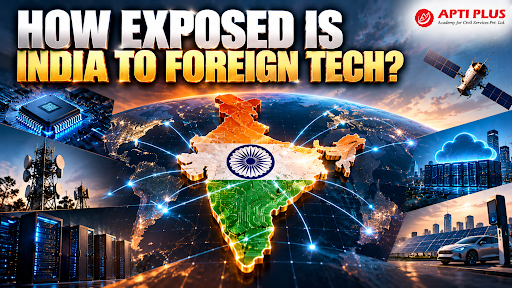
How Exposed Is India to Foreign Technology?
India exhibits high indigenous capability in downstream service delivery (UPI, Aadhaar, DigiLocker), but remains deeply exposed across 7 critical hardware and foundational layers:
A. Satellite Communication Systems
Foreign Constellation Reliance: Commercial Low Earth Orbit (LEO) satellite broadband proposals in India are dominated by foreign entities such as SpaceX's Starlink, Eutelsat OneWeb (French/UK equity), and SES.
Operational Vulnerabilities: Relying on foreign-controlled LEO constellations creates risks regarding un-monitored traffic routing through foreign optical links, non-compliance with local lawful interception, and arbitrary service suspension during conflict.
B. Satellite Navigation and GPS
NavIC Functionality Deficit: India's indigenous satellite navigation constellation, NavIC (IRNSS), currently operates with only 3 fully functional Positioning, Navigation, and Timing (PNT) satellites in orbit, failing the minimum requirement of 4 satellites necessary to provide standalone positioning services without relying on US GPS.
Strategic Exposure: During the 1999 Kargil Conflict, access to precise GPS data was restricted by foreign operators, underscoring the critical necessity of an operational domestic PNT network.
C. Cloud Computing and Data Centres
Hyperscaler Monopoly: Over 80% of enterprise and public-sector cloud infrastructure in India is hosted by US hyperscalers—Amazon Web Services (AWS), Microsoft Azure, and Google Cloud.
Extraterritorial Jurisdiction: Even when data is physically stored in Indian data centers (such as MeghRaj empanelled clouds), foreign parent companies remain subject to legal directives and sanctions issued by their home governments, creating severe compliance and access risks.
D. Semiconductors and Advanced Chips
Extreme Import Reliance: India imports 90–95% of its required microchips, spending over $150 billion on semiconductor imports between FY17 and FY25. (Source: NITI Aayog)
-
This dependency is geographically concentrated, with 70% of India's electronics imports originating from China and Hong Kong, and another 13% from Singapore, which is a trans-shipment hub for Chinese goods.
Supply Chokepoint: Advanced logic chips below 10 nm are 90% concentrated in Taiwan (TSMC), leaving domestic automotive, telecom, medical, and defense supply chains exposed to regional conflicts or trade blockades.
E. Artificial Intelligence Models
Foundational Model Dependence: Indian enterprise AI applications and deep-tech startups are overwhelmingly built on top of foreign foundational Large Language Models (LLMs) such as OpenAI (ChatGPT), Meta (LLaMA), and DeepSeek.
Supply-Chain Contamination: Foreign LLMs expose domestic infrastructure to access revocation, hardware GPU export restrictions, and hidden algorithmic backdoors or training data bias.
F. Operating Systems and Cybersecurity Software
Operating System Monopolies: Over 500 million Indian smartphones operate on Google's Android, while desktops, enterprise servers, and government workstations rely almost entirely on Microsoft Windows and Apple iOS.
Foreign Security Tools: Critical sectors rely heavily on foreign antivirus, firewall, and endpoint detection software, exposing domestic IT networks to catastrophic single-point failures caused by faulty software updates.
G. Digital Payments and Financial Networks
Consumer-Layer Concentration: Although Unified Payments Interface (UPI) and RuPay provide strong domestic settlement independence, foreign entities control a dominant share of the consumer-facing payment interface layer (e.g., Google Pay).
Hardware Layer Dependence: Financial infrastructure relies on imported Point of Sale (PoS) terminals, ATM microcontrollers, and foreign card network chips (Visa, Mastercard).
H. Defence Equipment and Military Technology
Subsystem Supply Chain Infiltration: While domestic defense procurement has increased to 65%, complex electronic subsystems, radar processing units, and drone flight controllers rely on unverified foreign components.
Software-Defined Weapons: Embedded guidance code in imported fighter jets and missile platforms remains accountable to foreign manufacturers, opening vectors for remote performance degradation or kill switches.
I. Subsea Communication Cables
Maritime Gateway Chokepoints: Over 95% of India's international data traffic travels via undersea fiber-optic cable landing stations (primarily in Mumbai and Chennai).
Foreign Ownership & Repair Reliance: Undersea infrastructure construction, maintenance, and cable-laying ships are predominantly foreign-owned, leaving international data bandwidth vulnerable to physical sabotage or maritime disruption.
J. Critical Minerals and Specialised Materials
Processing Monopoly: India is 100% import-dependent for raw inputs like lithium, cobalt, niobium, and rare earth permanent magnets, with processing capacity concentrated overwhelmingly in China (60–80% global monopoly).
Manufacturing Risk: Clean energy systems, electric vehicle (EV) motors, solar photovoltaic cells, and defense guidance chips cannot function without these 30 identified critical minerals.
How Does Foreign Technology Dependence Threaten National Security?
Technology Denial and Service Restrictions: Foreign suppliers can abruptly withhold software licenses, cloud access, or hardware spare parts during military or diplomatic standoff periods.
Foreign Government Sanctions: Domestic companies complying fully with Indian laws can be collateral damage of foreign sanctions enforced by overseas technology providers.
-
Case Study: In 2025, Indian oil refiner Nayara Energy was abruptly locked out of its corporate Microsoft cloud and email accounts due to unilateral EU sanctions targeting Russian oil firm Rosneft.
Disruption of Critical Infrastructure: Foreign Supervisory Control and Data Acquisition (SCADA) hardware embedded in domestic power grids, water plants, and transport systems can be disabled or manipulated remotely.
-
Case Study: In 2020–2021, Chinese state-sponsored threat group RedEcho deployed ShadowPad malware across 7 State Load Despatch Centres (SLDCs) near border zones to pre-position disruptive grid control capabilities.
Cybersecurity Vulnerabilities: Opaque global supply chains enable state-backed threat actors (APT36, APT41) to deploy dormant Trojan implants and backdoors that evade standard antivirus scans.
Military Operational Risks: Unverified foreign sub-components in unmanned aerial vehicles (UAVs) and weapon platforms create risks of electronic hijacking or remote navigation overrides during active operations.
-
Case Study: In February 2025, the Ministry of Defence cancelled contracts worth ₹230 crore for 400 military drones after cybersecurity audits discovered unauthorized Chinese electronic sub-components capable of triggering in-flight overrides.
Supply Chain Disruptions: Geopolitical conflict or export curbs in manufacturing hubs (e.g., Taiwan, China) can instantly stall domestic automobile, smartphone, and medical device assembly lines.
Economic Coercion: Access to critical hardware, cloud infrastructure, and financial messaging can be weaponized as economic leverage during trade disputes.
Data Security and Privacy Risks: Mass collection of location, communication, and biometric data by foreign platforms violates user privacy and feeds foreign machine-learning/AI models.
Strategic Intelligence Risks: Embedded hardware implants in video surveillance platforms and smart city Internet of Things (IoT) networks enable persistent overseas data exfiltration and surveillance.
-
Case Study: In April 2026, Indian closed-circuit television (CCTV) networks were hacked via foreign platform software EseeCloud, exposing sensitive security information.
Major Challenges in Achieving Technology Sovereignty
Dependence on Imported Semiconductors: Absence of commercial high-volume silicon fabs forces total reliance on foreign foundries (TSMC, Samsung) for compute, memory, and networking silicon.
High Research and Development Costs: India's Gross Expenditure on R&D (GERD) hovers at a low 0.6–0.74% of GDP, compared to 2.07% global average and 6–8% invested by technology superpowers like the US and China.
Limited Advanced Manufacturing Capacity: Domestic manufacturing remains heavily skewed toward low-value final assembly due to lack of local printed circuit board (PCB), display, and precision component clusters.
Foreign Patents and Intellectual Property: Overseas technology conglomerates hold vast global patent thickets across 5G/6G, chip design architectures (x86, ARM), and AI algorithms, forcing heavy royalty outflows.
Shortage of Specialised Skills: The domestic electronics industry faces a projected deficit of 250,000 to 300,000 professionals by 2027 in specialized fields such as VLSI design, device physics, semiconductor cleanroom operations, and hardware reverse-engineering. (Sources: Observer Research Foundation)
Dependence on Global Supply Chains: Foundational manufacturing inputs—such as ultra-pure silicon wafers, specialty chemicals, industrial gases, and photolithography tooling—are completely foreign-controlled.
Foreign Cloud and Software Ecosystems: Deep enterprise lock-in with proprietary foreign office suites, ERP platforms (SAP, Oracle), and public cloud providers makes migration technically complex and commercially expensive.
Limited Domestic Scale: High capital requirements for deep-tech hardware are hindered by risk-averse domestic venture capital and slow public procurement cycles for homegrown tech startups.
High Cost of Technology Substitution: Complete replacement of legacy foreign telecom, SCADA, and enterprise hardware ("rip-and-replace") is financially prohibitive and logistically disruptive for state utilities.

Major Government Initiatives
Digital India Programme: The foundational umbrella initiative driving nationwide digital public infrastructure (DPI), broadband connectivity, and e-governance transformation.
India Semiconductor Mission (ISM): Launched with a financial outlay of ₹76,000 crore ($10 billion), offering up to 50% fiscal support for commercial silicon fabs, display fabs, and OSAT/ATMP packaging units.
-
Key Progress: Approval of Tata Electronics commercial fab in Dholera (₹91,000 crore), Micron Technology ATMP unit in Sanand (₹22,516 crore), SiCSem Silicon Carbide fab in Odisha, and domestic deployment of the Vikram-32 processor.
India Semiconductor Mission 2.0 (ISM 2.0): Proposed evolution focusing on raw materials, specialty chemicals, equipment manufacturing, and statutory governance through a dedicated Semiconductor Authority.
Production Linked Incentive (PLI) Schemes: Capital incentives for Large-Scale Electronics Manufacturing, IT Hardware, Drones, and Advanced Chemistry Cells.
National Quantum Mission (NQM): Strategic initiative aimed at developing quantum computing, quantum communications, and post-quantum cryptographic standards to prevent future encryption breakage.
IndiaAI Mission: National initiative backing homegrown foundational models, compute infrastructure (10,000+ GPUs), Indian language datasets, and AI application development.
Bharat 6G Alliance: Public-private collaborative alliance driving domestic intellectual property creation, standard-setting, and hardware design for next-generation telecommunications networks.
Atmanirbhar Bharat & Make in India: Core macroeconomic framework prioritizing domestic defense manufacturing, indigenous drone production, and local electronics assembly.
National Cyber Security Policy & Frameworks: Apex regulatory directives implemented via CERT-In and NCIIPC, including mandatory Hardware Bill of Materials (HBOM) Ver 2.0 guidelines, IoTSCS certification, and the Trusted Telecom Portal.
MeghRaj Government Cloud: National cloud computing infrastructure operated by the National Informatics Centre (NIC), accommodating 2,100+ government departments.

Way Forward
Build Indigenous Capability in Critical Technologies: Transition from downstream assembly to mastering foundational deep-tech layers, including native kernels, specialized microchips, and root-of-trust cryptography.
Diversify Foreign Technology Suppliers: Avoid single-vendor or single-nation lock-ins by distributing hardware, cloud, and satellite procurement across multiple trusted democratic partners.
Strengthen Domestic Semiconductor Manufacturing: Execute NITI Aayog's Co-Creation Strategy by focusing on mature technology nodes (28–65 nm), Silicon Carbide (SiC) power chips, advanced OSAT/ATMP packaging, and leveraging India's 20% global VLSI design talent.
Expand Sovereign Cloud Infrastructure: Establish 100% domestically owned, legally bound sovereign cloud regions free of foreign legal jurisdiction for all critical government, financial, and defense data.
Improve NavIC Reliability: Accelerate ISRO launch schedules to deploy replacement satellites and mandate dual-band NavIC chipset integration across all domestic smartphones and transport telematics.
Promote Open-Source Software: Mandate open-source operating systems (Bharat Operating System Solutions - BOSS, XenevaOS) and open-architectures (RISC-V) across public administration and defense networks.
Strengthen Cybersecurity Audits: Implement full-stack supply chain audits (HBOM, AIBOM, CBOM) and expand active infrastructure testing through National Hardware Assurance Centres.
Introduce Technology Access Risk Assessments: Conduct mandatory risk evaluations for all new foreign software, cloud, and AI contracts in public procurement to prevent sudden service cutoff risks.
Ensure Data Portability and Exit Clauses: Enforce mandatory statutory data portability and vendor exit-assistance provisions in government enterprise software contracts.
Increase Research and Development Spending: Progressively elevate national R&D expenditure from 0.7% to 2.5–3.0% of GDP over the next decade with targeted deep-tech tax credits.
Strengthen Public-Private Research Partnerships: Adopt defense innovation models (akin to US DARPA/DIU) to co-fund domestic private startups and academic Centres of Excellence (CoEs).
Develop Long-Term Critical Technology Roadmaps: Enact a comprehensive Supply Chain Security Act and establish a unified National Cyber Command under the National Security Council Secretariat (NSCS).
Balance Self-Reliance with Global Cooperation: Build strategic Trusted Technology Alliances via multilateral frameworks like iCET (US), Trade and Technology Council (EU), Pax Silica, and digital partnerships with Japan and Taiwan.
Conclusion
Achieving digital and hardware sovereignty is an existential national security imperative required to protect India's strategic autonomy, economic resilience, and territorial defense in a weaponized global technological order.
|
PRACTICE QUESTION Q. Dependence on foreign technology can become a strategic vulnerability even when service providers operate within the law. Examine 250 words |