Why In News?
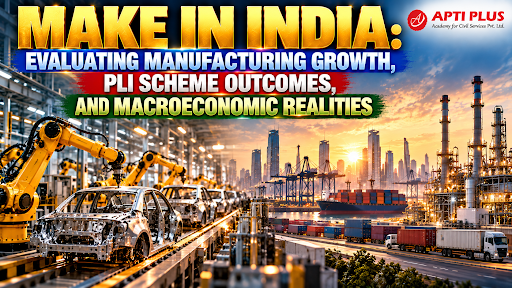
Prime Minister Narendra Modi marked 12 years of the Make in India initiative, highlighting significant gains in domestic production, investments, and exports.
What is Make in India?
The Make in India campaign was launched by the Union Government on 25 September 2014 to transform India into a global hub for manufacturing, design, and innovation.

Objectives
-
Manufacturing as a Growth Engine: Elevate manufacturing's contribution to Gross Value Added (GVA) from 15% to 25% by 2022 and sustain an annual sectoral growth rate of 12% to 14%.
-
Employment Generation: Absorb the nation's young demographic dividend by creating 100 million additional formal manufacturing jobs.
-
Export Promotion & Investment Facilitation: Facilitating foreign direct investment, fostering innovation, protecting intellectual property, and building world-class industrial infrastructure.
-
Global Manufacturing Hub: Transition India from an import-dependent economy into an indispensable link in Global Value Chains (GVCs).
Make in India 2.0 & 27 Focus Sectors: The initiative was expanded under Make in India 2.0 to cover 27 focus sectors, comprising 15 manufacturing sub-sectors and 12 service segments.
How Manufacturing Growth Performed?
-
Manufacturing Growth vs Overall GDP Growth: Under the old statistical series, manufacturing real output outpaced overall economy-wide growth in 5 of 12 years.
-
Under the revised national accounts series, manufacturing outpaced aggregate GDP growth in all 3 available years (FY 2023-24 to FY 2025-26), though the growth differential has been narrowing.
-
Manufacturing GVA Share: Manufacturing’s share of national GVA has remained between 15% and 17% over the last two decades. Under the revised national accounts series, manufacturing share expanded marginally from 14.6% in FY 2022-23 to 15.6% in FY 2025-26, falling short of the 25% statutory target.
-
Industrial Production Performance (IIP): Index of Industrial Production (IIP) data shows that manufacturing outpaced the general industrial index in only 3 out of 12 years under the old series.
-
Under the revised series, manufacturing growth matched overall IIP growth in FY 2023-24 (5.2%) but lagged general industrial momentum in FY 2024-25 and FY 2025-26.
Export Trends
-
Non-Petroleum Goods Exports: Non-petroleum merchandise exports expanded by 53%, rising from $253.5 billion in FY 2014-15 to $388.3 billion in FY 2025-26. However, this compares to a >400% expansion achieved during the preceding 12-year period (2002–2014).
-
Global Merchandise Export Share: Data from UNCTAD shows that while India’s share of global merchandise exports grew from 0.8% in 2002 to 1.7% in 2013, it remained stagnated at 1.7% in FY 2025-26.

What Are the Major Achievements?
Expansion of Electronics Manufacturing: Total electronics output grew nearly sevenfold from ₹1.9 lakh crore in FY 2014-15 to ₹13.11 lakh crore in FY 2025-26. Mobile phone production surged 33-fold from ₹18,000 crore to ₹6.27 lakh crore, establishing India as the world's 2nd largest mobile manufacturer by volume.

Automobile Production: Total vehicle production reached 31.03 million units in FY 2024-25, marking a 33% rise over FY 2014-15.
Pharmaceutical Manufacturing: Annual industry turnover reached ₹4.71 lakh crore in FY 2024-25. The Pharma PLI reversed India's trade balance in bulk drugs/APIs from a ₹1,930 crore deficit in FY 2021-22 to a ₹2,280 crore surplus in FY 2024-25.
Defence Manufacturing: Indigenous defence production expanded 283%, rising from ₹46,429 crore to ₹1.78 lakh crore in FY 2025-26.
Steel Production: Crude steel production rose from 81.7 million tonnes in FY 2014-15 to 170 million tonnes in FY 2025-26.
Solar PV Modules & Medical Devices: Solar module manufacturing capacity expanded from 2.3 GW in 2014 to 192 GW by June 2026 (with 30 GW cell capacity). Domestic medical device manufacturing grew from ₹28,000 crore in FY 2019-20 to ₹41,500 crore.
Digital Investment Facilitation & Infrastructure: Execution of the PM GatiShakti National Master Plan, National Single Window System (NSWS), and India Industrial Land Bank simplified industrial approvals and spatial planning.
Major Challenges Facing 'Make in India'
Assembly-Led Growth and Low Domestic Value Addition (DVA): While mobile phone manufacturing expanded 33-fold to ₹6.27 lakh crore in FY 2025–26, Domestic Value Addition (DVA) in electronics remains capped between 15% and 22%.
-
Approximately 80% of high-value active components—such as microprocessors, memory chips, printed circuit board assemblies (PCBAs), and display glass—are still imported.
Inverted Tariff Structures and Elevated Input Costs: Customs duties placed on intermediate industrial inputs exceed tariffs on finished products, creating negative effective protection.
-
For instance, a 30% anti-dumping duty on imported bare Printed Circuit Boards (PCBs) raises production costs for domestic electronics assemblers relative to regional competitors in Vietnam or Bangladesh.
Factor Market Rigidities and Execution Delays: Despite Parliament enacting the 4 Labour Codes in 2019 and 2020, full operational rollout stalled because multiple state governments delayed notifying state-level rules under the Concurrent List.
-
Industrial land acquisition faces long timelines (3 to 5 years) and a shortage of serviced land banks with pre-cleared environmental permits.
Sub-80% Factory Capacity Utilization and Soft Private CapEx: Private sector Gross Fixed Capital Formation (GFCF) as a proportion of GDP remained soft.
-
Reserve Bank of India (RBI) factory surveys indicate that capacity utilization stayed below the 80% threshold required to trigger greenfield private capital expenditure.
Capital Concentration and Exclusion of MSMEs: Cumulative Production Linked Incentive (PLI) performance exhibits steep asymmetry: approximately 83% of total realized PLI CapEx is concentrated in just 5 sectors (Solar PV Modules, Pharmaceuticals, Automobiles & Auto Components, Specialty Steel, and Large-Scale Electronics).

Major Government Initiatives Driving Manufacturing
Production Linked Incentive (PLI) Schemes: Launched across 14 strategic sectors with an approved outlay of ₹1.97 lakh crore , the PLI framework substitutes upfront subsidies with output-linked cash incentives (4% to 15% on incremental sales).
PM GatiShakti National Master Plan & National Logistics Policy (NLP): PM GatiShakti operates as a GIS-based digital platform integrating 57 Ministries/Departments and 1,700+ data layers to streamline multi-modal infrastructure planning.
-
Coupled with the Unified Logistics Interface Platform (ULIP) under the NLP, a joint study by DPIIT and NCAER confirmed that national logistics costs fell to 7.97% of GDP in FY24.
National Industrial Corridor Development Programme (NICDP): The government is developing new industrial smart cities with plug-and-play utility connections.
-
Phase-I cities—including Dholera, Shendra-Bidkin, Greater Noida, and Vikram Udyogpuri—are operational, attracting over ₹2.02 lakh crore in investment.
-
Electronics Manufacturing Clusters (EMC & EMC 2.0) provide pre-serviced infrastructure for electronics OEMs.
Targeted High-Tech & Component Missions:
-
India Semiconductor Mission (ISM / Semicon 2.0): Budgetary allocation of ₹1,27,500 crore / ₹76,000 crore to subsidize semiconductor fabs, compound semiconductor units, and ATMP/OSAT packaging facilities.
-
Electronics Component Manufacturing Scheme (ECMS): Notified with a ₹22,919 crore / ₹40,000 crore outlay to subsidize CapEx and turnover for midstream component fabrication.
-
National Manufacturing Mission (NMM): Announced in the Union Budget 2025–26 to act as a central facilitator for technology adoption and MSME value chain integration.
Digital Single Window & Sub-National Benchmarking: The National Single Window System (NSWS) operated by DPIIT integrates approvals across 30+ Central Ministries and state portals.
-
To foster competitive federalism, NITI Aayog launched the Investment Friendliness Index (IFI) 2026 to evaluate states across eight regulatory and infrastructure pillars.
What is the Way Forward?
Transitioning to Deep Component Localization: Incentives must shift from final assembly to midstream "n-1" component ecosystems—like PCBAs, active pharmaceutical ingredients (APIs), and display glass—to raise domestic value addition.
Scaling Plug-and-Play Industrial Clusters: Expansion requires well-connected brownfield and greenfield clusters with pre-cleared environmental permits, flatted factory complexes, and shared utility grids.
Specialized Industrial Hubs: India can emulate models like Taiwan's Tainan City Telecom Cluster, co-locating design, component fabrication, testing, and packaging suppliers to reduce lead times and logistics costs.
Correcting Inverted Tariff Structures: Import duties on intermediate inputs exceed those on finished products, creating negative effective protection and inflating costs for domestic assemblers.
Deepening MSME Integration and Financing: Lowering Production Linked Incentive (PLI) eligibility thresholds and offering digitized working capital mechanisms will help MSMEs enter supply chains.
Bridging the Industrial R&D Gap: Policy should shift from capital subsidies to mission-driven innovation that supports prototyping, piloting, and IP creation in sunrise sectors.
Rebalance Incentive Architecture: Shift PLI focus from downstream/final assembly to midstream/upstream component localization, e.g. Electronics Component Manufacturing Scheme (ECMS).
Conclusion
To sustain long-term growth from twelve years of industrial expansion, India must move beyond assembly to component localization, factor market reform, and high-tech Global Value Chain (GVC) integration.
Source: THEHINDU
|
PRACTICE QUESTION Q. Evaluating 'Make in India', analyze why sectoral gains in high-technology assembly have not fully translated into a structural expansion of manufacturing's share in GDP and global exports. 250 words |