Why In News?
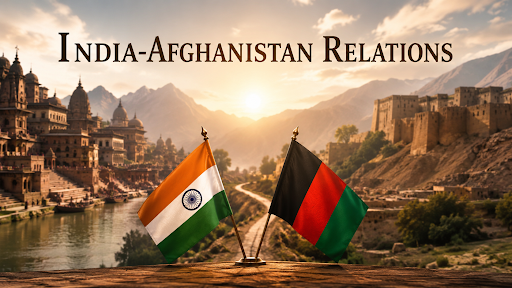
Five years post-2021 US withdrawal, India maintains its Kabul "Technical Mission" to deliver aid, leverage Chabahar Port, and mitigate regional terrorism risks.
Evolution of India-Afghanistan Relations
Ancient & Civilisational Roots: Shared historical linkages spanning the Indus Valley Civilization (Shortugai trading post), the Mauryan Empire under Ashoka (Kandahar rock edicts), Gandhara art, and centuries of overland trade.
Post-Independence Era (1950–1979): India and Afghanistan signed the historic Treaty of Friendship in 1950, establishing strong bilateral cooperation grounded in non-alignment.
Soviet Intervention & 1990s Taliban 1.0 (1979–2001): India maintained ties with the Soviet-backed government in the 1980s, opposed the Pakistan-backed Taliban 1.0 regime (1996–2001) following the IC-814 hijacking, and provided diplomatic and logistical support to the anti-Taliban Northern Alliance operating from Farkhor, Tajikistan.
Reconstruction & Democratic Republic Era (2001–2021): India emerged as Afghanistan’s largest regional development partner, investing over $3 billion in development assistance across all 34 provinces and signing Strategic Partnership Agreement (SPA) in 2011.
Post-August 2021 (Taliban 2.0 Realism): Following the fall of Kabul in August 2021, India evacuated diplomatic staff, but reopened its embassy with a "Technical Mission" in June 2022 to oversee humanitarian relief, maintain direct communication with the authorities, and protect strategic assets.
Why is Afghanistan Important to India?
National Security & Counter-Terrorism: Preventing Afghan territory from being utilized by hostile non-state terror outfits—including Jaish-e-Mohammed (JeM), Lashkar-e-Taiba (LeT), Al-Qaeda, and Islamic State Khorasan Province (IS-KP)—to launch attacks against India.
Strategic Counterbalance to Pakistan: A neutral or friendly government in Kabul prevents the Pakistani military establishment from utilizing Afghanistan as strategic depth against India.
Gateway to Central Asia & Eurasian Energy: Afghanistan provides the shortest geographical land bridge connecting South Asia to the oil and gas reserves of Central Asia, including the proposed TAPI (Turkmenistan-Afghanistan-Pakistan-India) natural gas pipeline.

Access to Critical Mineral Reserves: Afghanistan holds an estimated $1 trillion to $3 trillion in untapped mineral resources, including world-class reserves of lithium, copper (Mes Aynak), iron ore (Hajigak), cobalt, and rare earth elements vital for India's clean energy transition.
Countering Chinese Expansion in Eurasia: Active engagement prevents China from monopolizing Afghan critical minerals and integrating Kabul exclusively into the China-Pakistan Economic Corridor (CPEC) under the Belt and Road Initiative.
Enduring Soft Power and Goodwill: Preserving generational goodwill among 40+ million Afghans who view India as a non-interfering development partner.
Why is India Important to Afghanistan?
Largest Regional Development & Humanitarian Partner: India delivers unconditional development assistance, emergency wheat consignments, and medical supplies without political interference or debt-trap conditionalities.
Critical Food and Health Lifeline: India has supplied over 50,000 metric tonnes of wheat via the World Food Programme (WFP), millions of doses of vaccines, anti-TB medicines, and medical gear to hospitals in Kabul.
Trade Diversification via Chabahar Port: Provides Afghan farmers and traders access to the massive Indian market for dried fruits, saffron, asafoetida (hing), and fresh fruits, reducing vulnerability to frequent border blockades by Pakistan at Torkham and Chaman.
Human Capital Formation & Scholarships: Thousands of Afghan youth continue their higher education in Indian universities through Indian Council for Cultural Relations (ICCR) scholarships and online digital learning portals.
Strategic Diplomatic Autonomy: Strong ties with New Delhi provide Kabul with diplomatic leverage, preventing total subservience to Islamabad or Beijing.
India's Policy Towards Afghanistan
People-Centric Development Diplomacy: Anchored in unconditional support for the socio-economic welfare of the Afghan people, prioritizing healthcare, education, and basic nutrition.
Strict Implementation of UNSC Resolution 2593 (2021): Demands that Afghan territory must not be used for sheltering, training, planning, or financing terrorist acts against any nation.
Advocacy for Inclusive Governance & Human Rights: Consistently advocates for an inclusive, broad-based political structure in Kabul that respects the fundamental rights of women, girls, and ethnic minorities (Tajiks, Hazaras, Uzbeks).
Functional Engagement without Recognition: Maintains active diplomatic communication through its Technical Mission in Kabul to address consular, humanitarian, and security concerns without granting official diplomatic recognition to the Taliban regime.
Multimodal Connectivity via Iran: Invests in and operationalizes the Shahid Beheshti Terminal at Chabahar Port and the International North-South Transport Corridor (INSTC) to guarantee independent trade routes.
Areas of Cooperation
Infrastructure Projects
-
Afghan Parliament Building in Kabul: Constructed by India at a cost of around $90 million, symbolizing democratic friendship.
-
Salma Dam (Afghan-India Friendship Dam): A 42 MW hydroelectric and irrigation project built in Herat Province at ~$290 million.
-
Zaranj-Delaram Highway (Route 606): A 218 km highway built by the Border Roads Organisation (BRO), connecting southwestern Afghanistan to the Iranian border at Milak.
-
Transmission Lines & Sub-stations: A 220 kV double-circuit transmission line from Pul-e-Khumri to Kabul, bringing electricity to the capital.
-
Over 500 High Impact Community Development Projects (HICDPs): Small-scale drinking water, clinic, and school projects across all 34 provinces.
Humanitarian Assistance & Emergency Relief: Immediate deployment of rescue teams, emergency tents, and relief supplies following devastating earthquakes in Paktika, Khost, and Herat.
Bilateral Trade & Air Freight Corridors: Trade continuing through sea-land routes via Chabahar and dedicated air cargo corridors.
-
Total volume: $907.85 million in 2025–26.
-
Afghanistan to India: Dried fruits, fresh fruits, nuts, spices, and saffron.
-
India to Afghanistan: Pharmaceuticals, sugar, machinery, vehicles, and auto parts.
Educational & Capacity Building Partnerships: Sustained funding for Afghan students in India and ongoing support for the Indira Gandhi Institute of Child Health in Kabul.
Regional Security Mechanisms: Active coordination in the Moscow Format Consultations and the Regional Security Dialogues convened by National Security Advisors (NSAs).
What are the Challenges in India-Afghanistan Relations?
Absence of Formal Diplomatic Recognition: The international community, including India, withholds de jure recognition of the Taliban regime due to unfulfilled commitments on human rights and political inclusivity.
Severe Curtailment of Women's Rights: The Taliban's ban on female secondary and higher education, restrictions on female employment, and public dress codes draw global condemnation and limit bilateral cooperation.
Persistent Threat from Transnational Terror Outfits: The operational presence of groups like IS-KP, Al-Qaeda, and remnants of LeT/JeM poses security risks to Indian personnel and regional stability.
Pakistan's Blockade of Overland Transit: Islamabad denies transit access for Indian goods to Afghanistan through the Wagah-Attari border, forcing reliance on longer sea-land detours via Iran.
Chinese Strategic and Economic Encroachment: Beijing’s direct investments in the Amu Darya oil basin and push to integrate Kabul into the CPEC challenge India's regional footprint.
Banking & Sanctions Paralysis: The freezing of Afghan central bank reserves, lack of SWIFT connectivity, and international banking sanctions impede routine trade and financial settlements.
Way Forward for Strengthening India-Afghanistan Relations
Scale Targeted Humanitarian Relief via UN Agencies: Expand food assistance, life-saving medicines, medical diagnostic kits, and earthquake reconstruction support through the World Food Programme (WFP), WHO, and UNICEF.
Enhance Chabahar Port Trade Subsidies: Offer reduced terminal handling charges and dedicated container slots at Shahid Beheshti Terminal to make Chabahar the primary commercial gateway for Afghan dry fruits and agricultural exports.
Re-establish Regular Air Freight Corridors: Resume direct cargo flights between Kabul, Delhi, and Mumbai to provide perishable Afghan agricultural goods immediate access to high-value Indian markets.
Expand Distance Education & Digital Scholarships for Afghan Women: Utilize digital public infrastructure (e-VidyaBharati and SWAYAM platforms) to provide online university degrees and vocational courses for Afghan female students barred from physical classrooms.
Institutionalise Structured Security and Intelligence Dialogue: Maintain regular diplomatic and security consultations via the Technical Mission in Kabul to monitor terror outfits and secure non-aggression assurances.
Complete Stalled High-Impact Community Projects (HICDPs): Resume funding for pending community-level drinking water networks, rural primary health centres, and solar micro-grids across Afghan provinces.
Coordinate Regional Approaches via the Moscow Format & Shanghai Cooperation Organisation (SCO): Partner with Central Asian republics, Iran, and Russia to forge a regional consensus on Afghan stability, counter-narcotics enforcement, and humanitarian assistance.
Conclusion
India’s pragmatic engagement with Afghanistan combines firm national security vigilance under UNSC Resolution 2593 with unconditional humanitarian solidarity, preserving civilisational goodwill and anchoring strategic stability across Eurasia.
Source: THEHINDU
|
PRACTICE QUESTION Q. Discuss the geopolitical significance of Afghanistan as a transit gateway for India's trade and energy connectivity with Central Asia. (10 Marks, 150 Words) |