Why In News?
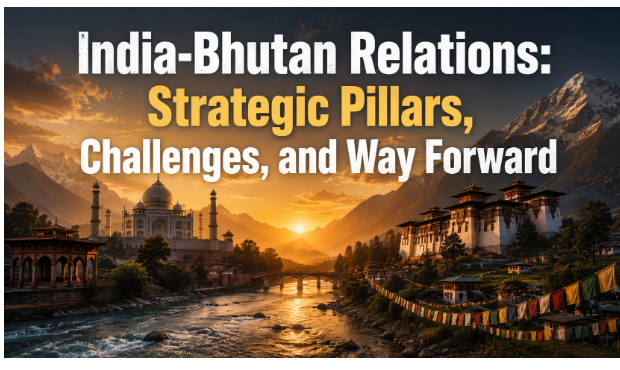
Bhutan Prime Minister reaffirming the exemplary "Bharat for Bhutan, Bhutan for Bharat" (B4B) partnership and advancing connectivity across the Gelephu Mindfulness City and cross-border rail corridors.
Highlights of the Recent Bilateral Engagement
Enduring Leadership Ties: Bhutanese Prime Minister emphasizing India's steadfast support for Bhutan's socioeconomic development and global South advocacy.
Doubling Development Assistance: India committed ₹10,000 crore ($1.2 billion) support package for Bhutan's 13th Five-Year Plan (2024–2029), covering project-tied assistance, high-impact community development projects, and an Economic Stimulus Plan.
Cross-Border Rail Network: Fast-tracking two railway projects: the 69 km Kokrajhar (Assam) to Gelephu (Bhutan) rail link (designated as a Special Railway Project worth ₹3,500 crore) and the Banarhat (West Bengal) to Samtse link, providing Bhutan its first-ever international railway network.
Anchoring the Gelephu Mindfulness City (GMC): India extended infrastructural, customs, and immigration support for King Jigme Khesar Namgyel Wangchuck's flagship 1,000 sq km carbon-neutral Special Administrative Region (SAR) along the Assam border.
Expanding Clean Hydropower Capacity: Joint operationalization of the 1,020 MW Punatsangchhu-II Hydroelectric Project, expanding Bhutan's total installed power capacity to 3,156 MW and generating over 4,300 million units of clean electricity annually for regional grids.
Evolution of India-Bhutan Relations
The 1949 Treaty of Friendship and Cooperation: Signed in Darjeeling in August 1949, establishing peace, free trade, and mutual non-interference, with Article 2 guiding Bhutan to seek India's advice in foreign affairs.
Strategic Infrastructure Era (1960s): Jawaharlal Nehru's historic 1958 visit to Paro initiated India's funding of Bhutan's First Five-Year Plan in 1961 and the deployment of Border Roads Organisation's Project DANTAK to construct the first motorable highways across the Himalayas.
The 2007 Revised Treaty of Friendship: Upgraded the bilateral framework to reflect modern sovereign realities, replacing the advisory clause of Article 2 with mutual consultations on matters of national security and expanding commercial cooperation.
Transition to Democratic Constitutional Monarchy (2008): India supported Bhutan's peaceful political evolution, fostering multi-party parliamentary ties while preserving the revered constitutional role of the Druk Gyalpo.
Why is Bhutan Important to India?
Strategic Buffer in the Eastern Himalayas: Bhutan separates mainland India from China's Tibet Autonomous Region.
-
The Doklam Plateau near the India-Bhutan-China tri-junction provides India strategic depth to defend the narrow 22-km-wide Siliguri Corridor ("Chicken's Neck"), which links the Northeast states to the rest of India.
Reliable Hydropower & Energy Security: Bhutan exports over 70% of its generated hydroelectricity to India, supplying clean, renewable peak-load power to eastern and northeastern industrial states.
Security Cooperation & Counter-Insurgency: Demonstrated during Operation All Clear (2003), when the Royal Bhutan Army dismantled 30 armed camps of Indian insurgent groups (ULFA, NDFB, KLO) operating from southern Bhutanese jungles.
Ecological Anchor & Transboundary River Basins: Bhutan maintains over 70% of its land under forest cover, regulating the hydrology of transboundary Himalayan rivers (Manas, Sankosh, Amochhu/Torsa) that flow into Assam and West Bengal.
Why is India Important to Bhutan?
Primary Development & Financial Partner: India funds over 60% of Bhutan's developmental capital expenditure, committing ₹10,000 crore for the 13th Five-Year Plan alongside an Economic Stimulus Package to revitalize post-pandemic growth. (Source: MEA)
Economic Lifeline & Trade Gateway: India is Bhutan's largest trading partner, accounting for 80% of Bhutan's exports and 85% of its imports, while providing duty-free sea-transit access through Kolkata and Haldia ports under the 2016 Agreement on Trade, Commerce and Transit. (Source: Ministry of Commerce and Industry).
Security Reassurance & Military Training: The Indian Military Training Team (IMTRAT) trains the Royal Bhutan Army, while the Indian Air Force and Army provide logistical and medical support.
Digital, Space & Educational Integration: India connected Bhutan to the National Knowledge Network (NKN), launched the joint ISRO-BhutanSat (INS-2B) satellite, and expanded RuPay card payment integration across Bhutanese banks.

India's Policy Towards Bhutan
Neighbourhood First & "B4B" Philosophy: Prioritizes Bhutan under the "Bharat for Bhutan, Bhutan for Bharat" doctrine, anchored in mutual respect, non-reciprocity, and shared prosperity.
Sovereignty and Non-Interference: Upholds Bhutan's internal policy autonomy while coordinating closely on regional security concerns.
Sub-Regional Connectivity Integrator: Fosters multilateral integration under the BBIN (Bangladesh, Bhutan, India, Nepal) framework and BIMSTEC to enable trilateral power trade.
Key Areas of Bilateral Cooperation
Hydropower & Clean Energy Generation: Joint execution of mega-projects including Chukha (336 MW), Kurichhu (60 MW), Tala (1,020 MW), Mangdechhu (720 MW), and Punatsangchhu-II (1,020 MW), creating 3,156 MW of operational green capacity.
Bilateral Trade: India is Bhutan's largest trading partner, with total bilateral trade reaching approximately $1.77 billion in 2024–25. India exports petroleum, rice, and machinery to Bhutan, while importing vital electricity, ferro-silicon, and cement.
-
India's Exports to Bhutan: $1.26 billion
-
India's Imports from Bhutan: $513.44 million
-
Trade Balance: Favors India by roughly $750 million
Cross-Border Railway & Multimodal Connectivity: Construction of the Kokrajhar-Gelephu line connecting to Assam's Bongaigaon industrial node, opening inland waterways via the Brahmaputra River (Dhubri port), and establishing modern Integrated Check Posts at Jaigaon-Phuentsholing.
The Gelephu Mindfulness City (GMC) SAR: India supports Bhutan's carbon-neutral special administrative zone with dedicated cross-border road corridors, green energy supply, digital connectivity, and streamlined customs clearance.
Space, IT & Digital Public Infrastructure: Operationalized the South Asia Satellite ground station in Thimphu, expanded UPI-RuPay cross-border payments, and provided a dedicated third high-speed international internet gateway via Gelephu.
Human Resource Development & Project DANTAK: Over 50,000 Indians work in Bhutan, while the Border Roads Organisation maintains 1,500+ km of Himalayan roads and bridges through Project DANTAK.
What are the Key Challenges In India-Bhutan Relations
China-Bhutan Boundary Negotiations & Strategic Vulnerability: Ongoing boundary talks between Thimphu and Beijing under the 3-Step Roadmap risk potential territorial swaps in the northern Jakarlung and Pasamlung valleys in exchange for the southern Doklam plateau, directly impacting India's Siliguri corridor defense.
Hydropower Cost Overruns & Geological Risks: The 1,200 MW Punatsangchhu-I project faces severe delays and cost escalations due to massive right-bank hillside landslides at the dam site, necessitating a transition to a barrage design.
Trade Asymmetry & Rising Hydropower Debt: Servicing Indian rupee hydro-loans constitutes over 65% of Bhutan's external debt, creating fiscal vulnerability whenever power generation dips during dry winter months.
Right-of-Way & Land Acquisition Friction in Transit States: Projects like the Banarhat-Samtse rail link face local land acquisition delays across tea garden estates in West Bengal.
Domestic Voices for Geopolitical Diversification: Growing sentiment among Bhutan's urban elite and business communities advocates establishing formal diplomatic ties with China and joining the Belt and Road Initiative (BRI).
Way Forward for Strengthening Relations
Expedite Kokrajhar-Gelephu Rail Link on War-Footing: Complete the 69 km rail corridor by 2028 under Special Railway Project fast-track clearances to unlock seamless freight transit for Bhutanese industries.
Co-Develop the Gelephu Mindfulness City as an Innovation Corridor: Channel Indian private venture capital and IT investments into the Gelephu Special Administrative Region, building green data centers and skill academies to retain youth.
Diversify into Solar-Hydro Hybrid and Battery Storage: Complement seasonal run-of-the-river hydro with floating solar and Battery Energy Storage Systems (BESS) to eliminate Bhutan's winter power deficit.
Operationalize Trilateral Power Trade via BBIN Corridor: Facilitate cross-border power transmission allowing Bhutan to export surplus hydro-electricity directly to power-deficient Bangladesh via the Indian national grid.
Maintain Institutionalized Security Alignment on Doklam: Preserve continuous real-time diplomatic and military coordination to ensure border settlements with China respect India's vital tri-junction security interests.
Scale Digital Public Infrastructure (DPI) Cooperation: Extend Digital India Bhashini language models, AI curriculum, and DigiLocker systems to empower the Bhutanese school education and civil service ecosystem.
Establish Dedicated Green Trade Corridors along Border Checkposts: Deploy 100% digital contactless customs clearance at Jaigaon, Dadgiri, and Samdrup Jongkhar to slash commercial freight dwell times by 50%.
Conclusion
The India-Bhutan partnership exemplifies South Asian good-neighbourliness, anchored by rail connectivity, the Gelephu Mindfulness City, and strategic coordination for regional security and prosperity.
Source: NEWSONAIR
|
PRACTICE QUESTION Q. "The India-Bhutan relationship is an exemplary model of mutual trust and peaceful coexistence, yet evolving geopolitical realities in the Eastern Himalayas pose new strategic challenges." Discuss. (15 Marks, 250 Words) |