Why In News?
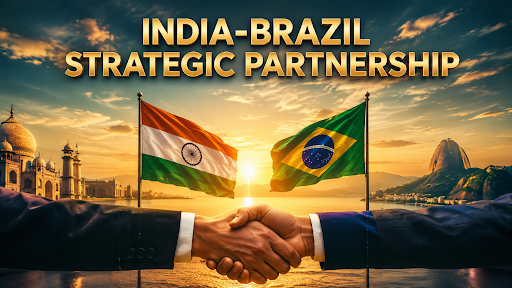
On the sidelines of the 12th BRICS Communications Ministers' Meeting in Pune, India and Brazil signed a Memorandum of Understanding (MoU) to deepen bilateral cooperation.
Key Highlights of the Bilateral Agreement
Scaling Digital Public Infrastructure (DPI)
India and Brazil will partner to build secure, scalable digital public platforms modeled after systems like Aadhaar and Unified Payments Interface (UPI) to improve citizen-government engagement.
Next-Generation & Emerging Technologies
Both nations discussed joint research, innovation, and development of new-age communication technologies, focusing on India's indigenous 4G/5G development, domestic manufacturing, 6G planning, Quantum Tech, and Satcom.
Strengthening Cybersecurity & Online Safety
Both countries agreed to share best practices to counter cross-border cyber threats, protect user privacy, prevent data breaches, and mitigate digital fraud.
User Safety & Vulnerable Demographics
Protecting vulnerable digital users, establishing joint frameworks for child online protection, and running public awareness campaigns against online financial scams.
Universal & Rural Connectivity
Both nations will explore non-terrestrial networks (NTNs) and satellite connectivity to bridge the digital divide in isolated, rural farming communities without relying heavily on expensive fiber-optic networks.
Ecosystem & Multilateral Synergy
The MoU connects Indian and Brazilian tech enterprises, startups, and academic labs beyond government ties. Both nations also agreed to coordinate on global telecom and technology standards.
Evolution of India-Brazil Relations
Post-Independence Foundations (1948)
Diplomatic relations were established in 1948, grounded in mutual non-alignment values, shared anti-colonial solidarity, and democratic principles across developing continents.
Creation of Trilateral IBSA (2003)
The launch of the IBSA Dialogue Forum (India, Brazil, South Africa) pioneered institutional South-South cooperation, uniting the three vibrant multi-ethnic democracies of the Global South.
Elevation to Strategic Partnership (2006)
Bilateral ties were formally elevated to a Strategic Partnership in 2006, initiating Joint Commission Meetings (JCM), regular bilateral summits, and structured commercial dialogues.
Plurilateral Synergy in BRICS & G20
Both nations collaborated as founding anchors of BRICS (2009), worked within the BASIC climate coalition, coordinated in the G20 Troika (India 2023, Brazil 2024, South Africa 2025), and continuously champion United Nations Security Council (UNSC) permanent seat reforms via the G4 grouping (India, Brazil, Germany, Japan).
Decadal Strategic Action Plan (2025–2026)
High-level State Visits by Prime Minister Narendra Modi to Brasília and President Luiz Inácio Lula da Silva to New Delhi established a 10-year bilateral roadmap across five pillars: defence-security, food security, energy-climate action, digital technologies, and critical mineral supply chains.
Why is Brazil Important to India?
Resource Wealth & Critical Mineral Security
Brazil possesses the world's second-largest rare earth reserves and vast deposits of lithium, niobium, iron ore, and nickel, serving as an indispensable alternative supplier for India's clean energy, electric vehicle (EV), and semiconductor manufacturing ambitions to reduce single-country dependencies.
Biofuels Alliance & Energy Resilience
As the world's leading sugarcane ethanol producer, Brazil co-founded the Global Biofuels Alliance (GBA) with India; both countries harmonize India's National Biofuel Policy (E20 mandate) with Brazil's RenovaBio program; ONGC Videsh holds participating interests in major Brazilian offshore hydrocarbon blocks.
Food Security & Agro-Trade Complementarity
Brazil provides stable supplies of crude soybean oil, raw sugar, and pulses; historically, Indian dairy cattle breeds (Gir and Kankrej) exported in the 1960s formed the genetic backbone of Brazil's high-yielding Zebu cattle industry.
Anchor for MERCOSUR Market Access
Brazil serves as the primary economic gateway for Indian exporters across Latin America via the India-MERCOSUR Preferential Trade Agreement (PTA).

Why is India Important to Brazil?
High-Growth Consumer Market
India's 1.4-billion population and rapid GDP growth make it the 13th largest export market for Brazil, importing billions of dollars in Brazilian crude oil, iron ore, gold, and agricultural commodities.
Affordable Generic Pharmaceuticals & Vaccines
Indian pharmaceutical majors (like Cipla, Dr. Reddy’s, Torrent) supply high-quality, affordable active pharmaceutical ingredients (APIs), oncology drugs, and vaccines to Brazil's public health system (Sistema Único de Saúde - SUS), drastically lowering healthcare procurement costs.
Adoption of Digital Public Infrastructure (DPI)
Brazil collaborates with India to study and adopt population-scale digital architectures, including the Unified Payments Interface (UPI), Aadhaar digital identity, and Bhashini AI voice translation.
Cost-Effective Space & Aerospace Technology
ISRO successfully launched Brazil's first fully indigenous Earth observation satellite, Amazonia-1, aboard PSLV-C51 in 2021; Brazilian aerospace major Embraer partners with Indian aerospace firms for the joint manufacture of the C-390 Millennium multi-mission transport aircraft.
Geopolitical Balancing in South America
Partnering with India enables Brazil to maintain multi-aligned strategic autonomy without over-relying on Chinese investments or Western diplomatic pressures.
India's Policy Towards Brazil
Pillar of Global South Multi-Alignment: India views Brazil as an essential democratic partner in building a multipolar global order, institutionalizing annual leader summits, and bridging developing country aspirations across Asia and Latin America.
Targeting $30 Billion Bilateral Trade by 2030: Bilateral trade crossed $15 billion in 2025; the policy prioritizes expanding the India-MERCOSUR PTA beyond its initial 450 tariff lines into services, investments, and industrial machinery.
-
India holds a trade surplus: Exports of roughly US$ 8.35 billion and imports from Brazil near US$ 6.86 billion.
Technology Co-Development & Joint Mining: Transitioning from traditional buyer-seller trade to co-production in pharmaceuticals, bio-refining, and deep-sea mineral exploration.
Areas of Cooperation
Telecommunications & Digital Public Goods: The Pune ICT MoU (August 2026) expands collaboration on trusted 5G/6G supply chains, national cybersecurity frameworks, and linking India’s UPI with Brazil's PIX instant payment network.
Biofuels & Clean Energy Transition: Scaling sustainable aviation fuels (SAF), flex-fuel automotive standards, green hydrogen, and expanding the International Solar Alliance (ISA) (ratified by Brazil in 2022).
Defence & Maritime Security: Guided by the Joint Defence Committee (JDC) and 2+2 Political-Military Dialogue, India and Brazil conduct joint naval exercises (IBSAMAR) and collaborate on maintenance facilities for Scorpene-class conventional submarines with Mazagon Dock Shipbuilders.
Space Technology & Rainforest Monitoring: Direct telemetry tracking and real-time high-resolution satellite imagery sharing to monitor deforestation and carbon capture in the Amazon basin.
Multilateral Reform Advocacy: Coordinated diplomacy in the G4, BRICS+, IBSA, and UNFCCC COP negotiations to demand predictable climate finance ($100B+ annual commitments) and permanent representation for developing nations on the UN Security Council.
Challenges in India-Brazil Relations
Long Maritime Distance and High Logistics Costs: Over 14,000 kilometers of geographical separation without direct trans-oceanic container shipping lines results in 40–50 day transit times, inflating freight costs for manufactured goods.
Narrow Scope of the India-MERCOSUR PTA: The existing trade pact covers only ~450 tariff lines with limited tariff concessions, leaving high import tariffs (30–50%) on Indian automobiles, electronics, and engineering items.
WTO Agricultural Disputes over Sugar Subsidies: Frictions arise periodically at the World Trade Organization (WTO) where Brazil challenged India's domestic sugarcane support prices and export subsidies.
Massive Chinese Economic Footprint in Brazil: China’s bilateral trade with Brazil exceeds $150 billion (dominating Brazilian soy and iron ore exports), making it difficult for Indian private industry to compete against heavily state-subsidized Chinese infrastructure investments.
Stringent Sanitary & Non-Tariff Regulatory Barriers (NTBs): Bureaucratic delays by Brazil's health surveillance agency (ANVISA) and complex Portuguese documentation slow down market access for Indian generic pharmaceuticals and agrochemicals.
Diplomatic Marginalization of the IBSA Forum: The rapid expansion of BRICS (BRICS+) and focus on G20 summits have diluted the focus and financial momentum of the trilateral IBSA Dialogue Forum.
Way Forward for Strengthening Relations
Finalize Comprehensive Expansion of India-MERCOSUR PTA: Expand the trade agreement to cover over 3,000 tariff lines, services trade, government procurement, and investment protections to reach the $30 billion trade target by 2030.
Establish Joint Critical Mineral & Rare Earth Processing Hubs: Institutionalize bilateral mining consortia in Brazil to extract and refine lithium, niobium, and rare earth elements for Indian EV and solar manufacturing.
Globalize Biofuel and Flex-Fuel Standards under GBA: Leverage the Global Biofuels Alliance to commercialize second-generation (2G) agricultural residue ethanol and establish global market benchmarks for sustainable aviation fuel.
Co-Produce Aerospace & Defence Hardware: Finalize the Embraer C-390 Millennium assembly lines in India under Make in India and expand joint R&D in unmanned aerial vehicles (UAVs) and maritime patrol radars.
Establish Direct Green Maritime Shipping Corridors: Partner with major shipping conglomerates to launch direct container feeder routes connecting Mumbai/Mundra ports with Santos and Paranagua to cut transit times below 25 days.
Deploy Bilateral Local Currency & Cross-Border Fintech Links: Integrate India’s UPI with Brazil’s PIX network and establish a direct Rupee-Real bilateral trade settlement mechanism to bypass dollar intermediaries.
Revitalize the Trilateral IBSA Dialogue Forum: Re-energize the IBSA Fund and convene regular standalone IBSA leader summits to present a united democratic front for the Global South.
Institutionalize Fast-Track Regulatory Approvals for Pharmaceuticals: Sign a bilateral mutual recognition agreement between India’s CDSCO and Brazil’s ANVISA to accelerate generic oncology and antibiotic clearances.
Conclusion
The India-Brazil Strategic Partnership stands as a cornerstone of Global South solidarity, driving an equitable multipolar world order through clean energy innovation, digital public infrastructure, and reformed multilateral governance.
Source: NEWSONAIR
|
PRACTICE QUESTION Q. Evaluate the role of the Global Biofuels Alliance (GBA) and the India-MERCOSUR Preferential Trade Agreement in deepening economic integration between India and Latin America. (10 Marks, 150 Words) |