Why In News?
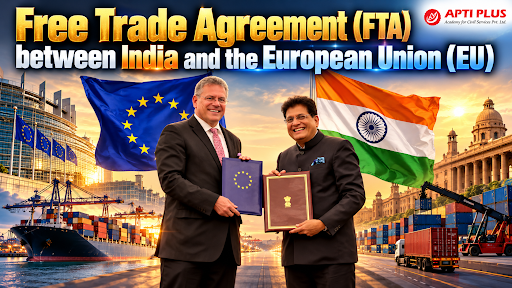
The India-EU Free Trade Agreement is scheduled to be signed on December 16, 2026, following nearly two decades of negotiations.
What is the India–EU Free Trade Agreement?
A Free Trade Agreement (FTA) is a legally binding international pact governed under Article XXIV of GATT 1994 that eliminates tariffs, quotas, and non-tariff barriers across substantially all trade between signatory states.
The agreement connects the world's 2nd largest economy (European Union) and 5th largest economy (India), establishing a combined marketplace valued at USD 24 trillion and covering one-third of global trade.
The agreement delivers preferential entry for 99% of Indian exports by trade value into the EU, while eliminating tariffs on 96.6% of EU tariff lines and 97% of Indian export lines.
-
In return, India offers tariff liberalisation on 92.1% of its tariff lines, covering 97.5% of EU exports.
What Are The Key Features Of The Trade Pact?
Phased Tariff Reduction and Elimination: 70.4% of Indian tariff lines covering 90.7% of Indian exports face immediate duty elimination upon entry into force.
-
India provides immediate zero-duty access on 49.6% of its tariff lines, with 39.5% of tariff lines subject to phased elimination over 5, 7, and 10 years.
Market Access for Indian Exports: Immediate zero-duty entry is unlocked for over USD 33 billion worth of labor-intensive Indian exports currently subject to 4% to 26% import duties in European markets.
Protection of Sensitive Domestic Agriculture: Core sensitive farm and dairy sectors—including milk, butter, rice, wheat, beef, poultry, soymeal, and sugar—are completely excluded from tariff cuts to protect Aatmanirbhar Bharat and smallholder livelihoods.
Services Commitments and Talent Mobility: The EU opens 144 services subsectors for Indian providers, while India opens 102 subsectors.
-
Dedicated Mode 4 mobility provisions grant 3-year visas for Intra-Corporate Transferees (ICTs), access to 37 sub-sectors for Contractual Service Suppliers (CSS), 17 sub-sectors for Independent Professionals (IP), and recognition for practitioners of Indian Traditional Medicine (ITM) under home titles.
Customs and Trade Facilitation: Establishes digitized customs clearance, standardized rules of origin with flexible Product Specific Rules (PSRs), and transparent administrative procedures to lower compliance costs for exporters.
Intellectual Property Protection: Incorporates TRIPS-aligned IP safeguards covering copyrights, trademarks, industrial designs, trade secrets, and plant varieties, while formally recognizing India's Traditional Knowledge Digital Library (TKDL) to prevent biopiracy.
Geographical Indications Standoff: To prevent negotiation impasses, a stand-alone Geographical Indications (GI) Agreement is being negotiated on a parallel track to resolve claims over Basmati Rice versus European wines, spirits, and cheeses (Champagne, Feta, Parmigiano Reggiano).
Investment and Business Opportunities: Investment protection is decoupled into an Investment Protection Agreement (IPA) featuring an institutionalized Investment Court System (ICS) to replace legacy Bilateral Investment Treaties (BITs).
Sustainable Trade and Climate Commitments: Dedicated Trade and Sustainable Development (TSD) chapter linking commercial preferences with ILO Core Labour Standards, environmental protection, women's economic empowerment, and technical dialogue on the Carbon Border Adjustment Mechanism (CBAM).
What Is The Current Status Of India–EU Bilateral Trade Relations?
EU as India's Premier Trading Partner: The EU is India's 3rd largest trading partner, accounting for 11.5% of total Indian trade in goods valued at EUR 118 billion in 2025.
Bilateral Merchandise Trade Landscape: Total merchandise trade reached USD 136.54 billion in 2024–25, with Indian exports amounting to USD 75.85 billion and imports standing at USD 60.68 billion, yielding a USD 15.17 billion trade surplus for India.
-
Top Indian exports include mineral fuels (16.5%), electrical machinery (12%), and organic chemicals (7.1%).
Robust Service Trade: Bilateral services trade expanded by 240% over a decade, reaching USD 77 billion (EUR 59.7 billion) in 2024, comprising USD 43 billion in Indian exports and USD 33 billion in imports. Bilateral trade is targeted to reach USD 200 billion by 2030 (Source: Ministry of Commerce and Industry).
Deepening Investment Relations: Over 1,500 European Global Capability Centers (GCCs) operate in India, employing skilled talent across engineering, financial modeling, and software R&D under
GDPR-compliant data frameworks.
What Are The Economic Benefits For India's Export Sectors?
Greater Access to the European Single Market: Indian exporters gain duty-free entry into a USD 17 trillion market of 450 million high-income European consumers.
Transformative Boost to Overall Exports: Projected to double Indian merchandise exports to the EU over the medium term, expanding total shipment value across high-margin industrial categories.
Level Playing Field for Textiles, Leather, and Footwear: Eliminates 12% to 17% EU import tariffs on Indian textiles, apparel, leather, and footwear, placing Indian MSME clusters in Tirupur, Ludhiana, and Kanpur on equal footing with zero-duty competitors like Bangladesh and Vietnam.
Opportunities for Generic Pharmaceuticals: Eliminates EU import duties of up to 11% on formulations and Active Pharmaceutical Ingredients (APIs), reinforcing India's status as the "pharmacy of the world" while preserving TRIPS flexibilities and Section 3(d) of the Patents Act, 1970.
Expansion in Marine Products and Chemicals: Eliminates tariffs up to 26% on marine goods and up to 12.8% across 97.5% of chemical export lines, benefiting coastal communities in Andhra Pradesh, Gujarat, and Kerala.
MSME Empowerment and Mass Employment: Boosts capacity utilization across labor-intensive MSME clusters in gems and jewellery, engineering goods, plastics, and sports items, driving millions of direct jobs for women, youth, and skilled artisans.
Technology Transfer and Capital Inflows: Phased tariff cuts on European precision machinery and medical devices lower capital input costs for domestic manufacturers, accelerating technology adoption under Make in India.
How Does The Pact Strengthen Strategic And Geopolitical Alignment?
Diversification of India's Export Destinations: Provides a structural shield against global tariff volatility, unilateral trade actions, and rising protectionism in traditional Western markets.
Consolidation of India–EU Strategic Partnership: Elevates ties from transactional commercial exchanges to a rules-based geoeconomic alliance rooted in democratic values, maritime security, and open supply lines.
Supply Chain Resilience and China-Plus-One Strategy: Positions India as a primary manufacturing and R&D hub in Europe's China-Plus-One diversification strategy across pharmaceuticals, electronics, auto components, and active chemicals.
Cooperation in Critical Technology and Security: Deepens institutional alignment via the India–EU Trade and Technology Council (TTC) in Artificial Intelligence (AI), semiconductors, quantum computing, cybersecurity, and clean energy.
Anchor in a Changing Global Trade Order: Reinforces rules-based multilateral trade, offering a collaborative blueprint between major developed and developing economies amid WTO appellate stalemates.
What Are the Challenges For India?
Carbon Border Adjustment Mechanism (CBAM) Non-Tariff Barriers: The EU's carbon border levy imposes reporting compliance costs on carbon-intensive Indian exports like steel and aluminium, eroding preferential tariff advantages.
-
Example: Indian steel exports face European carbon import levies without MFN exemption, placing 25% of India's steel exports under carbon compliance scrutiny.
Geographical Indication (GI) Standoff over Basmati Rice Sovereignty: Cross-border claims and political friction have stalled the formal registration of India's premier agricultural GI in European markets.

Data Governance Asymmetry and Limits on AI Auditing: The digital trade chapter establishes broad prohibitions on mandatory source code disclosure, restricting sovereign algorithmic oversight.
Non-Tariff Measures (NTMs) and GDPR Compliance Burdens: Stringent Sanitary and Phytosanitary (SPS) rules, Technical Barriers to Trade (TBT), and European data privacy laws create high entry barriers for Indian MSMEs.
Rapid Alert System Rejections in Agri-Food Exports: Strict maximum residue limits (MRLs) and European food safety alerts cause frequent border rejections for Indian agri-food exports.
Way Forward
Establishing National Carbon Accounting and Green Transition Subsidies: Decarbonize domestic industrial processes and establish recognized carbon verification bodies to navigate CBAM compliance.
Upgrading MSME Quality Assurance and GDPR Compliance Infrastructure: Provide state-backed assistance to small exporters for meeting European product quality, traceability, and data security standards.
-
Example: Ministry of MSME Quality Certification Scheme providing subsidized GDPR-compliance software tools and Zero Defect Zero Effect (ZED) manufacturing support to raise Indian textile and leather exports.
Leveraging Treaty Review Clauses for AI Governance and IP Recalibration: Utilize mandatory review mechanisms to preserve regulatory flexibilities for domestic public health and digital oversight.
Institutionalizing Bilateral GI Mutual Recognition Frameworks: Resolve the agricultural GI standoff through balanced, bilateral registration lists that respect territorial integrity.
-
Example: Parallel protection for 100 Indian GIs (Basmati Rice, Darjeeling Tea, Alphonso Mango) alongside iconic EU GIs (Champagne, Parmigiano Reggiano) under the Geographical Indications of Goods Act, 1999.
Conclusion
The India–EU Free Trade Agreement establishes a strategic partnership uniting 2 billion people and 25% of Global GDP. Maximizing its benefits requires domestic regulatory alignment, green industrial modernization, and robust GI safeguards to advance the vision of Viksit Bharat @2047.
Source: THEHINDU
|
PRACTICE QUESTION Q. Examine the economic and strategic significance of the India-EU Free Trade Agreement for India. Discuss the major challenges in its implementation and suggest a way forward. 250 words |