Why In News?
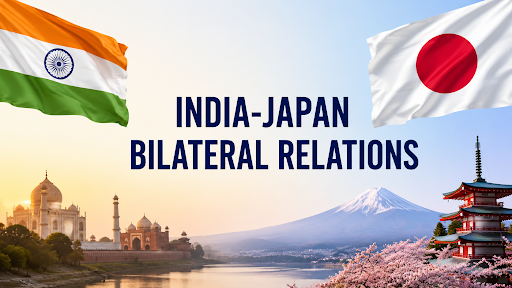
Indian Defence Minister Rajnath Singh and Japan's Defence Minister Shinjiro Koizumi held high-level bilateral talks in New Delhi to advance defence equipment co-production, maritime domain awareness, and Indo-Pacific security.
Highlights of the Recent Bilateral Meeting
Investment milestone: 2 trillion yen in investment commitments have already been made toward the 10 trillion yen private investment target for India set last year.
High-Speed Rail: Both sides reaffirmed cooperation on the Mumbai-Ahmedabad High-Speed Rail, agreeing to introduce Japan's state-of-the-art E10 series Shinkansen technology.
Next Generation Mobility Partnership: A new Memorandum of Cooperation was announced to deepen collaboration on future mobility technologies.
Energy cooperation: Japan pledged support for India's bid to join the International Energy Agency (IEA) and committed to help India establish around 1,000 biogas plants using cow dung as feedstock.
AI partnership: The two countries launched joint research and development on Large Language Models (LLMs) and issued a separate joint document on AI cooperation.
Strategic alignment: Leaders confirmed that Japan's "Free and Open Indo-Pacific (FOIP)" and India's "MAHASAGAR" vision are mutually aligned, and agreed to deepen strategic cooperation.
Economic coercion concerns: The Joint Statement expressed "grave concerns" over the use of economic coercion, widely read as an indirect reference to China's trade practices.
Oil stockpiling dialogue: Both sides agreed to launch a bilateral dialogue aimed at strengthening India's petroleum and oil reserve system, under the initiative referred to as "POWERR Asia".
Defence cooperation: Leaders instructed ministries to hold the next Japan-India "2+2" Ministerial Dialogue within the year, and welcomed progress on transfer of the UNICORN (Unified Complex Radio Antenna) naval technology.
Evolution of India-Japan Relations
Civilizational & Spiritual Roots: Direct cultural contact began in 752 AD when Indian monk Bodhisena performed the eye-opening consecration ceremony for the Great Buddha statue at Todaiji Temple in Nara, Japan.
Modern Historical Links: Thinkers like Swami Vivekananda and Tenshin Okakura fostered intellectual bonds; Indian jurist Justice Radhabinod Pal provided a famous dissenting judgment at the Tokyo International Military Tribunal.
Post-WWII Normalization: India concluded a separate Peace Treaty with Japan in 1952, waiving all war reparations. Japan granted its first-ever Yen loan (Official Development Assistance) to India in 1958.
Strategic Upgradation:
-
2000: Establishment of the Global Partnership during Prime Minister Yoshiro Mori's visit.
-
2006: Upgraded to Strategic and Global Partnership.
-
2014: Elevated to Special Strategic and Global Partnership under Prime Minister Narendra Modi and Prime Minister Shinzo Abe.
-
2018: India-Japan Vision Statement adopted, aligning India's "Act East Policy" with Japan's "Expanded Partnership for Quality Infrastructure".
-
2022 (14th Summit): Coincided with the 70th anniversary of diplomatic relations, deepening cooperation in cybersecurity, 5G, Open RAN, and quantum communications.
-
2025 (15th Summit): Launch of the Japan-India AI Cooperation Initiative and India-Japan Joint Vision for the Next Decade, spanning eight pillars including economy, technology, and state-prefecture engagement
Institutionalized Architecture: Relations feature Annual Prime Ministerial Summits, 2+2 Foreign and Defence Ministerial Dialogues, and active Quad leadership.
Strategic Importance of Japan to India
Infrastructure Financing & Mega-Projects: Japan is India's largest bilateral development partner, financing high-impact infrastructure such as the Mumbai-Ahmedabad High-Speed Rail (MAHSR), the Western Dedicated Freight Corridor (DFC), and modern metro networks across Delhi, Bengaluru, Chennai, and Ahmedabad.
Foreign Direct Investment (FDI): Japan is India's 5th largest source of FDI, contributing over $43 billion in cumulative inflows since 2000 and establishing 11 Japanese Industrial Townships (JITs) across 8 Indian States.
10 Trillion Yen Investment Ambition: Japan has committed to mobilizing 10 trillion Yen ($67+ billion) in public and private investments into India over the next decade targeting green hydrogen, semiconductors, and electric mobility.
Critical Technologies & Supply Chain Security: Japan partners with India under the Supply Chain Resilience Initiative (SCRI) to de-risk critical mineral supply chains, AI development, and semiconductor manufacturing.
Strategic Balancing: Japan acts as a vital technological and economic partner to counterbalance unilateral regional hegemony in the Indo-Pacific.
Strategic Importance of India to Japan
Massive Market & Demographic Complementarity: India offers a young demographic base of 1.4+ billion citizens and a rising middle class, providing essential growth markets for Japan's aging and demographically contracting society.
China-Plus-One Alternative: Over 1,400 Japanese corporations (including Suzuki, Toyota, Honda, Sony, Hitachi, and Mitsubishi) utilize India as a primary global manufacturing hub to reduce over-reliance on Chinese industrial supply chains.
Energy Security & Maritime Lifelines: Over 80% of Japan's petroleum and LNG imports transit through the Indian Ocean sea lanes of communication (SLOCs), making security cooperation with the Indian Navy critical for Japan's national survival.
Gateway to Global South: India serves as Japan's indispensable partner to deliver sustainable, transparent infrastructure across South Asia and Africa.
India's Policy Framework Towards Japan
Core Anchor of Act East Policy: India places Japan at the center of its Act East Policy and wider Indo-Pacific vision.
Indo-Pacific Oceans Initiative (IPOI): Japan champions the Connectivity Pillar of India's IPOI, focusing on sustainable marine and land connectivity.
Dedicated Investment Mechanisms: India established the Japan Plus fast-track desk under DPIIT to provide single-window regulatory support for Japanese business investments.
Security Reciprocity: India signed the Acquisition and Cross-Servicing Agreement (ACSA) with Japan to enable mutual logistics sharing and port access between the Indian Armed Forces and the Japan Self-Defense Forces.
Major Areas of Cooperation
Defence & Strategic Security: Formal 2+2 Ministerial Dialogues, Acquisition and Cross-Servicing Agreement (ACSA) logistics pact, and Quad quadrilateral framework (India, Japan, US, Australia) ensuring open sea lanes.
Trade & Economy: Operational Comprehensive Economic Partnership Agreement (CEPA) since 2011. Bilateral trade reached USD 27.5 billion in FY 2025-26.
Financial Stability: Bilateral $75 Billion Currency Swap Agreement ensuring financial and balance-of-payments stability.
Space Science: Joint Lunar Polar Exploration (LUPEX) mission between ISRO (providing lunar lander) and JAXA (providing lunar rover and H3 rocket) to explore water ice at the Moon's South Pole.
Development of India's North-East: Through the India-Japan Act East Forum, JICA funds regional road networks and smart cities across Assam, Meghalaya, Mizoram, and Tripura.
Skill Mobility: Specified Skilled Worker (SSW) and Technical Intern Training Program (TITP) enabling Indian professionals to work in Japan.
Key Challenges In India-Japan Relations
Sluggish Bilateral Trade Volume: Bilateral trade of $27.5 billion is dwarfed by China-Japan trade ($300B+) and India-China trade ($110B+).
Non-Tariff Barriers: Indian pharmaceutical, IT services, and agricultural exports face stringent Japanese technical and sanitary regulations.
Implementation Delays: Land acquisition hurdles and bureaucratic clearances have slowed projects like the High-Speed Rail corridor.
Geopolitical Divergences: Japan is a formal US treaty ally participating in Western sanctions against Russia; India maintains strict Strategic Autonomy and continues engagement with BRICS and Shanghai Cooperation Organisation (SCO).
Multilateral Disconnect: India withdrew from the Regional Comprehensive Economic Partnership (RCEP) in 2019, while Japan remains a core founding member.
Defence Procurement Bottlenecks: Negotiations on hardware (like the ShinMaywa US-2 aircraft) stalled due to high costs and restrictive IP sharing rules.
Way Forward
Next-Gen Defence Co-Development: Establish joint production lines for maritime surveillance UAVs and naval sensors in Indian Defence Industrial Corridors.
CEPA Revamp: Modernize the 2011 CEPA to eliminate non-tariff barriers and expand digital services trade.
Economic Security: Operationalize joint research for semiconductor assembly and critical mineral processing under the India-Japan Economic Security Initiative.
Third-Country Infrastructure: Re-energize the Asia-Africa Growth Corridor (AAGC) and collaborate on port projects in Sri Lanka and Bangladesh to offer alternatives to debt-trap lending.
Human Capital: Scale up Japanese language training to bridge demographic shortages in IT and advanced robotics.
Conclusion
The India-Japan Special Strategic and Global Partnership serves as the most stable, trustworthy, and natural relationship in the Indo-Pacific region. By combining Japan's capital and high-end engineering with India's scale, software prowess, and demographic vitality, both nations reinforce a free, open, inclusive, and rules-based world order.
Source: PIB
|
PRACTICE QUESTION Q. "The India-Japan Special Strategic and Global Partnership is anchored in shared democratic values and a common vision for a Free and Open Indo-Pacific." Examine the key pillars of this relationship and analyze how both nations navigate their divergent geopolitical choices. (250 Words) |