Why In News?
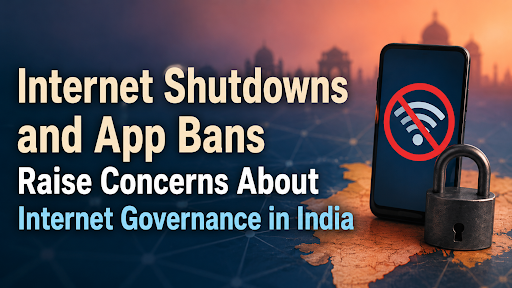
Mobile internet was suspended without a published order during the July 2026 Jantar Mantar protests in Delhi, violating Supreme Court guidelines and the Telecommunications (Temporary Suspension of Services) Rules, 2024.
What is Internet Governance?
It is the shared principles, norms, rules, technical standards, and decision-making processes that shape how the Internet is managed, operates, and evolves. It covers:
-
Internet Access — availability and continuity of connectivity.
-
Data Governance — rules on collection, storage, and use of data.
-
Platform Regulation — oversight of apps, intermediaries, and content.
-
Cybersecurity — protecting networks from threats.
-
Digital Rights — free speech, privacy, and access as rights exercised online.

Constitutional Framework
-
Article 19(1)(a) — Freedom of speech and expression, extended to online speech.
-
Article 19(1)(b) — Freedom of assembly (protests, including at Jantar Mantar).
-
Article 19(1)(g) — Freedom of trade, business, and profession — covers digital commerce and e-services.
-
Article 21 — Right to life and personal liberty — interpreted to include access to essential digital services.
-
Reasonable Restrictions — Under Article 19(2)/(6), on grounds of public order, sovereignty, security of the State.
-
Right to Access the Internet — Recognised as part of the fundamental right to freedom of speech and expression and trade, subject to reasonable restrictions.
Judicial Intervention (Anuradha Bhasin vs Union of India, 2020)
-
Case Origin: Arose from the communications lockdown in Jammu & Kashmir following the abrogation of Article 370 in August 2019.
-
Freedom of Speech Through the Internet: The Supreme Court held that the freedom of speech and expression under Article 19(1)(a), and freedom to practise any profession/trade under Article 19(1)(g), extend to the medium of internet.
-
Proportionality: Any restriction must satisfy the doctrine of proportionality — the least restrictive measure must be adopted.
-
Necessity of Restrictions: Shutdown orders must state reasons in writing and be necessary and unavoidable.
-
Periodic Review of Shutdown Orders: The Court directed that all suspension orders be published and be subject to periodic review by a Review Committee, and that indefinite suspension is impermissible.
Legal Mechanisms for Internet Shutdowns
Telecommunications (Temporary Suspension of Services) Rules, 2024 (superseding the 2017 Rules), issued under the Telecommunications Act, 2023:
-
Grounds: Public Emergency or Public Safety.
-
Competent Authority: Union/State Home Secretary (or an officer not below Joint Secretary rank in urgent cases).
-
Written Orders: Reasons must be recorded in writing.
-
Periodic Review: A Review Committee must examine orders within 5 working days.
In the 2026 Jantar Mantar case, Internet Freedom Foundation (IFF) alleged these safeguards — publication of orders, written reasons, and proportionate/time-bound restriction — were not followed, highlighting an implementation gap between law and practice.
What are App Bans?
Concerns With App Bans
|
Why Do Governments Impose Internet Restrictions?
|
Core Objective |
Government Rationale |
Applied Restrictions / Methods |
Case Study |
|
Countering National Security Threats & Separatism |
To stop cross-border coordination, protect sovereign territory, and prevent active anti-national actions. |
Complete regional blackouts, dropping telecom tower signals, and banning unapproved communication tools. |
Jammu & Kashmir (2019–2021): Following the abrogation of Article 370 in August 2019, the government enforced a prolonged internet blackout to maintain local stability and secure border intelligence. |
|
Controlling Mass Unrest & Protests |
To halt the rapid mobilization of violent crowds, minimize property destruction, and keep the public peace. |
Throttling mobile data to 2G speeds and temporarily shutting off local networks near hotspots. |
Manipur (Communal Violence): Extensive, multi-month mobile data blackouts were sequentially imposed to contain intense ethnic clashes and stop the spread of inflammatory social media footage. |
|
Managing Election Content & Misinformation |
To counter the rapid spread of deepfakes, inflammatory media, and foreign election meddling. |
Implementing targeted platform blocks on social media sites and messaging apps. |
Farmers' Protests / Delhi Borders: Localised mobile internet services were repeatedly cut at the Singhu, Ghazipur, and Tikri borders to monitor and regulate protest logistics during mass agitations. |
|
Preventing Academic Cheating & Malpractice |
To protect the credibility of competitive state hiring processes and school graduation exams. |
Scheduling localized, national internet shutdowns that coincide exactly with exam hours. |
Exams: State governments disable mobile internet for 3 to 4 hours across major districts during exams like NEET to prevent cheating via messaging apps |
|
Enforcing Data Sovereignty & Protectionism |
To protect local technical assets and build a domestic economy insulated from foreign tech monopolies. |
Directing national service providers to block global apps; enforcing strict on-shore data storage rules. |
China (The Great Firewall): The government restricts access to major Western platforms like Google, YouTube, and WhatsApp, which facilitated the growth of domestic platforms like Baidu and WeChat. |
|
Curbing Cybercrime & Harmful Content |
To limit the operation of financial scams, identity theft, and severe child exploitation networks. |
IP blocking, DNS tampering, and applying Deep Packet Inspection filters across web service providers. |
Global (INTERPOL Operations): Governments worldwide coordinate with domestic ISPs to drop DNS records and block dark web marketplaces linked to ransomware or illicit transactions. |
Concerns With Internet Shutdowns
-
Fundamental Rights: Shutdowns restrict Article 19(1)(a) freedom of speech and expression and Article 19(1)(g) freedom to practise a profession through the internet, as recognised by the Supreme Court in Anuradha Bhasin vs Union of India (2020).
-
Disproportionate Restriction: A blanket shutdown may affect millions of lawful users even when the security threat comes from a limited group or specific content, raising concerns under the proportionality principle.
-
Economic Losses: Digital payments, e-commerce, transport, tourism, online education and gig work can stop during prolonged shutdowns, hurting small businesses and daily-wage digital workers.
-
Education Disruption: Students lose access to online classes, examination material, scholarships and digital learning platforms, particularly in regions where physical alternatives are weak.
-
Healthcare Impact: Shutdowns can disrupt telemedicine, emergency communication, online health records and coordination among hospitals and patients.
-
Emergency Communication: During disasters, violence or epidemics, citizens may be unable to access early warnings, emergency helplines and verified information.
-
Information Vacuum: Cutting communication during unrest can increase dependence on rumours and unverified offline information, potentially worsening rather than reducing tensions.
-
Human Rights Concerns: Access Now recorded 84 internet shutdowns in India in 2024, the highest among democratic countries that year.
-
Governance Contradiction: Frequent shutdowns conflict with Digital India, digital payments and online public-service delivery by disconnecting citizens from essential digital infrastructure.
-
Impact on Businesses: Even short disruptions can affect UPI transactions, cloud services, logistics, customer support and digital commerce, creating losses beyond the directly affected locality.
-
Federalism and Accountability: Frequent state-level orders can create variations in standards and enforcement, making uniform constitutional safeguards difficult to maintain.
-
Judicial Concern: The Supreme Court held that shutdown orders must be published, temporary, proportionate and subject to judicial review; indefinite suspension is impermissible.
-
Overbreadth: Section 69A of the IT Act deals with blocking specific information, not shutting down the internet as a whole; using it for general internet suspension would exceed its intended scope.
Way Forward
Rights-Based Approach
-
Apply proportionality: Use internet suspension only when it is necessary and proportionate to the specific threat, following Anuradha Bhasin vs Union of India.
-
Prefer targeted measures: Block specific unlawful content, accounts or services before considering a region-wide shutdown.
Stronger Accountability
-
Record clear reasons: Every order should identify the threat, legal basis, geographical area and duration.
-
Ensure publication: The 2024 Rules require suspension orders to be published with reasons and limited to a defined area and duration.
-
Strengthen review: The statutory Review Committee should independently examine whether each shutdown satisfies legal and constitutional requirements.
Time-Bound Restrictions
-
Avoid indefinite shutdowns: The 2024 Rules prescribe a maximum duration of 15 calendar days for a suspension order.
-
Periodic reassessment: Authorities should withdraw restrictions immediately once the security threat declines.
Better Alternatives
-
Use localised restrictions: Restrict only the affected geographical pockets instead of an entire district or state.
-
Strengthen content moderation: Work with platforms to remove specific inciting or harmful content through lawful procedures.
-
Improve cyber policing: Use digital forensics and threat intelligence to identify the source of misinformation rather than disrupting all connectivity.
Protect Essential Services
-
Maintain emergency connectivity: Keep access available for hospitals, emergency services, disaster response and essential government communication.
-
Protect digital payments: Ensure critical financial and public-service infrastructure continues functioning during security restrictions.
Institutional Capacity
-
Train officials: Build specialised capacity among police and district authorities on digital rights, cyber threats and constitutional safeguards.
-
Create audit mechanisms: Maintain a national database of shutdown orders, duration, reasons and outcomes for independent evaluation.
Transparency & Judicial Oversight
-
Enable effective challenge: Affected citizens, businesses and platforms should have meaningful access to judicial remedies.
-
Publish aggregate data: Regular disclosure of shutdown frequency, duration and reasons can improve public accountability.
-
Use judicial review: Courts should scrutinise restrictions against legality, necessity, proportionality and procedural safeguards.
Technology-Led Governance
-
Deploy AI-based threat detection: Identify coordinated misinformation, bot networks and incitement without automatically disabling connectivity.
-
Develop early-warning systems: Combine cyber intelligence, social-media signals and ground intelligence to enable preventive and targeted intervention.
Conclusion
Balancing national security and public order with digital rights and transparency is essential to ensure the internet governance framework remains constitutionally sound and democratically accountable.
Source: INDIANEXPRESS
|
PRACTICE QUESTION Q. Internet shutdowns, though justified on grounds of public order and security, often fail the test of proportionality laid down by the Supreme Court." Discuss with reference to recent instances of internet restrictions in India. (250 words) |