Why In News?
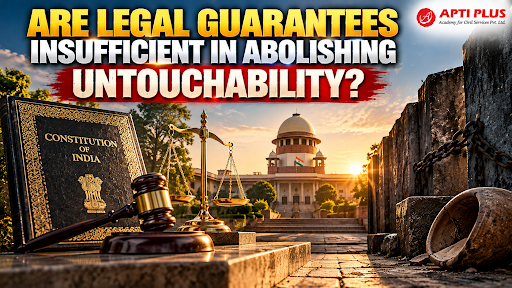
Public controversy over a ritual "purification" conducted in Uttarakhand following a speech by a prominent Dalit political leader, reigniting critical debate on whether legal guarantees are sufficient to eradicate untouchability.
What Is Untouchability?
Untouchability is an institutionalized and discriminatory social practice that ostracizes, excludes, and humiliates people from lower social groups or those outside the traditional caste system based on notions of ritual "purity" and "pollution".
-
Hereditary Hierarchy: Dr. B.R. Ambedkar conceptualized untouchability as a system of "graded inequality," where human worth, social status, and rights are hierarchically fixed at birth rather than determined by individual merit.
-
Division of Laborers: Ambedkar emphasized that untouchability and the caste system represent not merely a division of labor, but an involuntary, hereditary division of laborers that denies basic human dignity and choices.
-
Social Invisible Violence: Beyond physical avoidance, untouchability acts as a form of structural social violence that strips individuals of self-respect, rendering marginalized citizens socially "invisible" and trapping them in a permanent state of exclusion.
-
Restriction to Public Resources: Untouchability denies Dalits access to shared community infrastructure, including public drinking water wells, places of worship, village roads, schools, and cremation grounds.
-
Spatial Segregation: It enforces strict residential segregation, forcing Dalit families to reside in isolated hamlets or ghettoes on the peripheries of villages.
-
Occupational Monopoly: Untouchability forces marginalized communities into hereditary, degrading occupations—such as manual scavenging, clearing human excreta, and carcass removal—creating an oppressive phenomenon often described as "untouchability within the untouchables".
-
Social and Economic Boycotts: Any attempt by Dalits to assert their legal rights, access land, or challenge social hierarchies is frequently met with extra-judicial retaliations, including economic blockades and physical violence.
Global Parallels: While most strongly associated with the South Asian caste system, similar social exclusion has historically affected groups like the Burakumin in Japan, the Baekjeong in Korea, the Ragyabpa in Tibet, the Cagot in Europe, and the Al-Akhdam in Yemen.

Which Constitutional Provisions and Laws Prohibit Untouchability In India?
Abolishes Untouchability: Article 17 of the Constitution abolishes "untouchability" and forbids its practice in any form, declaring the enforcement of any disability arising therefrom as a punishable criminal offence.
Protection of Civil Rights Act, 1955: Originally enacted as the Untouchability (Offences) Act, 1955 and amended in 1976 as the Protection of Civil Rights Act, 1955 (PCR Act), it defines "civil rights" as rights accruing from the constitutional abolition of untouchability.
-
It criminalizes specific acts—such as denying entry to places of worship, shops, public restaurants, or water sources—classifying all offences as cognizable, non-compoundable, and punishable with enhanced prison terms for repeat offenders.
Scheduled Castes and Scheduled Tribes (Prevention of Atrocities) Act, 1989 Addresses Caste-Based Atrocities: Specialized hate crime legislation to punish brutal forms of caste violence, forced consumption of obnoxious substances, land dispossession, and sexual exploitation.
-
It mandates dedicated Special Courts for expedited trials, establishes administrative duties for police officers, and enforces a mandatory legal presumption under Section 8(c) that the accused was aware of the victim's caste identity during the crime.
Articles 14, 15, 16, and 21: Article 14 guarantees equality before the law and equal protection of laws, while Article 15 prohibits state discrimination on grounds of caste.
-
Article 15(4) and Article 16(4) empower the State to create affirmative action provisions and quotas in public employment for Scheduled Castes (SCs) and Scheduled Tribes (STs).
-
Article 21 guarantees the fundamental right to life with personal dignity.
-
Article 23 outlaws forced labor and bonded labor.
-
Article 46 directs the State to protect SCs and STs from social injustice,
-
Article 338 establishes the National Commission for Scheduled Castes (NCSC) as a constitutional monitoring body.

Why Legal Guarantees Fail To Eliminate Caste Discrimination On The Ground?
Constitutional Rights Enable Dalit Assertion: Legal protections give Dalits the power to challenge caste-based discrimination and seek justice through courts.
-
They recognise Dalits as equal citizens with enforceable rights rather than passive beneficiaries of state welfare.
Deep-Rooted Caste Mindsets Resist Legal Change: Laws cannot easily transform social attitudes shaped by centuries of caste hierarchy.
-
Despite legal prohibitions, beliefs about purity, pollution and social status continue to influence everyday interactions, reflecting what B. R. Ambedkar described the persistence of caste-based ideas in people's minds.
Weak Enforcement and Institutional Prejudice: Many victims face difficulties in reporting untouchability because of police inaction, caste bias and procedural barriers.
-
Authorities may refuse to register FIRs, mishandle evidence or dismiss genuine complaints, weakening the implementation of laws against caste-based atrocities.
Violence Against Dalits Challenging Traditional Hierarchies: Reservations, education and economic opportunities have enabled greater Dalit mobility and social assertion.
-
In response, some dominant caste groups resort to physical violence, economic restrictions and social boycotts to preserve traditional power relations and suppress demands for equality.

Ambedkar and Gandhi Views on Ending Untouchability
B.R. Ambedkar: End Caste-Based Inequality Through Rights and Structural Reform
-
Root Cause: Dr. B.R. Ambedkar viewed untouchability as a product of the caste system. He described caste as a “division of labourers” rather than merely a division of labour, highlighting the unequal status imposed on people by birth.
-
Annihilation of Caste: Ambedkar argued that society must dismantle caste-based hierarchies rather than rely only on reforms within the existing social order.
-
Legal and Economic Empowerment: He supported enforceable legal rights, political representation, access to education, economic opportunities and land reforms to secure substantive equality.
-
Call for Collective Action: His message, “Educate, Agitate, Organize,” encouraged oppressed communities to build awareness, assert their rights and mobilise for social change.
Mahatma Gandhi: Transform Social Attitudes Through Moral Reform
-
Moral Opposition: Gandhi regarded untouchability as a grave social wrong that Hindu society needed to reject through moral reflection and collective action.
-
Change in Social Conscience: He emphasised voluntary reform, moral accountability among privileged castes and the removal of discriminatory social practices.
-
Social Integration: Gandhi promoted inter-caste interaction, access to public spaces and temples, and greater participation of oppressed communities in social life.
-
Approach to Varna: Unlike Ambedkar, Gandhi did not initially advocate the complete destruction of the varna framework. His views evolved over time, and he later rejected caste-based discrimination and hereditary restrictions.
Constitutional Morality Must Shape Everyday Behaviour
-
Beyond Legal Protection: Constitutional provisions and anti-discrimination laws cannot eliminate untouchability unless people also change their daily behaviour.
-
Social Democracy: Ambedkar stressed that political democracy must rest on liberty, equality and fraternity in social life.
-
Everyday Equality: Equal access to housing, schools, public services, places of worship and shared social spaces must become a reality rather than remain a legal promise.
-
Complementary Lessons: Ambedkar's emphasis on enforceable rights and structural change, alongside Gandhi's focus on moral transformation and social reform, highlights the need to challenge both institutional discrimination and prejudiced attitudes.
What Are The Challenges In Eliminating Untouchability?
Judicial Delays and Weak Monitoring: The Ministry of Social Justice and Empowerment’s Annual Report on the Protection of Civil Rights (PCR) Act, 2022 recorded 1,242 pending cases, with judicial pendency exceeding 97%.

Coercion and Economic Dependence: A 2022 field study of 40 caste-atrocity cases in Rajasthan reportedly found that 80% ended in rajinama (compromise). Police barriers at the FIR stage, inadequate collection of autopsy evidence and Dalit victims’ economic dependence on dominant-caste landholders contributed to these outcomes.
Low Conviction Rates and Investigative Bias: The NCRB’s Crime in India 2023 recorded over 55,000 crimes against Scheduled Castes. The conviction rate of around 36% under the SC/ST (Prevention of Atrocities) Act raises concerns about investigation quality, evidence collection and prosecution effectiveness.
Police Misconduct and Welfare Fund Diversion: The NHRC’s report on atrocities highlighted alleged police failures, including refusal to register FIRs under the SC/ST (Prevention of Atrocities) Act, registration of cases under less stringent IPC provisions and custodial torture of Dalit complainants.

Measures to Eliminate Untouchability
Civil Remedies for Discrimination: Civil proceedings can complement criminal prosecution by enabling victims to seek compensation, corrective orders and protection against caste-based discrimination in housing, employment and public services.
-
A framework inspired by the POSH Act, 2013, could provide accessible complaint mechanisms and appropriate civil remedies, with clear evidentiary standards and safeguards.
Village-Level Grievance Redressal: Local complaint committees and legal aid centres can address social boycotts, denial of land access and exclusion from common water sources before conflicts escalate.
-
Gram Sabha-based mechanisms can promote mediation where appropriate, document violations and refer serious offences to the police.
Anti-Caste Education and Teacher Training: Schools should remove caste stereotypes from textbooks and train teachers to prevent discriminatory practices.
-
NCERT-based curricular reforms, human rights education and equal participation in activities such as mid-day meals can help eliminate caste prejudice from classrooms.
Integrated Housing and Shared Public Facilities: Inclusive housing policies and equal access to roads, drinking water, sanitation and other public services can reduce caste-based residential segregation.
-
Pradhan Mantri Awas Yojana (PMAY) implementation should promote non-discriminatory housing access and ensure that public infrastructure serves all communities equally.
Police Accountability and Effective Law Enforcement: Authorities must ensure prompt FIR registration, impartial investigations and timely trials in cases of caste discrimination and atrocities.
-
State Vigilance and Monitoring Committees, constituted under the SC/ST (Prevention of Atrocities) Rules, 1995, can review enforcement, investigate administrative negligence and monitor the progress of cases in Special Courts.
Legal Aid and Community Participation: Legal services institutions, civil society organisations and community leaders can help victims report discrimination, preserve evidence and access justice.
-
NALSA-supported legal aid services can strengthen victim representation, protect witnesses and reduce pressure on victims to accept forced compromises.
Ending Caste-Based Occupations: Mechanisation of hazardous sanitation work, rehabilitation support and alternative livelihood opportunities can weaken the link between caste and degrading occupations.
-
The Prohibition of Employment as Manual Scavengers and their Rehabilitation Act, 2013, along with skill development and financial assistance, provides a framework for this transition.
Conclusion
Legal guarantees provide an essential statutory framework, but complete eradication of untouchability requires coupling legal enforcement with civil remedies, institutional police accountability, and an active transformation of social consciousness..
Source: THEHINDU
|
PRACTICE QUESTION Q. Legal guarantees against untouchability are necessary but not sufficient. Examine (15 marks, 250 words) |