Why In News?
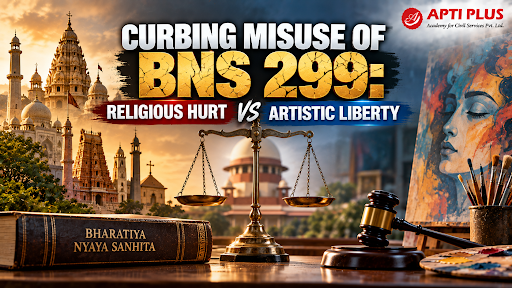
Experts have highlighted how Section 299 of the Bharatiya Nyaya Sanhita is weaponized to stifle free speech and artistic expression.
Debate over Free Speech and Religious Sentiments
India’s constitutional democracy protects freedom of speech (Article 19(1)(a)), but this right is subject to reasonable restrictions under Article 19(2) — including those related to public order, morality, and decency.
The debate arises when expressions — satire, art, academic critique, or political commentary — are perceived as hurting religious sentiments, leading to criminal prosecution under laws like Section 295A (IPC) or its successor Section 299 (BNS).
Section 299 of the Bharatiya Nyaya Sanhita (2023)
-
Offence Relating to Religion: Re‑codified under Chapter XV of the BNS, penalizing acts that outrage religious feelings.
-
Deliberate and Malicious Acts: Requires proof of premeditated malice — not accidental or academic discourse.
-
Intention to Outrage Religious Feelings: Covers words (spoken/written), signs, or visible representations designed to hurt sentiments.
-
Insult to Religion or Religious Beliefs: Punishable by up to three years’ imprisonment, fine, or both; cognizable and non‑bailable.
This codification modernizes colonial‑era provisions but retains their essential structure, emphasizing intent and malice as key elements.
Section 295A of the Indian Penal Code (1927)
-
Colonial‑Era Origin: Introduced via the Criminal Law Amendment Act XXV of 1927 to curb communal friction in British India.
-
Historical Trigger: The Rangeela Rasool controversy — a pamphlet deemed offensive to Islam — led to acquittal under existing law, prompting new legislation.
-
Purpose: Protection of public order rather than theological sanctity.
-
Effect: Criminalized “deliberate and malicious acts intended to outrage religious feelings.”
Relevant Constitutional Provisions
|

Free Speech vs Religious Sentiments
Dimension |
Article 19(1)(a) – Freedom of Speech |
Article 19(2) – Reasonable Restrictions |
|
Nature of Right |
Fundamental right to express opinions, art, satire, dissent |
State can impose restrictions for public order, morality, decency, and harmony |
|
Scope |
Creative, artistic, academic, and political debate |
Preventing communal riots, mob violence, hate speech |
|
Right to Offend? |
No constitutional right not to be offended; tolerance is expected |
Restrictions apply only when speech crosses into deliberate provocation |
|
Judicial Safeguards |
Courts protect genuine critique, satire, and academic freedom (Shreya Singhal, 2015) |
Restrictions must be proximate, not speculative (Ram Manohar Lohia, 1960) |
|
Public Order |
Free speech sustains pluralism and democratic dissent |
State invokes public order to justify bans or prosecutions |
|
Communal Harmony |
Encourages dialogue across diverse faiths |
Prevents violent retaliations sparked by malicious provocations |
|
Rule of Law |
Judicial scrutiny ensures liberty is not curtailed arbitrarily |
Prevents misuse of criminal statutes like Section 295A IPC / Section 299 BNS |
|
Balance Principle |
Restrictions must remain narrow exceptions |
Cannot smother fundamental rights; must be proportionate |
|
Ethical Dimension |
Speech carries responsibility to avoid incitement |
State must act as neutral arbiter, not majoritarian censor |
|
Comparative Insight |
U.S. First Amendment protects near‑absolute free speech |
European democracies allow restrictions on hate speech and blasphemy |
|
Digital Age Challenge |
Social media amplifies dissent and creativity |
Also magnifies communal provocation, requiring nuanced regulation |
|
Indian Case Law |
Rangarajan v. P. Jagjivan Ram (1989): danger must be imminent |
Courts insist restrictions cannot be based on speculative threats |
The judiciary’s role is crucial in ensuring that restrictions remain proportionate, intent‑based, and narrowly tailored, so that faith and freedom coexist in India’s plural democracy.
Judicial Intervention in Free Speech and Religious Sentiment Cases
Judicial Dimension |
Key Principles & Case Laws |
Impact on Constitutional Balance |
|
Judicial Review of Restrictions |
Courts examine whether restrictions under Article 19(2) are reasonable, proportionate, and proximate to public order. |
Prevents arbitrary censorship and ensures that the State’s power to restrict speech is not misused. |
|
Doctrine of Proximity |
Superintendent, Central Prison vs Ram Manohar Lohia (1960): Restrictions must have a direct and immediate nexus with public disorder. |
Protects free speech from vague or speculative threats. |
|
Protection of Artistic Freedom |
Rangarajan vs P. Jagjivan Ram (1989): “Anticipated danger should not be remote, conjectural, or far‑fetched.” |
Reinforces that creative works cannot be banned merely because they offend some groups. |
|
Digital Speech & Overbreadth |
Shreya Singhal vs Union of India (2015): Struck down Section 66A of the IT Act for chilling free expression online. |
Establishes that vague laws violate Article 19(1)(a) and create fear of prosecution. |
|
Balancing Religious Harmony |
Pravasi Bhalai Sangathan vs Union of India (2014): Hate speech must be curbed through existing penal laws, not new censorship. |
Encourages enforcement of intent‑based laws like Section 295A IPC / Section 299 BNS. |
|
Judicial Safeguards Against Vigilantism |
Courts emphasize rule of law — only judicially sanctioned restrictions are valid, not mob pressure. |
Prevents majoritarian veto over minority expression. |
|
Interpretation of “Malicious Intent” |
Mahendra Singh Dhoni vs Yerraguntla Shyamsundar (2017): Mere depiction of religious symbols without malice isn’t punishable. |
Clarifies that intent, not perception, determines culpability. |
|
Evolving Standards of Reasonableness |
Judiciary applies proportionality test — restriction must be least intrusive means to achieve legitimate aim. |
Aligns Indian jurisprudence with global free‑speech standards. |
|
Judicial Activism in Cultural Cases |
Courts often act as constitutional guardians — protecting filmmakers, writers, and journalists from arbitrary bans. |
Strengthens democratic discourse and artistic liberty. |
|
Preventive vs Punitive Approach |
Courts prefer post‑factum accountability (punishment after proven harm) over prior restraint (pre‑censorship). |
Ensures freedom flourishes unless clear harm is demonstrated. |
What are the Major Challenges?
Subjective Interpretation of Religious Offence: “Hurt sentiments” lack objective legal parameters. Converts personal sensitivity into a criminal trigger, enabling arbitrary enforcement.
Multiple FIRs Across Jurisdictions: Identical complaints filed in several states for the same content. Accused must seek transit anticipatory bail nationwide, causing procedural harassment.
Risk of Vexatious Complaints: Extortionists, political entrepreneurs, and publicity seekers exploit laws for personal gain. Absence of financial penalties encourages frivolous litigation.
Self‑Censorship and Chilling Effect: Fear of prosecution and mob backlash leads creators to drop bold or critical content. Suppresses India’s historic tradition of open debate and artistic freedom.
Conflict Between Liberty and Public Order: Authorities prioritize short‑term appeasement of mobs over defending lawful expression. Weakens rule of law and emboldens vigilante censorship.
Difficulty in Proving “Deliberate and Malicious Intent”: Police often arrest without verifying statutory thresholds. Investigations rely on perception rather than evidence.
Fragmented Legal Remedies: No uniform procedure for consolidating multi‑state FIRs or fast‑tracking speech cases. Prolongs litigation and multiplies harassment.
Political Instrumentalization of Offence Laws: Religious offence provisions used to silence dissent or opposition voices. Undermines neutrality and credibility of law enforcement.
Mob Pressure and Vigilantism: Law enforcement yields to street protests instead of upholding rule of law. Encourages extra‑legal intimidation of artists and journalists.
Media Trial and Public Polarization: Sensational coverage amplifies outrage and prejudices fair trial rights. Converts legal disputes into communal flashpoints.
Digital Amplification of Offence: Social media accelerates spread of provocative content and complaints. Creates jurisdictional confusion and over‑criminalization.
Way Forward
Prior Executive Sanction Before FIR Registration: Enforce Section 218 BNSS (erstwhile 196 CrPC) requiring government sanction before registering FIRs under Section 299. Prevents impulsive or politically motivated prosecutions.
-
Example: Arnesh Kumar vs State of Bihar (2014) — Supreme Court restricted automatic arrests for offences under seven years.
Judicial Pre‑Screening of Complaints: Require magistrate review before FIR registration for offences relating to religion. Ensures prima facie verification of “deliberate and malicious intent.”
Consolidation of Multi‑State FIRs: Codify mandatory clubbing of identical FIRs into one primary jurisdiction. Example: Arnab Goswami vs Union of India (2020) — SC consolidated FIRs to protect free speech.
Fast‑Track Free Speech Benches: Establish dedicated courts to dispose of speech‑related cases within 30–60 days. Prevents “process as punishment.”
Penalizing Frivolous and Vexatious Complaints: Apply Section 250 CrPC / BNSS equivalent to impose heavy compensatory costs on false complainants.
-
Example: Law Commission 267th Report on Hate Speech — recommends strict evidentiary standards.
Institutionalizing the “Spark in a Powder Keg” Test: Restrict public‑order curbs only to direct, proximate incitement to imminent violence.
-
Example: S. Rangarajan v. P. Jagjivan Ram (1989) — speech cannot be curtailed unless it acts like a spark in a powder keg.
Protection of Creative and Academic Expression: Explicit statutory exemption for satire, academic critique, and artistic works under Section 299 BNSS. Encourages intellectual pluralism and cultural vibrancy.
Police Training and Sensitization: Regular training on constitutional limits of free speech and intent‑based offences. Reduces arbitrary arrests and misuse of penal provisions.
Digital‑Era Safeguards: Introduce uniform cyber‑jurisdiction rules for online speech offences. Prevents overlapping FIRs across states for identical digital content.
Periodic Legislative Review: Mandate parliamentary review of Section 299 BNSS every five years. Keeps law aligned with evolving social realities and technological change.
Conclusion
Reforming Section 299 of the BNS by mandating prior judicial scrutiny and checking the heckler’s veto is essential to harmonize public order with constitutionally guaranteed expressive freedoms.
Source: INDIANEXPRESS
|
PRACTICE QUESTION Q. The tolerance of provocative ideas is the hallmark of a resilient democratic civilization. Discuss (10 Marks, 150 Words) |